I thank the gentleman from Illinois, and I also thank you for your friendship and your personal counsel over the years. Likewise, I am so pleased that your wife continues to do well. And to my…
I thank the gentleman from Illinois, and I also thank you for your friendship and your personal counsel over the years. Likewise, I am so pleased that your wife continues to do well.
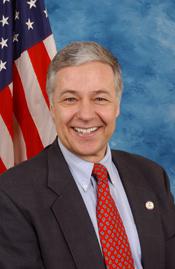
And to my friend, Mike Michaud, Mike--if I may have the latitude to address him by his first name, Mr. Speaker.
I don't mean to be nostalgic here for the moment, but I think when Members look back, they really don't remember all the difficult and challenging moments, they remember the things that really bring joy to their life. And one of the joys that I have in life is getting the opportunity to meet some real genuine people. And that's what Mike Michaud of Maine is.
You are a genuine human being and it is your nature, it is your character,
it is your moral compass, the reason I use the word ``genuine.'' You are truly one of the individuals that I will miss when I look back at Congress. I really will, Mike.
I only wish your conference had made you chairman of the Veterans' Affairs Committee, I really do, because you and I could have done a lot of great things together.
In reality, the unwritten history will be the success of the committee occurred not by your current chairman, but because of the work-around solutions that we were able to do, by you and I working together, with Stephanie Herseth and the Sergeant Major and Vic Snyder. So history may not credit you, Mr. Michaud, for all the things you've done, but I'm going to stand on the floor and let everybody know all the great things that you have done for veterans in this country, and I am very proud of you. So as I stand here and I think of not only myself, but I think about my colleagues, I want to make sure that you deserve the full measure.
When I think about over 20 years ago, frankly, Saddam Hussein was pretty stupid. He decided to take seven of his Iraqi divisions and he invaded Kuwait. He committed incredible atrocities upon the people of Kuwait, and raped and pillaged the city of Kuwait City.
And when the President then immediately sent the 101st and the 82nd Airborne divisions as a blocking force to then protect Saudi Arabia, they had to build up the logistics of Saudi Arabia itself and activate reservists. Not since World War II had there been such a deployment, not only of the air, but of the sea and the activation of the Guard and reserve and bringing Seventh Corps out of Europe.
You see, Saddam Hussein decided to pick a fight, and he also then took on the United States at a time when the United States was its strongest. We had completed the Reagan build-up. Reagan built up our forces. A lot of good judgments were made back in the latter part of the 1970s and 1980s. Les Aspin, then the chairman of the committee, even though he made some policy changes with regard to how soldiers were going to be paid, and those pay issues got resolved later, in the latter part of the 1990s, Les Aspin, and then the Democrat control of the Armed Services Committee, though, worked then with Ronald Reagan and built up our force. And that was about standing down the Soviet Union. So as we then stood down the Soviet Union, we had a military that was extraordinarily powerful. And Saddam Hussein took on America at a time when we were the most powerful.
Now, with regard to our combat experience, the combat experience for the Gulf War was truly also of value, in that our senior level leadership, the senior NCOs, the First Sergeants, the Sergeants Major, the Colonels, the General Officer Corps, the Admirals, they were Vietnam veterans. So as we went into Operations Desert Shield/Desert Storm, the leadership in that war, they said, well, we know what happened during Vietnam, and they always prided themselves that if they ever got themselves in another fight they were going to do things differently. So there was going to be no such thing as rotation. That's what happened in Vietnam.
So when we arrived in theater in the first Gulf War, duration was the theme, not rotation, meaning we will be here so long as it's necessary to throw Saddam Hussein out of Kuwait. As it turns out it was 100 days. That was a 100-day ground war. What isn't counted, though, is everything that it took to pull off a 100-day ground war.
Bringing out so many of the guardsmen and reservists was extraordinary. What was amazing about all this is that that type of a call-up of all the guardsmen and reservists to then support the active elements actually was bringing America to the war. When you pull out a teacher, you pull out someone who leads the church choir, you pull out someone who is the butcher and the baker and you then send them to war, you're bringing America to war. And America really at the time was a little shocked.
I mean, some of us, for myself the call-up was in 3 days. I got a notice and I was gone in 3 days. And it was a pretty extraordinary moment, not only in my life but in a lot of people's lives.
When I think back at all of this, I really compliment the extraordinary leadership, not only of then Dick Cheney, but also of Colin Powell and Norman Schwarzkopf. But I also look back with great pride of the men and women in theater. I believe that the active duty, of whom had always sort of looked down and chastised the reserve components, had new respect for the reserve components. And I look back at the Persian Gulf War, it was a defining moment, I think, at the time for our country.
With regard to the veterans, Mr. Michaud, you are absolutely correct. With a number in excess of 170,000, when you think of the number of those of us that actually went--I don't know the exact number, probably around 700,000 of us that went--that is a very large percentage that have some form of an illness.
I was pretty startled by all this. I do recall what it took to sort of expose that some bad things had happened; the fact that we had blown up one of the Army depots that contained some mustard and sarin gas, and that plume was so large that it went over tens of thousands of not only our own troops, including myself, but also about 10,000 of the U.K. And to think that the DOD was not forthcoming with that information to our veterans for a long time is very disturbing.
I do recall, when I got home I did not have the physical strength to even run down to the end of the lane. That is only about 1,000 feet. And here I am, 30 years old, physically fit, come back from war and I don't have the physical capacity. Something had happened to me, and I didn't know what it was. I do recall that my wife wanted me to go down to the VA or to go to the doctor, and I refused to do it. I refused to do it because, I said, Joni, if I go, they're just going to say it's in my head. I made it up. It's not real. Yet something had happened to my body.
When I then came to Congress, I can assure you when I look back at it, and all of us know when you run for Congress it takes about a year and it takes a lot out of you physically, and I was very sick during that 1 year when I first ran for Congress. When I got here, I decided that I had to accept and get out of the denial mode and step forward and provide voice to a lot of my comrades, and that is what I chose to do.
It is very difficult, especially all of us as public figures, to be willing to step forward and put a face, especially your own, on something like that. But I chose to do that. I remember working not only with the gentleman from Illinois but also Joe Kennedy at the time. That is one of the first things I learned about politics, too. When you take someone like Joe Kennedy and you marry him up with Steve Buyer, when we brought something to the floor, nobody voted against it.
So the things we were able to do by opening the VA to make sure that these veterans got their access to health care, then creating the compensation for undiagnosed illnesses, that was pretty radical. But we knew that something wrong had happened, and we wanted to make sure that our compassion was real, so let's make sure we take care of the families. And that is exactly what we sought to do.
I want to congratulate the gentleman for bringing this resolution. We have moved on to the second Gulf War, and now we are beginning to complete Iraq and we are still in Afghanistan. It is almost as though we have forgotten what happened to the veterans in the first Gulf War, and so many of them continue to suffer from these physical ailments. So when you take a moment like this, you are really saying unto the American people, ``Hey, we've still got some concerns. We still have some very real challenges out there.'' And as I leave, I know that my comrades are in good hands.
So I want to thank all of you for supporting the VA and for supporting my comrades. They were there for us and you remember, and for that I am forever grateful. Thank you and Godspeed.