Mr. Speaker, I stand today in grateful support of this resolution, which I am proud to have cosponsored. This resolution is about three things. First, re-acknowledgement of that region of our world…
Mr. Speaker, I stand today in grateful support of this resolution, which I am proud to have cosponsored.
This resolution is about three things. First, re-acknowledgement of that region of our world in which the present and future of our Nation and so many others lie: the Pacific and Asia. Second, recognition of a proud people and culture whose future lies now not only in their home islands, but in our own country. Third, responsibility for our actions which, like the consequences of those actions, will extend down through the generations.
On re-acknowledgement, as a product of the Pacific, I confess to a Pacific-centric view of our world. But can anyone doubt that our own future is inextricably tied to that of the Pacific? And as we look to the Pacific, we cannot overlook its island nations, whose strategic value and loyalty to democratic principles are unquestioned.
Foremost among these nations is the Republic of the Marshall Islands, with a proud history and culture dating back thousands of years. We celebrate in this resolution the mutually beneficial relationship we have enjoyed for more than half a century.
We also celebrate its people, who at home are striving to build a modern and sustainable island nation. And the emigration of many to new lands and new opportunities, especially in our country, are strengthening communities beyond their homeland.
My own state has especially benefited, with a Marshallese community of some 5000 strong poised for a major breakthrough into the mainstream of political, economic and social participation in Hawaii's affairs.
And, of course, we cannot forget that the Marshallese and their counterpart Pacific nations today have their sons and daughters serving with our armed forces in Iraq and Afghanistan, and lying grievously wounded defending our joint freedoms in military hospitals.
And lastly, this is a resolution of remembrance, of the dire consequences to a whole people and their aina, or land, of 66 nuclear tests, virtually all open air, from 1946 through 1958, including, 50 years ago, BRAVO, the world's first hydrogen bomb. Few of us, even today, can imagine the force and devastation released by just one such device, much less 66.
I have my own recollection, as a boy of just six, sitting on my grandparents' porch on the Island of Kauai, on a dark night, watching the entire sky light up from a single explosion 2,300 miles away. But the Marshallese lived through it, and they are still living through it, and will live through it for generations to come.
These stories are being told elsewhere, by Beverly Keever, in a February 25, 2004 article in the ``Honolulu Weekly,'' and by James Matayoshi, Mayor of Rongselap, in recent remarks on BRAVO day. I append these for the Record and commend them to your attention.
But today, we simply remember what happened and recommit ourselves to remedy that which must be remedied.
Mr. Speaker, there are lots of people to be thanked for this resolution. Chair Pombo and Ranking Member Rahall, for their commitment, Chair Hyde and Ranking Member Lantos for bringing this to the floor, and Chair Leach and Ranking Member Faleomavaega for their advocacy. But mostly, we thank the people of the Marshall Islands, for their friendship and support. We will not forget.
Mr. Speaker, I submit the following articles for insertion into the Record in connection with H. Con. Res. 364.
Suffering, Secrecy, Exile: Bravo 50 Years Later
(By Beverly Deepe Keever)
[From Honolulu Weekly, Feb. 25, 2004]
Almira Ainri was 10 years old when she was catapulted into
the atomic age.
In June of 1946, as the U.S. Navy readied the first atomic
bomb in peacetime--just the fourth in history--Ainri and
about 100 other inhabitants of Rongelap Atoll, in the
Marshall Islands, were sent south by ship to Lae Atoll, where
it was thought they would be safe from the effects of the
explosion 100 miles away, at Bikini Atoll.
Eight years later, in 1954, Ainri and other Rongelapese
weren't as lucky.
Fifty years ago this week, on Bikini Atoll, the U.S.
detonated the Bravo shot, a 15-megaton hydrogen bomb 1,000
times more powerful than the bomb it dropped on Hiroshima.
The most powerful bomb in U.S. nuclear history, Bravo had a
radioactive cloud that plumed over 7,000 square miles, an
area about the size of New Jersey. A hundred or so miles
downwind, near-lethal fallout powdered at least 236
inhabitants of the Rongelap and Utrik atolls, contaminating
their ancestral homelands. The Bravo-dusted islanders entered
history as unique examples of the effects of radioactive
fallout on humans.
Ainri, who now lives in Honolulu, is one of 118 survivors
of the Bravo shot. For her and other islanders, the bomb's
detonation set off a chain reaction of events over the last
half century. They became unwitting subjects in secret U.S.
research on the effects of nuclear fallout and ultimately
were forced to leave their idyllic homeland, which remains
uninhabitable to this day due to radioactivity.
Archeological finds on Bikini Atoll suggest that the first
Micronesians likely arrived in the Marshall Islands between
2,500 and 4,000 years ago. Germany annexed the islands in
1885. Japan captured them in 1914. Allied forces captured and
occupied them in World War II; the war's end left them in
U.S. hands. The U.S. began nuclear testing there the next
year.
The Marshall Islands were declared a Trust Territory by the
United Nations in 1947, with the U.S. as the administrator,
an arrangement that did not end until 1991. The following
treatment of the irradiated islanders raises doubts about the
behavior of the U.S. government:
U.S. officials failed to evacuate Ainri and other islanders
before the Bravo shot and then delayed their removal for more
than 50 hours after the fallout.
On March 7, 1954, six days after the Bravo shot, Project
4.1, ``Study of Response of Human Beings Exposed to
Significant Beta and Gamma Radiation due to Fallout from High
Yield Weapons,'' established a secret U.S. medical program to
monitor and evaluate islanders exposed to radiation, turning
them into experimental human subjects without their consent.
Ainri and other islanders were allowed to return to their
irradiated homeland in 1957. It was later deemed unsafe for
human habitation.
Marshall Islanders were injected with or fed radioactive
tracers without their consent, contrary to medical
recommendations made by U.S. medical officers six weeks after
the Bravo shot that the islanders should receive no more
exposure to radioactivity in their lifetimes.
The research projects arising from Bravo were begun just
seven years after war crimes tribunals convicted German
medical officers for their horrific experiments with
concentration camp inmates during World War II. Those
tribunals led to the Nuremberg Code, an international
standard for experiments involving human subjects, which
stipulated that the voluntary consent of the subject ``is
absolutely essential.'' The U.S. Atomic Energy Commission
established similar standards, requiring the consent of human
subjects and the expectation that an experiment would benefit
the subject, but they had little distribution or effect in
the U.S. bureaucracy.
Did U.S. bureaucratic bungling and operational obstacles
cause the mistreatment of the islanders or, as so many
islanders and others say, did U.S. officials make the
islanders guinea pigs to study the effects of radioactivity?
like needles over my whole body
At about 6 a.m. on March 1, 1954, Almira Ainri was awakened
by the brightness and noise of an inferno as hot as the core
of the sun. Ainri was 18 then, married, and pregnant with her
first child.
The island shook, she recalled. The air was gray. Snowlike
particles fell from the sky.
A day later, U.S. soldiers with Geiger counters arrived and
found people of Rongelap weak and vomiting. Fifty hours and
more after Bravo's detonation, the 236 inhabitants on or near
Rongelap and Utrik atolls were evacuated to the military
clinic at Kwajalein Atoll. There, they were scrubbed every
day with special soaps. The pressure of the water on Ainri's
blistered skin felt ``like needles over my whole body,'' she
said--``like I was burning.''
After the blast, Ainri gave birth to a son, Robert. His
thyroid glands were so damaged that he became dwarfed. The
glands were later removed, consigning him to a lifelong
regimen of medication. Ainri got pregnant again and gave
birth, she said, to ``a bunch of grapes, that had to be
pulled out of me.'' Twice more Ainri got pregnant, she said,
and gave birth to children who appeared normal but died
several days later. Another son, Alex, survived, but again
with damaged thyroid glands. Ainri herself has thyroid
problems; two new growths recently appeared there.
The suffering of Ainri and her family is hardly unique.
Within a decade of the Bravo shot, more than 90 percent of
the children who were under 12 years old at the time of the
explosion developed thyroid tumors. Today, Marshall Islanders
have one of the world's highest rates of abnormalities of the
thyroid, which often result in cases of retardation,
cretinism and stunted development.
For these and other conditions that the U.S. government
presumes were caused by its nuclear weapons testing, the U.S.
pays compensation. Those with leukemia or cancer of the
esophagus, stomach, small intestine, pancreas or bone are
awarded $125,000. Islanders with severe growth retardation
due to thyroid damage get $100,000.
By the end of 2002, a U.S. trust fund had paid about $79
million to 1,808 islanders, but because the trust fund could
not cover all its obligations, 46 percent of affected
islanders
died before they were fully paid for their injuries.
Rongelap Atoll comprises 61 islets with a combined land
mass of about three square miles and a lagoon of 388 square
miles. Because it is still too radioactive for humans, its
former residents are scattered. In Honolulu, Ainri lives in a
home where her pandanus floor mats mingle with a caller-I.D.
phone and a television set.
Under a 1996, $45-million agreement with the U.S., projects
are underway to prepare for the return of Rongelapese to the
five southernmost, least-contaminated islets of the atoll. A
glisteningly white church has been refurbished, complete with
striking lapis trim. An airstrip, desalinization plant, field
station, power plant and docks have been constructed or
installed. Phase 2 calls for the construction of 50 four-
bedroom homes, a dispensary and a hospital, school building,
residences for doctors and teachers, a library, a town hall
and a municipal building. All that is missing is a date when
the resettlement will occur.
the three surprises
Corporal Don Whitaker hardly could have imagined the
worldwide surprise his letter home would create. Writing to
his hometown newspaper, in Cincinnati, in March 1954,
Whitaker told of seeing distraught Marshall Islanders arrive
at a navy clinic on Kwajalein after the Bravo shot. It was
one of three surprises that shocked the world, and members of
President Eisenhower's administration.
The first surprise was the magnitude of the Bravo bomb's
blast. Its 15-megaton yield was more than twice what U.S.
officials had expected. Set off from Bikini Atoll, it
vaporized three of the atoll's 23 islets. The test was
expected, however.
Whitaker's letter was the next surprise. In it, he revealed
the evacuation of islanders that U.S. officials had tried to
keep secret. Published March 9, eight days after the blast,
Whitaker's letter prompted the Atomic Energy Commission to
issue a press release the next day, masking the magnitude of
the Bravo shot and its radioactive effects with a bland
announcement. But Bravo was hardly the ``routine atomic
test'' the release described, and the phrase ``some
radioactivity'' did not come close to describing the
islanders' dosage, which was the equivalent of the amount
received by Japanese citizens less than two miles from Ground
Zero at Hiroshima, lawyer-historian Jonathan M. Weisgall
writes.
Twenty-eight years later, the U.S. Defense Nuclear Agency
would call the Bravo shot ``the worst single incident of
fallout exposures in all the U.S. atmospheric testing
program.''
The third surprise came just days after the AEC had assured
the public that the irradiated islanders were fine. A
Japanese tuna trawler, the No. 5 Fukuryu Maru (``Lucky
Dragon''), was 112 miles east of Bikini Atoll at the time of
the Bravo explosion, well outside the danger zone announced
by U.S. officials. Yet Bravo's staggering detonation powdered
the boat's 23 crew members with what is known in Japan as shi
no hai--``ashes of death.'' When the Fukuryu Maru reached its
home port of Yaizu, about 120 miles south of Tokyo, on March
14, the crew was suffering from a radiation sickness that
stunned the world.
The crewmen's sickness and the subsequent panic over
radioactive tuna in the U.S. and Japanese fish markets led to
an international furor. The Japanese government and people
dubbed it ``a second Hiroshima'' and it nearly led to
severing diplomatic relations. A U.S. government doctor
dispatched to Japan blamed the Japanese press for
exaggerating the condition of the fishermen, who, he
predicted, would recover completely in about a month.
Six months later, Aikichi Kuboyama, the 40-year-old radio
operator of the Fukuryu Maru, died. He was ``probably the
world's first hydrogen-bomb casualty,'' said The New York
Times.
It was this triple-play of surprises--Bravo's tremendous
force, Whitaker's letter and the plight of the Fukuryu Maru--
that chinked the U.S. government's usual policy of secrecy.
Instead, the word fallout entered the world's lexicon. For
the first time, people in Japan and Russia, London and Bonn,
New York and Milwaukee, were aware of a danger that could not
be smelled, seen, felt or heard.
the sun rising in the west
The Bravo shot was the first U.S. hydrogen device that
could be delivered by airplane. It was designed to catch up
with the Soviets who, in August 1953, had exploded their
first hydrogen bomb deliverable by aircraft.
The Bravo shot was so dangerous that it could not be
detonated in the continental United States. Nor could it be
set off at Enewetak Atoll, where the U.S. conducted nuclear
blast tests from 1948 to 1958, for fear it would wipe out the
extensive U.S. equipment and installations there. So it was
tested at Bikini Atoll.
Even before the Bravo shot, experts knew that the
radioactive dust of atmospheric nuclear weapons explosions
was invisibly and unknowingly powdering the continental
United States and touching others worldwide. The U.S.
government's failure to move the Rongelap and Utrik Islanders
in advance of the Bravo shot is painfully ironic because
Almira Ainri and other Rongelapese had been moved before the
first peacetime atomic test, in 1946--and Bravo was 1,000
times more powerful. Yet the islanders were not moved in 1954
because of ``the high cost and logistic problems . . . in
supporting such an operation,'' according to U.S. medical
officers.
Six hours before Bravo, U.S. officials knew that the winds
had shifted, putting Rongelap and Utrik Islanders in the path
of fallout, but they proceeded with the detonation anyway.
That knowledge, coupled with the lag of several days after
the detonation before islanders were evacuated, led to
speculation that the U.S. deliberately used the islanders as
guinea pigs.
A month after the Bravo shot, Atomic Energy Commission
chair Lewis Strauss told reporters that allegations that the
evacuation of the Marshall Islanders had been deliberately
delayed were ``utterly false, irresponsible and gravely
unjust to the men engaged in this patriotic service.'' He
also said that he had just visited the islanders at the
Kwajalein clinic and they ``appeared to me to be well and
happy.''
Bravo was detonated at 6 a.m. Within four hours, the 28
U.S. weathermen on Rongerik Atoll, in the Marshall Islands,
saw a mist from the blast. Seven hours later, the needle of
their radiation-measuring instrument went off the scale. They
were evacuated the next day.
Clouds of snowlike particles moved over Alinginae,
Rongelap, Utrik and Ailuk atolls. The clouds deposited
radioactive fallout on the people below and irradiated them
with doses of ``cloud shine,'' radiation produced by the
blast itself, which Rongelapese described as being like ``the
sun rising in the west.''
About two-thirds of the Rongelapese were nauseated for two
days, according to a U.S. medical officer who examined them a
week after Bravo. Roughly one in ten were vomiting and had
diarrhea. Some had itching, burning skin that turned into
black-pigmented areas and lesions, some of which became
ulcerated and infected. Hair fell out. Blood counts fell.
The Bravo-dusted islanders disappeared from the news for
the next year, because of the AEC's clampdown on information.
But if they were not making news, they were making medical
history.
guinea pigs
Within days of the Bravo shot, irradiated islanders were
unwittingly swept into a top-secret effort to research the
effects of radioactive fallout on humans. ``Never before in
history had an isolated human population been subjected to
high but sub-lethal amounts of radioactivity without the
physical and psychological complexities associated with
nuclear explosion,'' said scientist Neal O. Hines. Islanders
would not learn the true nature of the experiment for 40
years, until 1994, when President Clinton ordered thousands
of documents declassified in the wake of a national scandal
involving human radiation experiments.
Four months before the Bravo shot, a then-secret U.S.
document listed research Project 4.1 among 48 tests to be
conducted during and after the explosion. ``(D)ue to possible
adverse publicity reaction, you will specifically instruct
all personnel in this project to be particularly careful not
to discuss the purposes of this project and its background or
its findings with any except those who have a specific `need
to know,' '' the document said.
The purpose of Project 4.1 was to study the effects of
fallout radiation on human beings.
Three days after Bravo, Project 4.1 began to unfold in
Washington, D.C., where top medical officials decided that
the victims of its hazardous debris would be appropriate
research subjects. A week after the blast, 25 officials of
the AEC's medical program arrived at Kwajalein Atoll. Six
weeks after the blast, Project 4.1 workers recommended a
lifelong study of the affected islanders. After thyroid
nodules began to appear on Rongelapese and Utrik islanders in
1963, they were studied every year.
They began to complain that they were being treated like
guinea pigs rather than sick humans needing treatment. A
doctor who evaluated them annually came close to agreeing
when he wrote, 38 years after Bravo, ``In retrospect, it was
unfortunate that the AEC, because it was a research
organization, did not include support of basic health care of
populations under study.''
return to rongelap
In 1957, U.S. officials assured Rongelapese that their
homeland was safe and returned them there. Upon their return,
U.S. medical officers shifted the emphasis of their study to
what researchers who studied the documents released in the
1990s described as ``the formation of an integrated long-term
human environmental research program to document the
bioaccumulation of fallout and the human effects of this
exposure.'' In sum, U.S. officials knew they were placing the
Rongelapese in a radioactive environment, even though the
islanders had already sustained more than a lifetime's worth
of radiation.
A 1982 U.S. Department of Energy report indicated that some
inhabited areas of Rongelap were as contaminated as the parts
forbidden to humans. It was the first report prepared for the
Rongelapese in their own language and it shocked them. ``All
we needed to see was the center fold-out and our worst fears
were confirmed!'' Marshall Islands Senator Jeton Anjain told
the U.S. Senate Committee on Energy and Natural Resources in
1991.
Rongelap, their principal island of residence since their
1957 return, had been assigned a level ``3'' of
contamination, meaning it was unsafe for human habitation.
In 1984, Rongelapese representatives asked the U.S. to
evacuate them. The U.S. refused.
The next year, the Rongelapese left anyway. ``It was by no
means an easy decision, for our people knew that it might
mean they and their children would never again know life on
their ancestral homeland of the last 4,000 years,'' Anjain
told the U.S. Senate committee.
``But the safety of our children and the unborn was more
important.''
After living on radioactive Rongelap for 28 years, 70
islanders were moved by Greenpeace to Majetto Island, 100
miles away. Confirming their fears, a 1988 study authorized
by the U.S. government and subsequent official testimony
recommended that part of Rongelap Atoll be considered
``forbidden'' territory and that the remaining part would be
safe only if inhabitants ate imported food for the next 30 to
50 years.
the only thing I could think of was nazi germany
Residents of Rongelap and Enewetak atolls were also used in
human radiation experiments involving radioactive tracers of
tritiated water and chromium-51 injections, Marshall Islands
Foreign Minister Phillip Muller told the U.S. Senate
Committee on Governmental Affairs in 1996.
The U.S. Department of Energy withheld critical information
about the adverse effects of U.S. weapons tests from the U.S.
Congress and Marshallese officials, Muller said, and medical
research without the consent of Marshallese subjects
continued.
Marshallese Senator Tony de Brum told the committee that
U.S. doctors 50 years ago pulled healthy as well as unhealthy
teeth of islanders without their consent, for use in
cesium, strontium or plutonium studies. Even in the mid-
1990s, islanders were unsure whether they were being cared
for or studied by U.S. medical personnel, de Brum said.
In 1999, Muller's allegations of human radiation
experiments were confirmed by the Department of Energy, the
successor agency of the Atomic Energy Commission.
Declassified documents showed that U.S. officials included
the irradiated islanders under the umbrella of its extensive
biological program. Its worst known cases included x-raying
the male organs of Oregon and Washington state prisoners,
feeding radioactive fallout materials to university students,
giving small doses of radioactive iron to pregnant women and
feeding Quaker Oats laced with radioactive traces of iron and
calcium to supposedly mentally retarded boys in a
Massachusetts state home. Upon first learning about these
kinds of experiments in 1993, Energy Secretary Hazel O'Leary
said, ``The only thing I could think of was Nazi Germany.''
who will pay?
Under the U.N. Trusteeship, the U.S. government was to
prepare the people of the Marshall Islands for self-
government. In 1986, President Reagan signed the Compact of
Free Association after its ratification by the Marshall
Islands government and Congress. Its provisions expired in
2001. New provisions for the compact were agreed upon earlier
this year, but they are silent on U.S. funding that has since
become inadequate to cover the spiraling claims of those
harmed by U.S. nuclear weapons testing, including Bravo's
fallout.
There may be a ray of hope for the Marshallese, however.
The compacts say that nuclear testing damages to persons or
property discovered after the original 1986 agreement can be
covered in a new request to the U.S. Congress with
documentation that circumstances have changed.
One changed circumstance is that the U.S. government did
not disclose to the Marshallese government the yield of 44 of
the 66 U.S. nuclear weapons tests detonated in its republic
until 1993. The next year, a comprehensive list of 1,054 U.S.
nuclear weapons tests worldwide and their yields was made
public by the Department of Energy. It shows that the yield
of 82 tests in the U.S.-administered Bikini, Enewetak and
Johnston Atolls and Pacific waters from 1946 to 1962 was at
least 128,704 kilotons. That's the equivalent of 8,580
Hiroshima-sized bombs, or 1.47 such bombs per day for 16
years.
A second changed circumstance is that the personal-injury
and property claims arising from nuclear weapons testing have
exceeded the capacity of the $150 million trust fund
established to pay them.
The people of Enewetak and Bikini have been awarded just
over $1 billion for property damages, radiological cleanup,
loss of use and hardship and suffering, but as of the end of
2002, less than one percent of that money could be paid. And
class-action damage claims for the people of Rongelap and
Utrik are still pending.
About 5,000 claims seeking a combined $5.75 billion for
radiation-related damages arising from U.S. weapons testing
in the Pacific have been pressed. The U.S. has paid $759
million.
In 2000, invoking the ``changed circumstances'' provision
of the compact, the Marshallese government asked the U.S.
Congress for more funds and services to meet health costs and
property damages. (Its petition can be viewed online at
www.rmiembassyus.org_click ``nuclear'' and then
``petition.'')
In November 2001, the Marshallese government's petition was
resubmitted to a new U.S. Congress and President Bush. As of
early this month, the U.S. has yet to take any action.
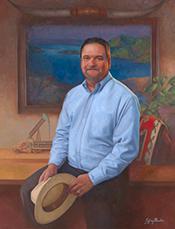 Rep. Richard W. Pombo (R-CA)
 +5
+5