S.Res. 384Senate108th Congress (2003-2005)In Committee
A resolution expressing the sense of the Senate on the development of self-government in Kosovo.
Sponsored by 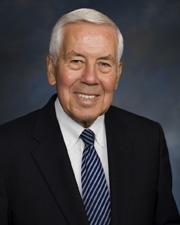 Sen. Richard G. Lugar (R-IN)
Introduced June 18, 2004
Legislative Activity
Stay on top of the latest movement without scrolling through every action
SenateIntro Referral
Latest Action
Referred to the Committee on Foreign Relations. (text of measure as introduced: CR S7056-7057)
June 18, 2004
View full timeline
SenateIntro Referral
Introduced in Senate
June 18, 2004
SenateIntro Referral
Referred to the Committee on Foreign Relations. (text of measure as introduced: CR S7056-7057)
June 18, 2004
Floor Debate
1 memberWhat members said about S.Res. 384 on the floor
Floor Debate
1 memberWhat members said about S.Res. 384 on the floor
1 Republican
Sen. Richard G. LugarR-IN · Jun 18, 2004
Mr. President, today I stand to submit a resolution focused on the development of self-government in Kosovo. I am pleased that Senators Voinovich, Allen, Smith, and Biden have joined me in co-…
Bill Text
Latest available legislative text
Introduced in SenateIssued June 18, 2004
        [Congressional Bills 108th Congress]
[From the U.S. Government Publishing Office]
[S. Res. 384 Introduced in Senate (IS)]

108th CONGRESS
2d Session
S. RES. 384

Expressing the sense of the Senate on the development of self-
government in Kosovo.

_______________________________________________________________________

IN THE SENATE OF THE UNITED STATES

June 18, 2004

Mr. Lugar (for himself, Mr. Voinovich, Mr. Allen, Mr. Smith, and Mr.
Biden) introduced the following bill; which was referred to the
Committee on Foreign Relations

_______________________________________________________________________

RESOLUTION

Expressing the sense of the Senate on the development of self-
government in Kosovo.

Whereas United Nations Security Council Resolution 1244 of June 10, 1999,
mandates an international civil presence and an international security
presence in Kosovo, ending a brutal conflict in Kosovo;
Whereas during and immediately after the conflict, the people of Kosovo suffered
from ethnic cleansing, war crimes, and crimes against humanity;
Whereas more than 4 years after the end of the Kosovo conflict, the incidence of
ethnic strife in Kosovo remains unacceptably high, and the need for the
fundamental work of ethnic reconciliation in Kosovo remains great;
Whereas the ethnic violence that erupted in Kosovo on March 17, 2004, claiming
the lives of 19 people, displacing more than 4,000 Kosovo Serbs and
other minorities, and resulting in the destruction of more than 500
homes and at least 30 churches belonging to Kosovo minorities, serves as
a reminder of serious challenges that remain in Kosovo;
Whereas the United States and the international community strongly condemned the
ethnic violence that erupted in Kosovo on March 17, 2004;
Whereas the Senate adopted a resolution on April 8, 2004, urging political
leaders to fulfill their commitment to rebuild property that was
destroyed in the violence of mid-March 2004 in Kosovo, and to take all
possible action to allow the more than 4,000 people displaced during the
violence to return quickly and safely to their homes and communities;
Whereas ethnic crimes and violent reprisals against Kosovo citizens of all
ethnic groups harm the victims, their families, and their communities,
and impair their common future;
Whereas the integration of Kosovo into Europe, and into the international
community, depends on the ability of the people of Kosovo to overcome
the divisions which have too often marked the past in Kosovo;
Whereas an important goal of the international civil presence in Kosovo
established by United Nations Security Council Resolution 1244 is to
facilitate a political process to determine the future status of Kosovo,
taking into account the Rambouillet accords of 1999;
Whereas ``Standards'' of democratic self governance and a multiethnic society in
Kosovo are embodied in the goals enunciated by the Special
Representative of the United Nations Secretary General in April 2002, to
include the effective functioning of democratic institutions, the rule
of law, the sustainable return of displaced persons, dialogue with
Serbia and Montenegro, freedom of movement, a stable free-market
economy, property rights, and the further development of the Kosovo
Protection Corps;
Whereas the people of Kosovo have made some important progress toward the
fulfillment of these goals while continuing to face challenges,
particularly on issues of refugee return and freedom of movement of
Kosovo minorities;
Whereas the United Nations Security Council, in its Presidential statement of
December 12, 2003, endorsed the elaboration by UNMIK (the United Nations
Interim Administration in Kosovo) of the ``Standards'' in the
``Standards for Kosovo'' document and welcomed the plan to periodically
review the progress in Kosovo in implementing the standards;
Whereas UNMIK has drafted a comprehensive ``Standards Implementation Plan'' to
give Kosovo precise guidance on the actions that must be taken to
achieve the standards;
Whereas the United States and UNMIK are currently working together with the
Provisional Institutions of Self-Government of Kosovo (PISG) to help
Kosovo meet the standards with a view to carry out a comprehensive
review of the progress in Kosovo ``around mid-2005''; and
Whereas considerable further progress toward the realization of the standards
remains to be accomplished before the process of determining the future
status of Kosovo can begin: Now, therefore, be it
Resolved, That it is the sense of the Senate that the United States
should--
(1) intensify its efforts to help Kosovo achieve the
``Standards'', as set out by the Special Representative of the
United Nations Secretary General in Kosovo in October 2002, and
as further elaborated in the UNMIK (the United Nations Interim
Administration in Kosovo) ``Standards For Kosovo'' paper of
December 10, 2003, to bring about a stable, multiethnic, and
democratic society in Kosovo by carrying out the steps called
for in the Kosovo Standards Implementation Plan drafted by
UNMIK;
(2) further encourage Kosovo to become a factor for
stability in the region by having good relations with its
neighbors, and in particular, by engaging in dialogue with
Belgrade in an effort to secure a peaceful, long-term solution
for peace in the region;
(3) encourage Belgrade to support the standards
implementation process in Kosovo, including by constructive
participation in the direct technical talks launched October
14, 2003;
(4) enhance efforts to provide support to KFOR (the North
Atlantic Treaty Organization-led international security force
in Kosovo), and to call upon the PISG (Provisional Institutions
of Self-Government of Kosovo) to ensure the security and
freedom of movement for all the people of Kosovo, and the
return of refugees and internally displaced persons;
(5) urge all people in Kosovo to reject the ethnic violence
that erupted in Kosovo on March 17, 2004, and work with UNMIK
and KFOR to apprehend and prosecute the perpetrators of the
violence, to rebuild property destroyed during the violence,
and to work to ensure that displaced persons are able to return
safely to their homes and communities;
(6) promote steps to foster the development of the Kosovo
economy through strengthened cooperation with the South Central
Europe region and Euro-Atlantic institutions, without prejudice
to its future political status; and
(7) call upon the leaders of the PISG, and upon the leaders
of all political parties and communities of Kosovo, to renew
and enhance their efforts in cooperation with UNMIK, KFOR, and
the international community to achieve the matters described in
paragraphs (1) through (6).
<all>