Madam Speaker, I yield myself such time as I may consume. I would like to begin by expressing my great appreciation to my very dear friend, the distinguished and very able Chair of the Committee on…
Madam Speaker, I yield myself such time as I may consume.
I would like to begin by expressing my great appreciation to my very dear friend, the distinguished and very able Chair of the Committee on Rules, my friend from Rochester (Ms. Slaughter).
And with all due respect to my distinguished committee Chair, I am compelled, not surprisingly, to rise in the strongest possible opposition to this rule.
Over the last 1\1/2\ years, my colleagues Messrs. Diaz-Balart, Hastings, and Sessions have stood right here at this lectern and opposed many, many deeply flawed rules. We began this Congress very inauspiciously as the leadership jammed through the opening week agenda before even bothering to set up the Rules Committee, allowing Ms. Slaughter to become Chair of that committee. From the very outset, there has been no pretense of concern for due process, not an inkling of respect for the rules of this House.
While we started at a low point, we have sunk lower and lower with each subsequent rule. One by one the Democratic leadership has trampled the rules and traditions of this body in an effort to shut down debate, cut both Republicans and Democrats out of the process, and jam through poorly constructed bills that rarely, rarely, if ever, become public law. I frequently marvel at each new low and assume that we have reached the rock bottom. As we have considered new forms of restrictive rules crafted under an ever-more restrictive process, I have often thought, ``This one takes the cake. The Democratic leadership couldn't possibly stoop any lower than this.'' Until the next comes, shutting down due process to an even greater degree.
So this time I'm not going to say that this rule is the absolute bottom of the barrel. I don't doubt that with a little more time and effort, based on the track record we've seen, the Democratic leadership will find a way to trample the rules and traditions of this House even more thoroughly. I will say that this is clearly the worst example that we've seen in the last 17 months since they have been in charge.
But before I get into the details of this egregious rule, Madam Speaker, I think it's important to discuss why it even matters what kind of a process is used to craft legislation and hold votes. I know the inner workings of the Rules Committee are thought to be so arcane that even some of our colleagues consider them to be a little too ``inside baseball.'' In fact, the distinguished Chair just spent all of her time talking about the bill itself. She didn't talk about the fact that they're trampling on the rights of Republicans and Democrats. Start talking about rules and procedure and regular order, and most Americans' eyes, and even some of our colleagues', start to glaze over.
So to illustrate why process matters, I will use another set of rules that are
more widely understood as an example. Even before the advent of the television show Law & Order, most of us were familiar with the basics of our criminal justice system. We're all familiar with our basic rights enshrined in the Constitution. We cannot be held without a charge. We're protected from self-incrimination and unlawful searches and seizures. We must be read our Miranda rights when placed under arrest. These basic rights are fundamental, fundamental, Madam Speaker, to American democracy. We know that there can be no justice without a fair process, and we know that the protection of the rights of the individual is more important than the outcome of any one particular case.
The Bill of Rights and the laws that have been enacted to uphold it aren't just a cryptic system of rules and regulations. They guarantee, Madam Speaker, they guarantee our civil rights and they guard against tyranny. Without a fair process, power is abused and rights are abridged. Process matters, Madam Speaker. Process matters because process is democracy.
The rules of the House were established for the very same reason. They ensure that the American people, through their elected representatives, have a say in the crafting of laws that govern them. The rules guard against abuses of power, and they ensure that the legislative process is transparent and fair. Thwarting due process is not just arcane political maneuvering around obscure, complicated rules that no one should care about. It subverts the principles of representative democracy. Let me say again, Madam Speaker, the rule that we are considering at this moment very clearly subverts the principles of representative democracy.
The Democratic leadership's casual disregard for these rules and principles has faced growing criticism in the media. Last week the Politico accused them of ``breaking promises,'' promises for an open legislative process that followed regular order and the rules of the House. Not surprisingly, the paper cited today's underlying bill, the supplemental appropriations, as Exhibit A in the Democrats' assault on an open and inclusive process, which was promised at the beginning of this Congress. That's not my saying that; that's an independent newspaper that made that statement.
Even before the new lows of the supplemental, another publication, Investors Business Daily, reported recently on the leadership's ``widening power grab,'' accusing them of ``anti-democratic'' behavior, running a ``dictatorship,'' and ``showing little or no concern for holding actual votes or building consensus on issues.'' Now, Madam Speaker, those are pretty harsh charges coming from a newspaper that is clearly a very independent publication. And they go on to say that this is all being done in an effort to ``manipulate Congress.'' Madam Speaker, ``dictatorship'' and ``anti-democratic,'' those are pretty harsh words, but they are clearly warranted.
The process used to craft the underlying supplemental appropriations bill has been atrocious. Committee work was completely abandoned. Without a single hearing, without a markup, without so much as consulting Mr. Lewis and the committee members, this bill was concocted behind closed doors. Zero input, zero deliberation, zero consultation. The Senate, of course, won't stand for that kind of treatment and intends to hold a markup later today before proceeding with its floor debate. But the Democratic leaders in this House apparently deem this to be a lesser body, with no right to due process.
The Democratic leadership intended to bring this bill up last week. They had to pull it from the schedule because fiscally conservative Members within their own caucus were outraged at the contents. A week later, Madam Speaker, a backroom deal has now been struck, bringing the remaining Democratic Members on board. How? Bringing Members on board by imposing a tax on small businesses in this country, which is exactly what this is. You see, Democrats love to stir up class warfare by justifying the small business tax as just a tax on the rich. Unless, of course, we are talking about millionaire farmers, and then they like to give them massive government payouts, which is what they did just yesterday in the farm bill.
To add to their inconsistency, they actually waived their own PAYGO rule to fund the farm bill subsidies, and today they refuse to waive the same PAYGO rule and use it as an excuse to levy massive tax increases on small businessmen and women in this country. Only in Washington would such logic be employed.
We became aware of the rough outline of this tax increase, along with every other provision of this bill, only through press reports. Some have reported a $183 billion price tag on this bill. Others have said it would be costing at least $250 billion. Various outlets reported on various provisions. But we didn't get a chance to see for ourselves what was in this massive bill until 3 p.m. yesterday. In fact, the distinguished former Chair of the Committee on Appropriations, the now ranking member, my good friend, Mr. Lewis, came before us. Within the hour before that 3 p.m. meeting, he had just gotten the copy of the measure.
Most egregious of all, we're not actually considering a bill here today. We will be voting on three amendments to a Senate amendment to an old House bill that has already passed but was never enacted. Did you catch that? If it sounds gimmicky and underhanded, that's because that's exactly what it is. In fact, this morning I heard our colleague Mr. McDermott on National Public Radio, where he said the crafting of this is tantamount to John Kerry's very famous line in which he said ``I voted for it before I voted against it.'' The Democratic leadership knows that a vote on their full package would never pass; so they plotted a way around an actual vote on final passage.
For anyone who missed that, let me repeat. The House of Representatives will not be permitted a vote on the full underlying proposal. When Investors Business Daily calls this a dictatorship, they seem to have a point.
So what exactly is in this $183-250 billion bill that comes to us without any due process and will pass without a vote? Who can say for sure? But I know that at least $62 billion in new entitlements are included; $11 billion in unemployment insurance, and our friend Mr. Weller will be talking about this in a few minutes; and at least $51 billion in benefits for veterans. Clearly, these are very, very important issues that need to be addressed.
I don't doubt that the Democratic majority will try to claim that Republicans don't care about our veterans or those facing economic hardship. We hear that time and time again. To the contrary, these are such critically important issues for us that we passionately believe that we must address them in a serious and deliberative way. It is simply not good enough to slap together a proposal without a single moment of testimony or debate, throw some money at our problems, and call it a day.
The very critical issues addressed in this bill, from funding for Iraq and Afghanistan to international food assistance to the tremendously important domestic programs, all of these deserve a substantive, deliberative process. We should have an opportunity to examine which of these are truly emergencies and which should be included in the regular appropriations process. And all of them should have the benefit of an open debate to ensure that we are addressing our priorities effectively.
This rule allows for none of this, Madam Speaker. It thwarts the rules and traditions that were put in place to guard against abuses of power, and it blocks consideration of even a single amendment, including the very thoughtful and responsible alternative proposed by the man sitting to my right here, the distinguished ranking member of the committee, Mr. Lewis. He's offered a clean supplemental appropriations bill which simply provides our troops the funding they need without bogging it down with all kinds of unrelated items or adding new policy that prevents them from carrying out their mission.
Our hope is to get this critical funding to our troops before Memorial Day, which is fast approaching. That's not an arbitrary deadline and it's not a gimmick. Our military commanders have told us that they desperately need this funding now, and we want to be able to go home for Memorial Day and tell our veterans and our military families that we passed a clean bill that funds our troops and their mission. We
want to tell them we crafted a bill without regard to politics, without regard to providing political cover or fodder for political ads. We simply gave the troops the funding they desperately need. Now, Madam Speaker, that's exactly what the distinguished ranking member, Mr. Lewis, should be able to provide, and I'm going to seek an opportunity for him to do just that.
But, unfortunately, the Democratic majority can't advance their flawed policies without shutting down the process. So they prefer closed rules to open debate. They prefer backroom deals to the transparent committee process. They prefer hollow, ill-gotten victories that die after the House vote to substantive, bipartisan legislation that is enacted into law. That's exactly what we need to do, Madam Speaker.
So I urge a ``no'' vote on the rule, and I am going to urge a ``no'' vote on the previous question.
Madam Speaker, I reserve the balance of my time.
Madam Speaker, I notice my colleague doesn't spend any time at all talking about the rule which is being considered at this time and shutting down democracy which we all aspire to in Iraq and other places in the world.
With that, I would like to yield 4 minutes to the author of the very important measure that will be made in order if we are able to defeat the previous question, a clean supplemental, my good friend from Redlands, the ranking member of the Appropriations Committee, Mr. Lewis.
Will the gentlewoman yield for a question?
I would just like to remind my colleague that 82 percent of the people who fall in the category about what she has just mentioned are small business men and women. And I think we need to realize this is a small business tax.
I thank my friend for yielding.
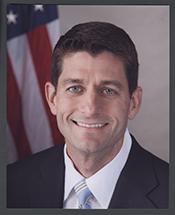
Madam Speaker, at this time I am very happy to yield 3 minutes to the distinguished ranking member of the Committee on the Budget, my friend from Janesville, Wisconsin (Mr. Ryan).
I am happy to yield my friend an additional 30 seconds.
Madam Speaker, let me say in the name of saying they are taxing the rich, the facts show it. Eighty-two percent of the people who fall in that category are small businessmen and women. That's just the facts.
With that, I am happy to yield 3 minutes to my good friend from Morris, Illinois (Mr. Weller), the ranking member of the Income Security and Family Support Subcommittee of Ways and Means.
Madam Speaker, may I inquire of the Chair how much time is remaining on each side.
In light of the fact there is much more time remaining on the other side, may I ask the distinguished Chair if she might proceed and yield some of her time.
I reserve the balance of my time.
Madam Speaker, I understand that my good friend from Cleveland was unable to get time from his side of the aisle.
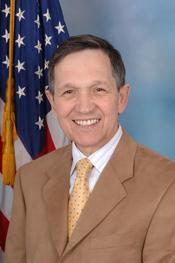
And so at this time I am happy to yield 1 minute to the gentleman from Cleveland, the Democratic Presidential candidate, Mr. Kucinich.
Madam Speaker, may I inquire again how much time is remaining on each side.
Madam Speaker, with that, I am happy to yield 1 minute to the very distinguished gentlewoman from Brooksville, Florida (Ms. Ginny Brown-Waite).
Yes, we have a couple of speakers and then I am going to close.
Let me yield to my very good friend from Wichita, who is a member of the Appropriations Committee and who has worked long and hard here, for 1 minute.
(Mr. TIAHRT asked and was given permission to revise and extend his remarks.)
Will the gentleman yield?
That is not my goal, Madam Speaker.
Madam Speaker, let me yield myself 30 seconds.
Let me begin by apologizing to my friend from Wausau. The notion of engaging in debate on the House floor is something I feel strongly about, and I am always happy to yield to people when they make requests for me to yield. I was simply asking my friend to
yield because of the fact that the $40 billion post-9/11 supplemental about which my friend complained and referred to as ``this crowd'' came to this floor under unanimous consent, a bipartisan agreement.
And the three supplemental appropriations, Madam Speaker, about which my friend referred, never, never, denied a motion to recommit to the minority. And I ensured as chairman of the Rules Committee at that time the right of the minority would, in fact, be maintained.
Madam Speaker, I am very happy to yield 1 minute to my friend from Auburn, Washington, the former sheriff, David Reichert.
I inquire, is the distinguished Chair of the Rules Committee the final speaker for the majority?
Madam Speaker, let me yield myself the balance of my time.
Let me say at the outset, and again the last thing I want to do is offend my friend from Wausau by asking him to yield at any point, but I would be happy to yield to him if he wants to respond to what I am about to say. And that is, the fact of the matter is we have in this Congress the single highest number of closed rules in the 219-year history of the Republic. Never before has this, has the United States Congress had such a period of closed rules. I will tell you, it is absolutely outrageous. Why, because we were promised something that was much, much different than that.
On a supplemental appropriations bill, my good friend, the chairman of the committee said, ``The majority leadership decide to obliterate the legislative process. They discarded a bipartisan committee product, and they threw in unrelated, partisan political items that characterized a full partisan agenda. They have taken abusive power to a new level.''
Madam Speaker, let me say that when we did that, we provided the minority a right to have a bite at the apple, a motion to recommit. They had an opportunity to offer a proposal. I will tell you it is just plain wrong to see what has been taking place here.
I am going to urge my colleagues to oppose the previous question so I can amend the rule to simply give Republicans one simple bite at the apple, something we always guaranteed the now-majority.
Mr. Lewis, the ranking member on the Committee on Appropriations, introduced a bill on Tuesday, H.R. 6062, a clean supplemental, to provide troop funding without strings and extraneous spending. If the previous question is defeated, I will amend the rule to make in order an alternative motion to concur by Mr. Lewis which would simply state that the House concurs in the Senate amendment with an amendment consisting of the text of H.R. 6062. This way the House has the opportunity to send the Senate a clean supplemental to get our troops the money that they desperately need without the hocus-pocus, three-in- one vote political gamesmanship that we have before us at this moment.
It's simply the right thing for us to do to send that clean supplemental.
Madam Speaker, at this point I would like to ask unanimous consent to have the text of the extraneous material and the amendment included in the Record.
Madam Speaker, it's just one simple bite at the apple, something we always guaranteed the Democrats when we were in charge. It's one amendment. We're just trying to help the Democratic majority become the majority that they promised that they would be. It's not too late. Let them do it, Madam Speaker.
Vote ``no'' on the previous question.
Madam Speaker, on that I demand the yeas and nays.