Mr. Speaker, I yield myself such time as I may consume. (Mr. DREIER asked and was given permission to revise and extend his remarks.) Mr. Speaker, I would like to begin by expressing my appreciation…
Mr. Speaker, I yield myself such time as I may consume.
(Mr. DREIER asked and was given permission to revise and extend his remarks.)
Mr. Speaker, I would like to begin by expressing my appreciation to my very good new friend from Tampa (Ms. Castor) for yielding me the customary 30 minutes, and to congratulate her on her statement that she has just provided. But, Mr. Speaker, I rise to reluctantly oppose this rule.
This bill has lots of problems, and I understand the problems on the other side of the aisle. I am very happy to see the distinguished Chair of the Committee on the Judiciary, my very good friend John Conyers, here.
It was just a year ago, it was just a year ago this month, that we were on the floor with our own lobbying bill, and we faced many of the same problems and challenges that Chairman Conyers and others in the Democratic leadership are facing at this moment. Trying to address the concerns that our colleagues have on this issue is a challenge, a very challenging thing, and they have discovered the lesson that I learned long ago, and that is reform is very hard work. It is a constant work in progress.
I was reminded by one of my staff members that I had said at one point as we moved ahead with a reform bill, which I am happy to say we passed in the last Congress, I said, when we are done with that reform, what we need to do is work on more reform.
This is, again, a constant work in progress, and will continue to be. And I believe it is part of our responsibility to constantly look at ways in which we can reform and improve the operations of this institution.
But if the bill that this House passed in the last Congress was described as a ``sham,'' it is very unfortunate, and Mr. Conyers and Ms. Castor and others were there when I was describing this, the very distinguished chair of the Committee on Rules no fewer than seven times when we, a year ago this month, were debating this measure, described the bill I had, H.R. 4975, as a ``sham'' bill.
I have to say, as I listen to my friend from Tampa (Ms. Castor) talk about
this bill, she was going through the fact that we will have disclosure on the Internet of travel, and she went through basically the provisions included in H.R. 4975; it is basically the same bill. But, unfortunately, there are a number of important provisions included in H.R. 4975 that are not included in this measure. I find that to be somewhat troubling.
For instance, while starting out with a 2-year restriction on lobbying after Congress, the majority left that provision on the cutting room floor. They recognized, as we did, that the economics of attracting and retaining good staff, they don't work with that kind of restriction. But instead of retaining a provision which passed the House last year and would provide everyone with a degree of transparency about who was and was not under the lobbying restriction, and I am going to offer an amendment to add that back which I hope will be able to improve the bill. But this bill, as we have it, is not nearly to the level of what the new majority described as a sham in the last Congress.
While this bill provides important new criminal penalties for lobbying violations, it includes nothing, absolutely nothing, Mr. Speaker, to make enforcement more rigorous.
I offered an amendment in the Rules Committee to add a provision which again was included in the bill that we had passed out of this House last year which would allow the House inspector general to randomly audit lobbying disclosure filings and forward cases of wrongdoing to the Department of Justice for prosecution.
The majority's answer to that proposal was, no, we don't want enforcement of our bill. Enforcement is always a challenge. We deal with that with the issue of illegal immigration and a wide range of things. It is easy to put all kinds of great ideas out there, but if there is no enforcement, it has no teeth and no chance of success. That is something that is very lacking in this bill. We had it in our lobbying reform bill that passed last year, and I offered it as an amendment at the Rules Committee. Unfortunately, my colleagues in the majority on the Rules Committee rejected it.
Mr. Speaker, last year, Mr. Castle added a provision on the floor requiring lobbyists to take ethics training. Is that provision in this bill? Nope, it's not.
Did the majority make Mr. Castle's amendment in order to consider that? Nope, they didn't.
My colleague, Dr. Gingrey, a former member of the Rules Committee, added an amendment on the floor dealing with the personal leadership of PAC funds. That was not included in the bill, and his amendment was not made in order. Last year, with bipartisan support on the floor, we amended our bill, H.R. 4975, to say that Members who have leadership PACs cannot transfer those dollars into their own account for personal use, which is what can happen today. It is not allowed for principal campaign committee accounts, but that loophole which allows Members to transfer money from their leadership PAC for personal use is still going to be allowed. And the attempt to even offer an amendment to close that horrendous loophole was denied.
That is to say nothing of the other creative ideas that were summarily rejected by the Rules Committee majority last evening.
Mr. Speaker, if the bill which I sponsored last year was a sham, and as I said the chairman of the Rules Committee, although last night she said she never said it, seven times it is in the Congressional Record when she was offering her motion to recommit, if it was a sham, then this bill can only be characterized at this moment as being ``sub- sham,'' and our efforts to raise it to the level of a mere sham were rebuffed, unfortunately, in the Rules Committee.
Which brings me to the rule for this bill, Mr. Speaker. For all of the criticism the Republicans take for the way we administered the House, and we hear that constantly up in the Rules Committee and down here on the floor, it is notable this bill makes in order fewer amendments than we did when we considered our bill last year.
The rule for H.R. 4975, our lobbying bill, made in order nine amendments. This year, only five amendments were made in order. And while it gives Mr. Van Hollen an up-or-down vote on his so-called bundling disclosure bill, it doesn't attach it to the lobbying bill going to the Senate, making it much more difficult to ultimately reach passage.
Mr. Speaker, this rule and these bills are not unlike many of the so- called reforms instituted in this Congress, which means all show and no substance whatsoever.
For instance, our Democratic friends take credit for adopting and supposedly improving Republican earmark disclosure reforms. As Mr. Flake found out just last week, when it comes to actually trying to enforce those rules, the Rules Committee eliminated every avenue for a Member to bring this question before the House. On top of that, Mr. Flake had several amendments addressing lobbying for earmarks. Mr. Speaker, none of those amendments were made in order.
In the end, there is little in this bill that is truly objectionable. My friend from Tampa went through and outlined the provisions included in H.R. 4975 that passed this House a year ago this month with bipartisan support. Again, there is little that is truly objectionable. There is very little that is in this bill that is beyond what we had in the last Congress; and, unfortunately, it doesn't include or even provide an opportunity to provide amendments to include many of the items that were so important in this effort.
This bill takes no risk, reaches no heights, and falls short of the lofty promises made by my newly minted majority colleagues. Unfortunately, the rule is unacceptable in its current form, Mr. Speaker, and I am going to urge its defeat.
Mr. Speaker, I reserve the balance of my time.
Mr. Speaker, we're all reformers today, and at this time I'm very happy to yield 2 minutes to a great reformer from Cherryville, North Carolina (Mr. McHenry).
Mr. Speaker, will the gentleman yield?
Mr. Speaker, I thank my very dear friend for yielding, and I would simply say the reason we're calling for a ``no'' vote on the rule is that we should allow us to get to what I, as we now know, affectionately describe what the former minority leadership called the sham level. We need to at least get up to the level, and I'm very appreciative of the remarks that my friend has offered characterizing, I think correctly, my bill.
Mr. Speaker, I yield 4 minutes to a former member of the Rules Committee, our good friend from Marietta, Georgia (Mr. Gingrey).
Mr. Speaker, I yield 4 minutes to the leader on the issue of earmark reform, the gentleman from Mesa, Arizona (Mr. Flake).
Mr. Speaker, I would just like to clarify this once again, if I might.
So a private institution is not allowed to provide any kind of meal or support, tickets or things like that, but a public institution is able to?
So that won't be changed under this bill that we are considering right now. Am I correct in concluding that?
Mr. Speaker, I yield myself such time as I may consume to simply say to my friend, the example of allowing a public institution to provide meals and tickets and all kinds of things while a private institution cannot do that underscores the fact that this issue needs to be addressed in a broad bipartisan way.
Now, in the exchange that I had with the distinguished Chair of the Committee on the Judiciary upstairs, he was happy to give it back over to us at the Rules Committee. We should have had an original jurisdiction hearing on a wide range of these issues that have not been addressed. In the last Congress, we held four original jurisdiction hearings on this issue. This year there have been none.
So I think that the point that my friend from Mesa is making, very correctly, is that he made a bipartisan attempt to the new majority leadership to try and address this and was rebuffed.
Everyone has recognized, I believe, certainly on our side of the aisle, and we did so when we were in the majority, that the issue of reform needs to be done in a bipartisan way. I know that on the Judiciary Committee, Mr. Smith, the ranking member, has worked with Chairman Conyers; but there are many of the rest of us who have been involved in this issue of reform who I believe should have been consulted, especially in light of a number of provisions that were included; and, in fact, one provision which is absolutely outrageous, no hearing whatsoever, it was literally snuck into this bill, dealing with the question of Members attending charitable events. No hearing, no consideration whatsoever. A piecemeal attempt to do this.
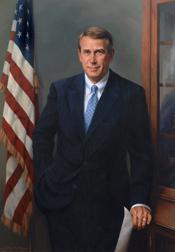
Now, Mr. Speaker, on the 29th of March, nearly 2 months ago, the minority leader, Mr. Boehner, sent a letter to the Speaker asking that she deal with these important questions which impact every single Member of this institution with a bipartisan panel. Mr. Speaker, I am saddened to inform the House that Minority Leader Boehner has gotten no response to that letter that was sent nearly 2 months ago. So that is why we are concerned about this process.
Yes, the bill itself is one which included so much of what I was proud to include in H.R. 4975; does not get to that level. But I am urging opposition to this rule, as is Mr. Flake, as was Dr. Gingrey and others of my colleagues, so that we can try and improve this in a bipartisan way.
Mr. Speaker, I reserve the balance of my time.
Mr. Speaker, may I inquire of the Chair how much time is remaining on each side? And then I would like to ask my colleague, she indicated she was the last speaker a few minutes ago, and then Mr. Doggett joined us.
So the gentlewoman is the last speaker?
Mr. Speaker, the gentlewoman is on her feet and so I would actually like to engage her in a colloquy, if I might, and ask some questions. I would be more than happy to yield to my friend from Tampa.
I am very concerned about the ramifications of this measure, and I talked about the concern that I have over this issue of charitable events, and that this item was in a piecemeal way stuck into this rule, and I raised the issue of the letter.
Mr. Speaker, I submit for printing in the Record a copy of the letter that was sent by Mr. Boehner to my California colleague Speaker Pelosi. Mr. Speaker, the reason I do that is that there has been no response to this nearly 2-month-old letter; and I hope that maybe someone on the Speaker's staff will read the Congressional Record and see this request for a truly bipartisan approach to this issue.
Congress of the United States,
House of Representatives,
Washington, DC, March 29, 2007.
Hon. Nancy Pelosi,
Speaker of the House, U.S. Capitol,
Washington, DC.
Dear Speaker Pelosi: The American people have every right
to expect the highest ethical standards here in the people's
House. Yet, less than three months into the 110th Congress it
has become clear that House ethics rules are hopelessly
broken. Members on both sides of the aisle are understandably
frustrated because they know you can't ``clean up Congress''
with confusing rules that are as difficult to comply with as
they are to enforce.
It is equally clear that until the ethics rules are
repaired through a genuinely bipartisan process, they will
continue to lack the credibility needed to ensure broad
compliance, effective enforcement and widespread public
acceptance.
As you know, sweeping changes to House ethics rules imposed
at the start of this Congress were drafted in secret by the
incoming Majority without consulting either the Minority or
the staff of the nonpartisan Ethics Committee. The new rules
were then rammed through the House with no opportunity to
carefully analyze the proposals or to improve them in any
way. The consequences of this ill-considered approach are now
being felt by Members and staff on both sides of the aisle:
A staffer may attend an evening reception hosted by a
corporation and consume shrimp, champagne, sliced filet and
canapes . . . but may not accept a slice of pizza or a $7 box
lunch provided by the very same
corporation at a policy briefing the next day. [see Ethics
Committee ``pink sheet'', Feb 6, 2007 (pp. 4-5)]
Although Members and staff may play in a $1,000 per person
charity golf tournament to benefit a local scholarship fund,
they are prohibited from similarly helping the American Red
Cross raise funds for Katrina victims by playing in its golf
tournament--solely because the Red Cross employs lobbyists.
[see Ethics Committee ``pink sheet'', Jan 19, 2007 (p. 7)]
In order to go on a ``first date'' with someone who happens
to be a lobbyist, a staffer must agree to pay for his or her
full share of the lunch or dinner, as well as anything else
of value, such as a movie, concert or ballgame. [see Ethics
Committee ``pink sneet'', Feb 6, 2007 (p.2)]
A Member may accept $200 tickets for the Final Four from
Ohio State (public university), but not $20 tickets to a
preseason game from Xavier University (private university).
[see Gifts & Travel, House Ethics Committee, April 2000 (p.
37)]
A Member may accept a $15 t-shirt or $20 hat from the Farm
Bureau, but not a $12 mug or mouse pad. Similarly, a $4 latte
is OK--but a $4 sandwich is not. [see Ethics Committee ``pink
sheet'', Feb 6, 2007 (p. 5)]
A Member who has his own airplane is prohibited from flying
it for any purpose--official, campaign or personal--even at
his own expense. [see Ethics Committee letter to Rep. Stevan
Pearce, Feb 16, 2007]
A staffer invited to a post-season barbecue for her
daughter's soccer team may not attend once she learns that it
will be held in the home of a player whose father is a
lobbyist. [see Ethics Committee ``pink sheet'', Feb 6, 2007
(p. 2)]
Although a Member may not accept dinner from a lobbyist who
uses his own funds or those of his firm, he may accept dinner
from the very same lobbyist using a credit card provided by
his state or local government clients. [see clause 5(a)(3)(O)
of House Rule XXV]
A corporate executive who is not a lobbyist may not use his
expense account to take a Member out to dinner, but may--in
many cases--take the same Member to dinner using his personal
funds. [see Ethics Committee ``pink sheet'', Feb 6, 2007 (p.
3)]
A Member may not take a privately-funded trip if a lobbyist
accompanies him to and from Washington; but the same Member
may spend five days in Brussels discussing global warming
with environmental group lobbyists--as long as none of them
are on the same flights to and from the meeting. [see Ethics
Committee ``pink sheet'', March 14, 2007 (p. 2)]
It's no surprise that Members deeply committed to following
the rules are confused and concerned by the current state of
disarray in the House.
Making matters worse, the chaos inflicted on Members and
staff by careless (or worse) Democrat rule writers has now
infected the legislative process as well. For example,
confusion over the proper application of congressional
earmark rules has made it possible for Democratic leaders to
certify as ``earmark free'' a multi-billion dollar Continuing
Resolution that any knowledgeable observer will confirm was
laden with them.
Moreover, the failure of the House Ethics Committee to
provide official guidance to Members seeking to comply with
newly adopted earmark ``conflict of interest'' rules until
after the deadline fix submission of earmark requests had
expired has unnecessarily disrupted the FY08 appropriations
process by delaying for more than a month processing of many
Member earmark requests, and complicated efforts to make the
earmark process more transparent.
This latter incident underscores the folly of Democrats
rushing to unilaterally impose complicated and contradictory
new rules on the House, and then denying an entirely
reasonable joint request by the Chairman and Ranking
Republican of the Ethics Committee for the additional
resources the panel needs to carry out its added
responsibilities to Members.
Sadly, Democrat leaders straining to legitimize their
campaign rhetoric have instead left Members--on both sides of
the aisle--more vulnerable than ever to violating rules that
are hard to define, riddled with logical inconsistencies, and
utterly unlikely to prevent the sort of abuses that have
properly sparked so much public outrage.
After all, few of the ``Culture of Corruption'' violations
by Duke Cunningham and Bob Ney--or alleged violations by
William Jefferson and Alan Mollohan--would have been
prevented had the recently passed ethics changes been in
effect last year.
Rather, the principled path to a more ethical Congress is
through clearcut, common sense rules that are widely
communicated and firmly enforced. And, as you and your fellow
Democrat leaders argued so persuasively during the last
Congress, the process of developing those rules must be
transparent and genuinely bipartisan.
To that end, I ask that you join me in appointing a
bipartisan working group tasked with analyzing House ethics
rules--and recommending fair, sensible and understandable
revisions that working group members believe would improve
both compliance and enforcement.
As with the Livingston-Cardin ethics task force in 1997,
the working group should be led by co-chairs and evenly
divided between majority and minority members. I propose that
it consist of six to eight members, including a member of the
ethics committee from each party (but neither its chairman
nor ranking minority member), one elected leader from each
party, and one or two additional Members from each side of
the aisle.
I further propose that we direct the working group to
report back its recommendations no later than July 1, 2007 to
allow time for the House to consider its proposed revisions
to the Rules of the House prior to the August recess.
Madam Speaker, I have been encouraged by recent public
statements made by you and members of your staff noting your
desire to correct evident problems with several of the new
rules. Thus, I hope you will commit to work constructively
with me to ensure that any revisions to the Code of Conduct
and other House rules are imbued with the sort of credibility
that you have often pointed out can only result from a
thoroughly bipartisan effort.
Sincerely,
John A. Boehner,
Republican Leader.
Mr. Speaker, I would simply ask my colleague from Tampa to describe a term that is in this bill.
Now, one of the questions out there is that Members of Congress are often approached by people and considered for employment beyond their service in this institution. Now, in H.R. 4975, we were very specific in saying that when negotiation for compensation, and those are the exact words that we used in H.R. 4975, are included in the bill, then there has to be a letter to the Committee on Standards of Official Conduct stating that that negotiating process has begun. So we had that exact term of ``negotiating for compensation.'' Those are the three words that we had in there.
Now, I would like to inquire of my friend from Tampa why it was in this measure that they went from ``negotiation for compensation'' to simply ``negotiation.'' And the reason I say that is a very sincere one.
The question naturally comes to mind, now, the gentlewoman from Tampa is new here and obviously not prepared to leave at this point. But there are people, Mr. Speaker, who may have been here for a while and people have decided they wanted to approach them.
Is it negotiation if it is simply said to that person, ``Gosh, we'd like you to consider going to work for us''? And so I am wondering if my friend might define this term ``negotiation'' for us. And I am happy to yield to the distinguished manager of this rule.
Mr. Speaker, if I might reclaim my time. And I do so to simply say, I was posing a question to my colleague, not asking for a campaign speech on what the American people sent us to do here in November. The fact is, Democrats and Republicans alike are committed to reform. I am very proud of the record we have had on reform, and I am honored to have had it praised by the distinguished Chair of the Committee on the Judiciary.
The question that I have is a very specific one: Why in this legislation did we go from the utilization of three words, ``negotiation for compensation,'' to this open-ended question of simply ``negotiation''?
I would be happy to further yield to my friend to elucidate us on that.
Mr. Speaker, if I could reclaim my time. My question, and I will pose it again to my colleague from Tampa. The issue of negotiation for Members of Congress, the debate that we are having now is not about the message that was sent last November, it is not about Medicare part D. It is a question about the issue of lobbying and ethics reform in this institution. And obviously my colleague doesn't really have an answer to this question.
What it does do is it underscores the fact that it is absolutely essential that we deal with this issue in a responsible, bipartisan way to try to bring about some kind of resolution in here. And so I am very, very troubled with the way that this has been handled in a piecemeal way.
And so, Mr. Speaker, it is true that the effort is a valiant one. I congratulate and praise those who have been involved in it. And as I said in my opening remarks, it's very clear that reform is a work in progress. And we need to do more on the issue of reform. It's just that this bill is nowhere near the level of the bill that was passed under the Republican Congress. And I will say, I hope very much this institution will pass a bill that is even better than the one that I was privileged to author in the 109th Congress. And I believe that we could do better than we did in the 109th Congress. It's just that this measure, after all of this talk of reform, after all of this talk about the message sent last November, falls short of where we were in the last Congress, and that's why we are very troubled by this.
Mr. Speaker, I'm going to urge my colleagues to vote ``no'' on the previous question, so that when we succeed in defeating the previous question, I will be able to make in order an amendment that was offered that specifically provides greater disclosure and transparency and accountability which, again, are the three buzz words that are used around here: transparency, disclosure and accountability.
If, in fact, a Member is asking for an earmark, if a Member has been asked for an earmark by a lobbyist, under the amendment that I hope that we will be able to make in order, that Mr. Flake has propounded and unfortunately it was rejected by the Rules Committee, it would simply require that lobbying entity to disclose the fact that they have, in fact, made that in order.
Mr. Speaker, I ask unanimous consent that I be able to, just before the vote on the previous question, have printed in the Congressional Record a detailed explanation of the amendment that would require that lobbyists who make a request of a Member, that they call for an earmark to be made, that that information be made public. I believe that that, in and of itself, is a very, very modest but responsible thing that needs to be done in this effort to ensure greater transparency and disclosure.
So, with that, Mr. Speaker, I urge a ``no'' vote on the previous question.
Mr. Speaker, I yield back the balance of my time.
Mr. Speaker, may I ask the indulgence of the Chair to ask unanimous consent if I could reclaim my time. I didn't realize that my very distinguished colleague from Kentucky was here, and he had a very important question that he wanted to pose on this, and I'd ask unanimous consent to be able to reclaim my time and yield to the gentleman from Kentucky.
Thank you very much, Mr. Speaker, and thanks to my colleagues for their consideration.
Mr. Speaker, on that I demand the yeas and nays.