Mr. Speaker, we are in the midst of the ``Cover the Uninsured Week,'' and I rise to remind the Chamber of the worsening health care crisis that we face as a Nation, and propose a solution to one of…
Mr. Speaker, we are in the midst of the ``Cover the Uninsured Week,'' and I rise to remind the Chamber of the worsening health care crisis that we face as a Nation, and propose a solution to one of the biggest challenges of the 21st Century facing us.
Lack of health insurance often denies necessary medical care. Forty seven million Americans are uninsured. This problem is not limited to the poor or the unemployed. Researchers have estimated that about four- fifths of the uninsured are either employed or members of a family with an employed adult.
As well, there are an additional 50 million Americans who are underinsured; that is, they have coverage that would not protect them from catastrophic medical expenses. Simply put, an increasing number of Americans lack adequate health insurance because they and their employers simply cannot afford it.
Despite the challenges of the war in Iraq and the slumping economy, we all agree that the uninsured need to be covered. Even the health insurance companies have their own plan for covering the uninsured. I'm glad that we're on the same page, after all these years.
The real question we face is, how do we go about covering the uninsured? And how do we ensure that every American has access to quality medical care when they need it?
I strongly believe in a single-payer national health insurance, an approach that has been too often marginalized in debates on this issue, even though it has been successfully employed in almost every industrial nation except our own.
Mr. Speaker, it's time for Congress to consider single-payer, not only as a viable option to cover the uninsured, but as the preferred solution to fix our broken health care system. And make no mistake about it, it is in very bad shape.
According to a January 2007 article in the Journal of Health Affairs, France, Japan and Australia rated best, and the United States worst in new rankings focusing on preventable deaths due to treatable conditions, in 19 leading industrialized nations.
The article revealed that if the United States health care system performed as well as those top three countries, there'd be 101,000 fewer deaths in the United States each year.
Equally disturbing, the Institute of Medicine reports that 20,000 Americans die each year as a direct result of having no health insurance. How can we, in the Congress, who receive fairly decent health care, tell 47 million uninsured Americans that they cannot have access to health care?
With the knowledge that 20,000 Americans die each year without health insurance, how can we, in Congress, who do have health insurance, not place universal health care as a front burner issue in this chamber?
This is a moral challenge that we all must pick up. And incrementalism will not work. Expanding a broken system or fixing parts of it will not work. We must approach the health care solution the same way a physician approaches the treatment of disease. Doctors do not employ treatments only because they are easy or feasible. They choose evidence-based solutions based upon peer-reviewed research in order to employ the most state-of-the-art care available. And so I propose we take the same approach to crafting a universal health care plan.
So today, I ask the following question: What further disaster must befall us before we face the crisis of the uninsured and the underinsured?
How many more people must die due to the inability to receive care in the world's healthiest Nation before we, in Congress, take action and create a truly universal health care system?
For those who believe that we are not ready to have a universal health care system, and must delay the formation of a comprehensive, national health insurance program, I ask you to consider the following evidence that demonstrates why we can ill afford delaying action on a universal health care system.
Health care horror stories are cases in which the result is so tragic that it shocks the conscience. We hear about them almost every day, in the newspapers, magazines, the Internet, television, radio, personal encounters with our friends and neighbors.
In the movie ``Sicko'' we, as a Nation, saw firsthand how even those with health insurance suffer under the current, for profit, employer- based private health insurance system.
In my office, I receive scores of health care horror stories each month, and have binders in my office of health care tragedies that we have collected over the last 8 years. In fact, when Michael Moore was doing research for ``Sicko'' he received 25,000 health care horror stories himself, after he made an appeal for those horror stories on his website.
I'd like to read a health care horror story sent to us by Adrienne Campbell from Michigan, a story, that, unfortunately, millions of Americans who are underinsured or uninsured can relate to. Here's her story.
My sister, who is 22 years old right now, was diagnosed with cervical cancer, the same cancer I had at the same age. She graduated from college back in December, so she is off my dad's insurance.
Jobs are hard to find here in Michigan, so she's working two part- time jobs, and neither of them provide insurance for part-time workers.
She has to go through what I did, but instead of actually being able to get medical treatment right away, then having to pay for it, she has to put off until she and the hospital can work out a payment plan. They told her the soonest they might be able to perform the surgery will be in April.
We've been calling around seeking other options. She's at Stage 4. I was at Stage 2, when I went through my ordeal, so she's in much worse condition than I was; which worries me.
This is unacceptable. It's like I am living my horror all over again, only this is my sister. This is why we have
to fight. We have to shake things up this election year.
There's nothing you can do for my sister at this point, except keep her in your prayers, and I hope that she can get surgery soon. But, for those women who may get cervical cancer down the road, let's fight for universal health care so they don't have to go through the money worries.
I love my sister, Victoria, or as my daughter calls her, Aunt Gickie, because she can't say Vickie.
Please, just keep her in your prayers and thoughts. Thanks for letting me vent. I love her too much to see this happen to her.
Mr. Speaker, we do not have a health care system in this country. What exists is a fragmented, nonsystem of health care. It's a wasteful and inefficient patchwork of different plans and schemes that allow too many people to fall between the cracks.
The complexity of this nonsystem is what makes it unsustainable. Private health insurers are in the business to make a profit. Make no mistake about it. In fact, the real problem is that insurance companies are not as much in the business to provide care as they are in the business to deny care. They keep profits up by avoiding high risk patients, limiting the coverage of those they do insure, and passing costs back to patients through copayments and deductibles.
They deny coverage based on pre-existing conditions, including such costly diseases as athletes foot and yeast infections.
They employ an army of adjusters who go through mountains of paperwork, all mostly working to figure out a way to deny a claim. We have the story of insurance company whistleblower, Dr. Linda Pino, who tells us she was paid a bonus on how many claims that she could deny, and threatened with demotion if she authorized payment on more claims than her peers.
These practices are harmful. They're expensive. All those adjusters and paperwork cost a lot of money. Add to that insurance costs the insurance company's spending on advertising, huge executive salaries, and profits for shareholders, and the result is an average overhead of 15 cents on the dollar. Compare that with Medicare's overhead which is between 2 and 3 cents.
The complexity of this nonsystem not only leads to gaps in coverage and navigating nightmares, but it's underscored by the duplicity and waste created by the multitude of health insurance companies.
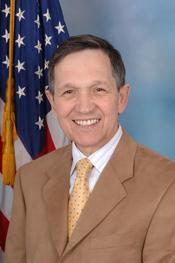
Mr. Speaker, I'm pleased now to recognize the gentleman from Ohio, who's been on this plan for--several Congresses ago he was and is the original co-founder and original signer with me to this bill. He's worked relentlessly in the Congress and across the country in making it clear that we're working on a system that some day is going to bring so much joy and benefit to the millions of Americans in this country. He's a fearless, dedicated, articulate leader, and I would now yield to my colleague, Dennis Kucinich.
Mr. Speaker, may I say to my colleague that I am so flattered that he remembers the days when we started out with just a few Members. We're up somewhere about 90 now and growing every week, every month. More and more people are joining us. And in addition, there are growing numbers of medical professionals, doctors, researchers, health care experts, who are all recognizing how important what you have said is in terms of how we move out of the situation that we're in.
Your description of the pain and suffering of so many of our citizens because of the lack of health care leads to situations so horrible that they truly shock the conscious.
Thank you, Congressman Kucinich.
And as our numbers grow in the Congress, you know that the American people have already indicated in policy after policy that they want a universal health care plan. Many are willing to even pay more to get it, but they don't have to. And this is a labor of love which I am so proud that nearly 100 of our colleagues are now working with us.
And I yield again to the gentleman.
In addition, we are creating a system of preventive health care. We are creating a system in which people, when they initially get sick, can go to a doctor instead of being forced to go to emergency rooms where they get temporary treatment, and then they're back at home or on the streets again. We will make the country healthier. And national health care is an ambition that is very much related to national security. So I'm pleased that all of these things can occur with the consideration of House Resolution 676.
In the last 10 years, the cost of health care to businesses has increased 140 percent. We need an efficient universal health care system that protects American businesses from skyrocketing health care costs so that, as a Nation, we can remain competitive in the global marketplace.
The rising cost of health care in this country has played a significant role in the current economic climate, specifically with regard to the outsourcing of labor to foreign countries. Between 2000 and 2007, United States health premiums have risen 98 percent, while wages have only increased by 23 percent. The average family health insurance plan now costs more than the earnings of a full-time minimum wage worker.
Our fractured non-system of health care is crippling our economy. But don't take my word for it, just ask the United Automobile Workers and the AFL-CIO, or even the automobile makers themselves. Health care has become such a central issue for General Motors that Economists magazine only partly
in jest called the company a pension hedge fund wand health insurance business that happens to make cars.
Ford and General Motors pay nearly $1,500 in health care costs for each vehicle they produce, while BMW pays $450 in Germany, and Honda only $150 per vehicle in Japan.
A General Motors executive told former Senator Tom Daschle, a proponent of universal health care, that the high cost of health care is the single largest impediment to creating more jobs in the United States. An IBM executive, Senior Vice President for Human Resources Mr. J. Randall McDonald, recently predicted that 5 years from now this problem will have to be cured or the competitiveness of the United States will be drastically impacted.
Small business employees are one of the fastest growing segments of the uninsured and now comprise about one-fifth of the total uninsured population. Kansas Governor Kathleen Sebelius told the New York Times, ``Affordable coverage for small business owners and self-employed individuals is probably the biggest challenge that we have in Kansas and most states.''
Incredibly, one-fifth of working age Americans, both insured and uninsured, have medical debt that they are paying off over time. More than two-fifths of these people owe $2,000 or more. Medical bills are the leading cause of bankruptcy in the United States, accounting for half of the personal bankruptcies. If unpaid medical bills are the leading cause of bankruptcy in this country, then how can we in good conscience delay any longer in Congress to create a truly universal health care system?
High deductibles in private health insurance plans are another barrier to consistent care. Eleven million people with health insurance have per-person deductibles of $1,000 or more. One recent study found that 44 percent of adults with deductibles of $1,000 or more did not fill a prescription, declined to see a specialist, skipped a recommended test or treatment, or didn't see a doctor when they had a serious medical problem.
There are additional sums spent by hospitals and doctor's offices to deal with each insurance company's rules, regulations, and forms to fill out. After a number of our satellite industries take a cut, we're looking at up to 50 cents on the dollar being spent on administration, marketing and profits. All this is money we could be spending on health care.
Drug prices in this country are about 60 percent higher than prices in Canada or Britain, and this is not because Big Pharma is doing so much research and development. In fact, data from the pharmaceutical companies' own annual reports show that they spend almost three times as much working on marketing and administrative costs as they do on research and development.
It is not because American companies are carrying the burden of doing research and development for the rest of the world. Drug companies in the European Union put out about the same number of new products each year that American companies do. And our drug industry's research and development gets huge taxpayer subsidies from government-supported research done by the National Institutes of Health and American universities. In fact, only a very small percentage of the new drugs produced in America are in fact innovative developments. Most are varieties of old drugs developed simply to extend patent protections so that they can keep on charging those high, excessive prices.
The reason drugs cost more in America than anywhere else boils down to a single factor: Profit. The drug companies have the highest profit margins of all American corporations. Their profits as a percent of sales run about 19 percent, compared to a median of about 5 percent for Fortune 500 companies.
Mr. Speaker, the American people are concerned about the direction in which our economy is heading. As we spiral headlong toward a recession, if we're not already in one, both large corporations and small businesses have to make difficult decisions to keep their business afloat. For most Americans, the loss of employment means the loss of health insurance.
The bottom line: If we can streamline the operations of the health care system by decreasing wasteful overhead and appropriately allocating funds, we can not only ensure the coverage of everybody in the United States, but we can provide for true health care. And that is an important point; coverage does not equal care.
My plan, H.R. 676, is simple. And its simplicity is the very thing that will allow it to succeed where others will fail. Many of the plans generally add an individual mandate and even more insurance options. Others suggest financial mechanisms like tax credits or savings accounts. These other plans will not guarantee coverage that is universal, affordable or comprehensive. They fail to do anything to decrease administrative costs or complexity, in fact, they add to it. They can't control costs, and so ultimately they will be unsustainable.
Now, I began from the premise that health care is a basic human right, not a privilege, a basic human right. This is the consensus opinion of the international community, as enshrined in the Universal Declaration of Human Rights and other documents.
I also believe that government has a fundamental role to play in guaranteeing this right to each and all of its citizens. This is the view of the other industrialized nations, all of which have single payer health care systems that cover all their people, cost far less than ours and, sadly, get more and better results in terms of health outcomes.
I believe that health care must not be a market commodity. The market dictates that one's ability to consume a particular product is constrained by one's ability to pay for it. This approach may be feasible when one is talking about buying hamburgers or tennis shoes, but it is unacceptable when it comes to health care. Our access to health services should be determined by only one thing, what our doctor thinks we need. Profit should not be a factor.
Let me clarify: I do not advocate socialized or government-run health care, such as the National Health Service in Great Britain. I propose a plan that is publicly financed, but privately delivered, like those in Germany or France or Taiwan.
The role of the government in the H.R. 676 proposal is limited to collecting revenues and disbursing payments to providers. Doctors, hospitals and clinics will continue to be run privately. I believe they will be required to operate as not-for-profit organizations.
In a single payer system, we could do just that. We will do just that. Revenues would flow into the system through an automatic payroll tax, very little paperwork required. Doctors would bill the government electronically and they would be reimbursed electronically, cutting out the middle man, and the savings would be tremendous.
Studies by the Congressional Budget Office, the Government Accountability Office and consultancies such as the Lewin Group consistently find that the savings under a single payer plan would be more than enough to cover all of the uninsured. So, in fact, it's possible to cover all Americans under a comprehensive health plan without spending any more money than we do now. We would just be more efficient with it.
The two other major drivers of health inflation are the increasing use of expensive prescription drugs and the proliferation of new and expensive medical technologies. A single payer system would address both these costs.
By leveraging the buying power of the Federal Government, we can negotiate huge discounts both for drugs and for other major drivers of health inflation such as medical technology. We can bring down the cost of medical technology by allocating it more efficiently. As it is, we have no organizing structure to manage the distribution of health care resources. The result is that we have a glut of medical imaging machines, specialists, and other medical services which are seen as generating the most potential profit for their owners; hospital A has one MRI machine, hospital B then feels it must have two MRI machines, and so on. To end up with MRI machines all over town standing vacant while we continue to spend enormous sums on acquiring more is unwise and impractical and should be ended.
Under a single payer system, we can distribute resources more efficiently so
that we are buying MRI machines based on the need for them, not based on how much profit they can generate for a particular hospital.
A regional board could determine, with the input of doctors and other providers, what number of machines would be appropriate for the population based on demographics and other factors.
Allow an explanation of how a single-payer system under H.R. 676 would work. Existing public health care spending, including government spending for Medicare and Medicaid, would continue, but it would flow into a single trust fund. We would add a payroll tax of about 3.3 percent each to workers and employers. In addition to the 1.45 percent Medicare tax, the total health care tax would be 4.75 percent. This is cheaper than what the private health insurance companies charge; so families and businesses will be spending less than what they are spending now if they have insurance.
We also get revenue from other sources like one quarter of 1 percent tax on certain stock and bond transactions. All these revenue sources add up to more than enough to cover current spending. But just in case there are additional expenses in a particular year, we also authorize an annual appropriation.
Revenue flows from the Federal trust fund into the accounts of the currently existing Medicare regions. Reimbursement is then negotiated with doctors and other providers at the regional level, with current levels being the starting point. Doctors are paid on a fee-for-service basis, while hospitals and other large institutions are paid with monthly lump sums known as global budgets based on current expenditures. Global budgets are cost-control mechanisms that are very effective in other single-payer systems.
Every American would receive a national health insurance card at birth or would be able to apply for one at the post office or other government facility. The application form is limited to 2 pages. Everyone living in the United States would be eligible. All medical necessary services would be covered, including inpatient and outpatient care, mental health care, dental care, and prescription drugs. Patients can go to the doctor or health care provider of their choice.
Private insurance companies are prohibited from duplicating the coverage provided under the plan. They may still offer coverage for nonmedically necessary services, such as cosmetic surgery. They are not prohibited from being hired by the government to do billing services, but overhead costs would be strictly regulated.
This plan relies on the existing Medicare infrastructure for administration. There is no ``new government bureaucracy.'' In fact, there will be far less bureaucracy in health care after the role of the insurance companies has been limited.
Just to let you know, there are nationally recognized health economists and physicians who believe that if we spent more efficiently the money we are already currently spending on health care, then we would cover every American with quality and affordable health insurance right now through a privately delivered, public financed, single-payer system.
Mr. Speaker, I thank you for your cooperation.