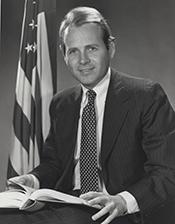
Mr. Speaker, I'd like to pay tribute to a great American, my friend and my personal mentor, Jack Kemp. As a 23-year-old kid, Jack Kemp took a chance on me and had me come and serve as his personal…
Mr. Speaker, I'd like to pay tribute to a great American, my friend and my personal mentor, Jack Kemp.
As a 23-year-old kid, Jack Kemp took a chance on me and had me come and serve as his personal economic policy analyst in a new thing he was starting called Empower America. As his aid and his speechwriter, I learned not only how he articulated his vision, but, more importantly, the philosophical underpinnings of this vision and the universal power of Jack Kemp's vision.
You see, Jack is the reason I ran for Congress. He saw something in me that I didn't even know was in me. He taught me how to approach people with that sort of infectious optimism that I strive for, and he reminds us that there is nothing more than uplifting the idea of America that we champion. I would consider myself blessed to have a mere thimbleful of his abilities and vision.
Jack Kemp had a transforming impact on the economic landscape of America. And, as true as that is, his impact on our Nation's political landscape may be even greater, though not in a partisan or a very narrow political sense. I mean in the way that America understands itself, in the way that we understood the great purpose of our system of self-government.
Jack Kemp was a self-taught man. He read the economic classics, beginning with Adam Smith's Wealth of Nations. He also read and studied the Declaration of Independence. Both, as it happens, were published in 1776, year 1 of our country's independence.
He mastered and spelled out for us the great insight that economic freedom and political freedom are intertwined in integrated parts of the order of human freedom. He reminded us that families, faith, and education, not government, are the true sources of the qualities of character without which there can be neither economic nor political freedom.
Jack wasn't interested in the details and the fine print or even the micromanaging policies that he promoted, nor were his policies merely short-term tinkering. Whether he was advancing his 30 percent across- the-board income tax or his enterprise zones, he was never looking for just ways to add up points to gross domestic product.
What he promoted was America itself, the American idea, which, in the 1970s, had fallen on hard times. The American idea needed an American renaissance, and he was just the man to inspire that rebirth.
Two great leaders that Jack always talked about were Thomas Jefferson and Abraham Lincoln. He was a fine student of those two men.
I simply want to close by saying that the life of Jack Kemp is a life where they broke the mold. Ronald Reagan motivated me; Jack Kemp inspired me.
May God bless Jack Kemp and the memory and the works of this fine man, and may He bless his family.
I'd like to pay tribute a great American--my friend and my personal mentor--Jack Kemp. As a 23-year-old kid, Jack took a chance on me, asking me to serve as his staff economic analyst at a new think tank, Empower America. As his aide and speechwriter, I learned not only how he articulated his vision, but more fundamentally the philosophical underpinnings and universal power of this vision.
Jack is the reason I ran for Congress. I was motivated by Ronald Reagan, but inspired by Jack Kemp. He saw something in me that I didn't even know existed. He taught me how to approach people with an infectious optimism, and reminds us all that there is nothing more uplifting than the idea of America. I would consider myself blessed to have a mere thimble full of his abilities and vision.
Jack Kemp had a transforming impact on the economic landscape of America. True as that is, his impact on our nation's political landscape may be greater, though not in a partisan or narrowly political sense. I mean in the way America understands itself and in the way we understand the great purposes of our system of self- government.
Kemp taught himself by reading the economic classics beginning with Adam Smith's Wealth of Nations, but he also read and studied the Declaration of Independence, both as it happens, were, published in 1776, year one of America's independence. Kemp mastered . . . and spelled out for us . . . the great insight that economic freedom and political freedom are intertwined and integrated parts of the order of human freedom. He reminded us that families, faith, and education--not government--are the true sources of the qualities of character without which there can be neither economic nor political freedom.
Jack was not that interested in details and fine print, even of the policies he promoted. Nor were his proposals mere short-term tinkering. Whether he was advancing his 30 percent across the board income tax strategy, or his enterprise zones, or lowering regulatory barriers to growth and homeownership, he was never just looking for ways to add a point or two to the GDP. What Jack promoted was America itself . . . the ``American idea'' which in the 1970s had fallen on hard times. The ``American idea'' needed an ``American Renaissance'' and he was just the man to inspire that rebirth.
The driving passion of Jack's life was to bring every person to full participation in a society of opportunity and freedom, especially the poor and minorities who could not quite reach up to the first rung on that opportunity ladder. You might say that Jack's greatest indignation was reserved for programs and policies, intended or not, that cut away the bottom rungs on the ladder and left the poor in despair of improving their lives.
Jack's way to the boundless opportunities of the future led him through the past, to the American Revolution and the Civil War. The American statesmen who inspired him most were Thomas Jefferson and Abraham Lincoln.
He loved Mr. Jefferson particularly for the immortal words he carved into the Declaration of Independence--that by the Laws of Nature and of Nature's God, all men are created equal in their inalienable rights to life, liberty, and pursuit of happiness. ``All men'' meant all human beings, Jack used to say, not just males or whites or Anglo-Saxons or people from some specific background. The American idea, in other words, is freedom for all human beings everywhere in the world for all time to come.
The more Kemp studied Lincoln's statecraft, the more he embraced Lincoln's vision. The Great Emancipator's titanic struggle against the abomination of race-based slavery, of course, was tethered to the golden words of Jefferson's Declaration. ``All honor to Jefferson,'' wrote Lincoln, ``to the man who, in the concrete pressure of a struggle for national independence by a single people, had the coolness, forecast, and capacity to introduce into a merely revolutionary document, an abstract truth, applicable to all men and all times, and so embalm it there, that to-day, and in all coming days, it shall be a rebuke and a stumbling-block to the very harbingers of re-appearing tyranny and oppression.''
Lincoln's statecraft was intended to open the doors to citizenship, voting rights, work and ownership opportunities to the enslaved blacks just as much as anyone else. Kemp saw that Lincoln's struggle against black slavery was part and parcel of Lincoln's project to extend the benefits of self-government and free markets to all.
Jack could quote passage after passage from Lincoln's speeches and writings to illustrate that the opposite of slavery--where one
person owns another person--is freedom and equal opportunity--where every human being has the right to own and acquire property. One of the most succinct Lincoln quotes that epitomized Kemp's perspective was from a speech Lincoln gave on his way to the White House:
I don't believe in a law to prevent a man from getting rich
[Lincoln said]; it would do more harm than good. So while we
do not propose any war upon capital, we do wish to allow the
humblest man an equal chance to get rich with everybody else.
When one starts poor, as most do in the race of life, free
society is such that he knows he can better his condition; he
knows that there is no fixed condition of labor . . . I want
every man to have the chance . . . and I believe a black man
is entitled to it--in which he can better his condition, [and
look forward with hope].
Kemp and Lincoln had the same principal concern: to open up a path for those at the bottom to rise as high as their abilities and imagination could take them. Jack never lost a night's sleep worrying about taxing the rich too much. He lost sleep over programs that foreclose opportunity by weakening incentives for the poor to become rich.
With due respect, no statesman of the last generation has made the spirit of Lincoln so much his own as Jack Kemp. Rare was the Kemp speech or essay that did not sooner or later recur to Lincoln for insights on democracy, whether in domestic or foreign policy.
In his effort to grow in his understanding of Lincoln, Jack met and corresponded with the best Lincoln scholars in America; occasionally he challenged them. He was pleased by the invitations to join Lincoln historical associations and was professionally recognized for his knowledge and interest. So vital was Lincoln's vision of equality and opportunity that Jack would debate and respond to those who saw Lincoln as a proponent of ever growing federal programs--for example, former New York Governor Mario Cuomo who co-edited a book of Lincoln speeches. Even so, Kemp had a good word for anyone, left or right, who recognized Lincoln's greatness, importance to the meaning of America, and relevance for the economic and political issues of our time. It was altogether fitting and proper that Jack's last syndicated column published in February was titled ``Honoring Lincoln,'' in celebrating the bicentennial of the birth of our greatest President.
It is true that Jack was a fighter for his vision of the American idea, but Lincoln deepened Jack's natural inclination to rise above party to the love of country. Last November, across the political divide, Kemp wrote a touching letter to his 17 grandchildren rejoicing in the transformation of America that allowed an African-American to win the Presidency. But that wasn't all. Jack noted that Barack Obama, like himself, often referred to his Illinois predecessor, Abraham Lincoln. It was quintessential Kemp to praise Obama generously even as he reiterated his personal vision of America:
When President-elect Obama quoted Abraham Lincoln on the
night of his election [Kemp wrote], he was acknowledging the
transcendent qualities of vision and leadership that are
always present, but often overlooked and neglected by
pettiness, partisanship and petulance. . . . President-elect
Obama's honoring of Lincoln in many of his speeches reminds
us of how vital it is to elevate these ideas and ideals to
our nation's consciousness and inculcate his principles at a
time of such great challenges and even greater opportunities.
Kemp himself contested for the Presidency and like a number of other excellent statesmen in the past who were driven by ideas, he did not reach that goal. But I believe with all my heart that through his ideas and his passion, his unconventional thinking and dedication to the principles of equality, freedom, and opportunity, Kemp made us a better people and our country a nobler place.