Bill Summary vs Full Text: Which Should You Read?
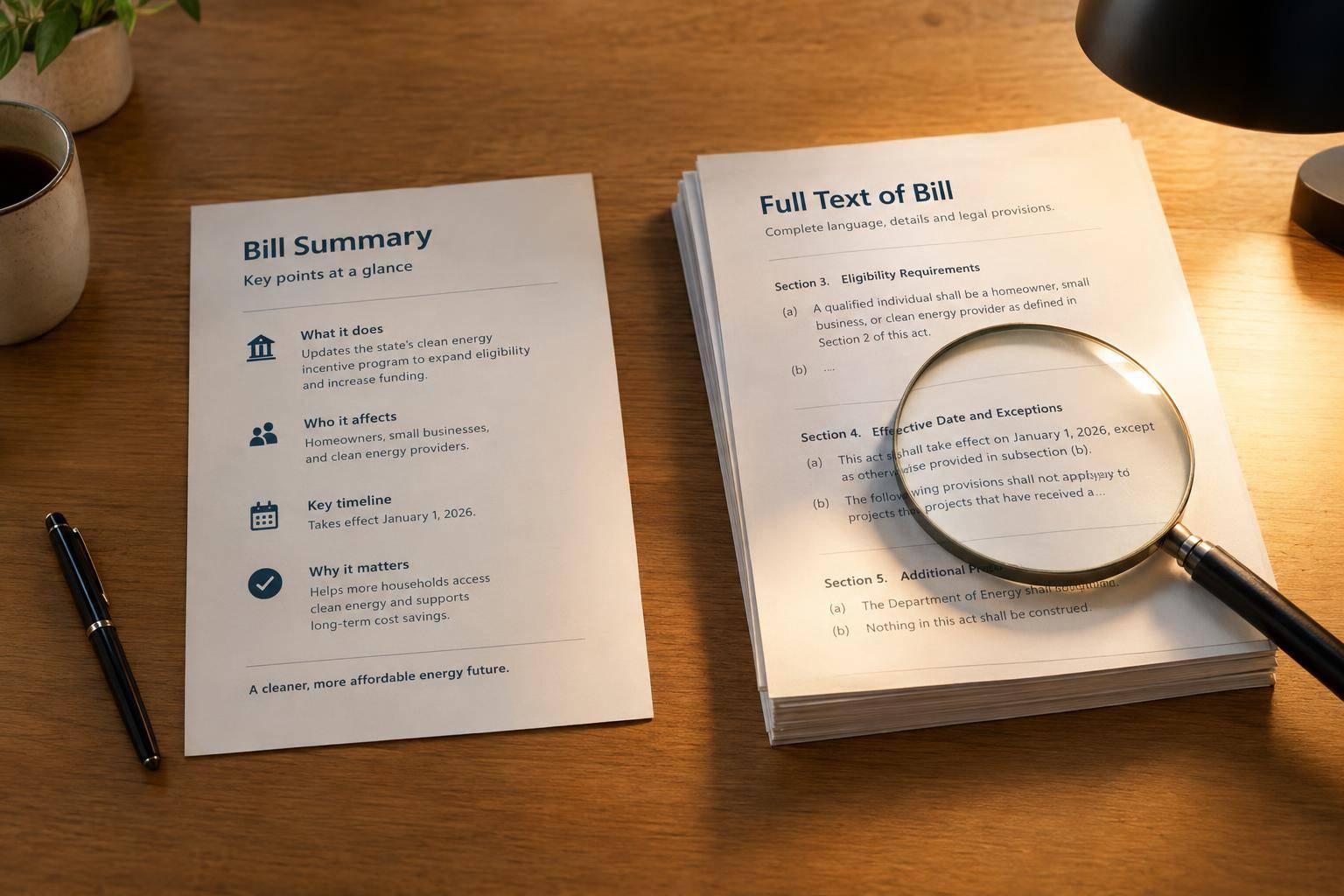
I start with a bill summary for the main idea - and check the full text before relying on a rule, deadline, or dollar amount. A proposed $10,000 tax credit, for example, may apply only to certain businesses and tax years.
Here’s how I choose what to read:
- Summary: For the bill’s purpose, main provisions, and a first check of whether it affects you.
- Full text: For exact wording, eligibility, exceptions, funding terms, and effective dates.
- Both: For reporting, policy research, or business decisions.
Quick Comparison
| What I check | Bill summary | Full text |
|---|---|---|
| Purpose | Explains goals and main provisions | States proposed legal changes |
| Exceptions and dates | May leave out details | Provides exact terms |
| Version | May lag behind new text | Shows one specific version |
| Best use | General awareness | Checking precise claims and rules |
Before relying on either, I match the bill version and check its status. A bill is not law until enacted. I use AI summaries to find provisions - not to verify legal duties - and seek qualified advice for high-stakes decisions.
Bill Summary vs Full Text: Key Differences
A bill summary and the full text serve different purposes. The key is knowing what each gives you - and what it leaves out.
| Criterion | Bill summary | Full text |
|---|---|---|
| Purpose | Explains policy goals and main provisions | States the exact proposed legal changes |
| Exceptions and dates | May shorten qualifications and timing rules | Specifies exemptions, deadlines, phase-ins, and effective dates |
| Version match | Describes a particular version; updates may lag | Contains the exact wording of a particular legislative version |
| Best for | General awareness and screening for relevance | Verifying eligibility, funding, obligations, and legal changes |
Choose the format based on your question, not the page count. A short bill with cross-references can take longer to read than a longer, well-organized one. What you need to verify determines whether a summary is enough or you need the full text.
Summaries Explain Purpose and Main Provisions
Summaries work best for a first-pass review, not final verification. They may leave out eligibility edge cases, exceptions, and timing details. CRS summaries offer a neutral starting point for research because CRS prepares nonpartisan summaries of congressional measures.
A summary might describe a benefit without listing every eligibility condition. It might mention funding but leave out spending restrictions. Updates may also lag behind newly published text. Use the summary to find relevant provisions, not as proof that a particular condition applies.
Full Text Gives the Exact Proposed Changes
For questions about legal effect, the full text is the source of record. It spells out definitions, eligibility rules, exemptions, enforcement powers, penalties, funding limits, and implementation dates.
Funding language deserves close attention: authorization and appropriation are not the same. Read the relevant provision to check whether it authorizes funding, appropriates funds, or limits how the money may be spent.
Strike-and-insert instructions can change existing law without repeating the full rule. Read the referenced statute and surrounding provisions to see what changes - and what stays the same.
When to Use a Summary, Full Text, or Both
Use the comparison above to decide how much of a bill you need to read.
| Your goal | What to read | What to verify |
|---|---|---|
| General awareness | Summary first | Purpose and major provisions |
| Policy analysis | Summary and full text | How the proposal works in practice |
| Personal or organizational impact | Full text, usually after the summary | Who qualifies, required actions, exceptions, and dates |
| Reporting or briefings | Summary for context; relevant text for precise claims | Exact wording and the correct bill version |
Start With a Summary for Initial Research
Start with summaries to screen bills, compare approaches, and draft initial briefings. Then check the sponsor, committees, actions, and current status in the bill record.
Before publishing deadlines or requirements, verify them in the matching bill text. If the bill still looks relevant, read the full text.
Check Full Text for Requirements and Exceptions
When checking eligibility, mandates, penalties, reporting duties, funding terms, or effective dates, search the full text. Read the surrounding subsection and definitions, too.
Hypothetical example: A summary describes an annual workplace reporting requirement. The text exempts employers with fewer than 50 employees. An owner with 32 employees would shift from planning for that reporting duty to checking whether the bill’s employee-count definition confirms the exemption. Separate recordkeeping duties could still apply.
If a provision changes the outcome, check how it applies to the facts that matter to you.
Use Both to Assess Policy or Business Impact
Hypothetical example: A summary highlights a $10,000 business tax credit. The text limits it to qualified rural manufacturers and taxable years beginning after January 1, 2028. A business outside that defined category would not qualify; an eligible business would still need to check its tax-year start date and qualifying expenses before counting on the benefit.
Use the summary to frame the issue. Then connect each business conclusion to a specific provision: who it covers, what action it requires, when it starts, and any penalties or consequences.
How to Verify Bill Versions and Provisions
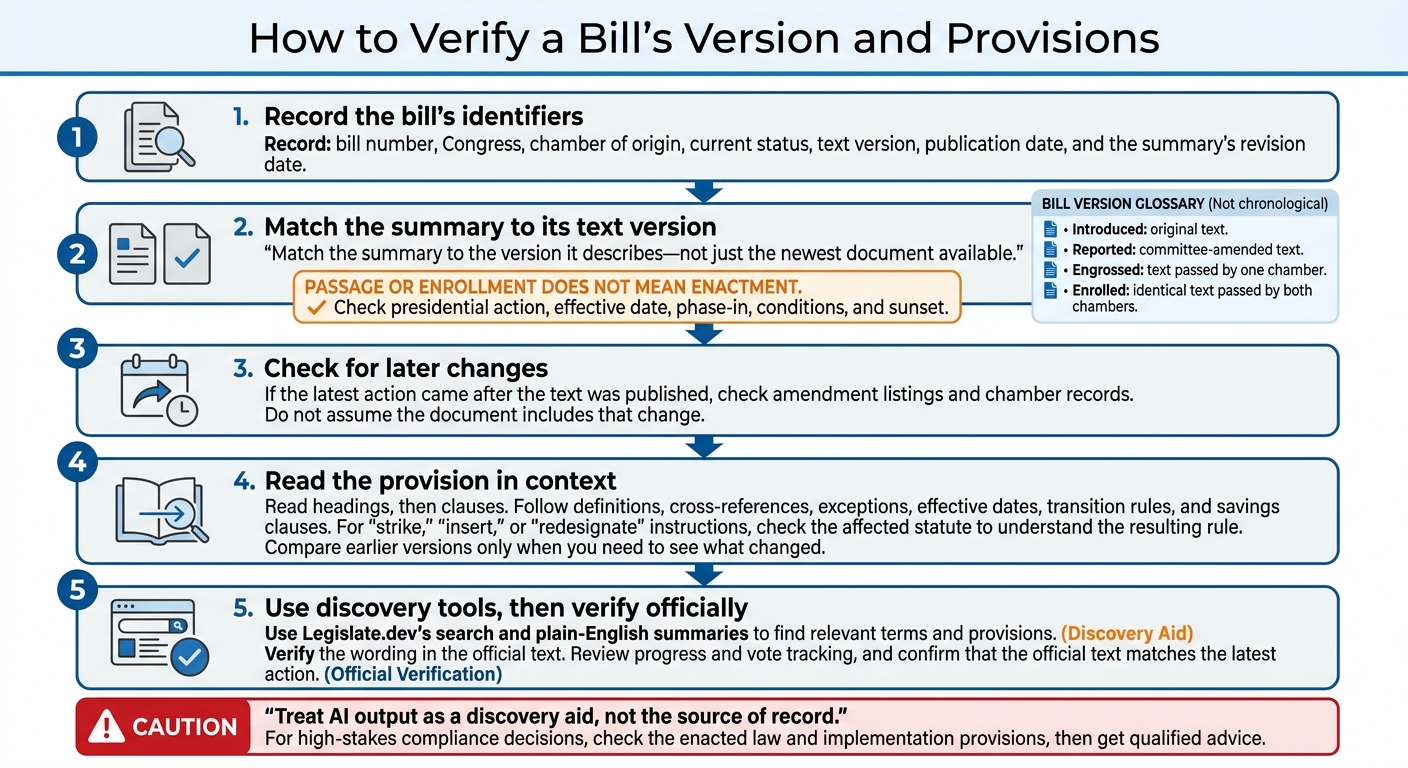
How to Verify a Bill’s Version and Provisions
When a summary suggests a bill matters to you, check that you’re reading the right version before relying on any provision.
Check the Summary’s Version and the Bill’s Status
Record the bill number, Congress, chamber of origin, current status, text version, publication date, and the summary’s revision date. Match the summary to the version it describes - not just the newest document available.
Each version marks a different step: introduced is the original text, reported is the committee-amended text, engrossed is the text passed by one chamber, and enrolled is the identical text passed by both chambers. Passage or enrollment does not mean enactment. Check presidential action, along with the law’s effective date, phase-in, conditions, or sunset.
If the latest action came after the text was published, check amendment listings and chamber records. Don’t assume the document includes that change.
Read Each Provision in Context
Once you’ve confirmed the version, read the headings, then the clauses. Follow definitions, cross-references, exceptions, effective dates, transition rules, and savings clauses. Instructions such as “strike,” “insert,” or “redesignate” mean you’ll need to check the affected statute to understand the resulting rule. Compare earlier versions only when you need to see what changed.
Use Legislate.dev to Find Details to Verify
Use Legislate.dev’s search and plain-English summaries to find relevant terms and provisions. Then check the wording in the official text. Review progress and vote tracking, and confirm that the official text matches the latest action.
Treat AI output as a discovery aid, not the source of record. For high-stakes compliance decisions, check the enacted law and implementation provisions, then get qualified advice.
Conclusion: Start With a Summary, Verify the Details
How closely you review a bill depends on the decision you need to make:
- For general awareness, read the summary. It explains the bill’s purpose, major provisions, and relevance.
- Before relying on details, check the version and date. Make sure the summary matches the bill you’re reviewing.
- For exact answers, read the full text. Verify definitions, eligibility, requirements, exceptions, deadlines, and changes to existing law.
- For impact analysis, use both. Start with the summary to map affected parties, required actions, costs, and effective dates. Check those details against the full text.
For high-stakes decisions, confirm that the bill became law and check which provisions are currently in effect. If the consequences are material, seek qualified legal, tax, or compliance advice.
FAQs
What should I do if a summary conflicts with the bill text?
Use the full legislative text as your final reference. It’s the authoritative primary source. Summaries are meant for quick scanning and general awareness.
To check definitions, exceptions, effective dates, or changes to existing law, read the official bill text or documents from the Government Publishing Office. The legislative record links to these official sources for final verification.
How can I tell whether an amendment affects me?
Start with the bill summary to see which policy areas and groups it affects, such as veterans, businesses, or federal agencies. If the bill touches your interests, read the full text for definitions, effective dates, and exceptions.
Amendments often change existing laws, such as the Internal Revenue Code. The full text spells out how those changes affect requirements or benefits you currently rely on.
How do I check whether an enacted provision is in effect?
Read the full legislative text, not just a summary. Check for effective dates or timelines tied to enactment, including any stated number of days, months, or years before a provision takes effect.
For the most authoritative check, compare the bill text with the official public law PDFs or the Statutes at Large in GovInfo, the official archive for federal documents.