How to Read and Understand Legislation Quickly
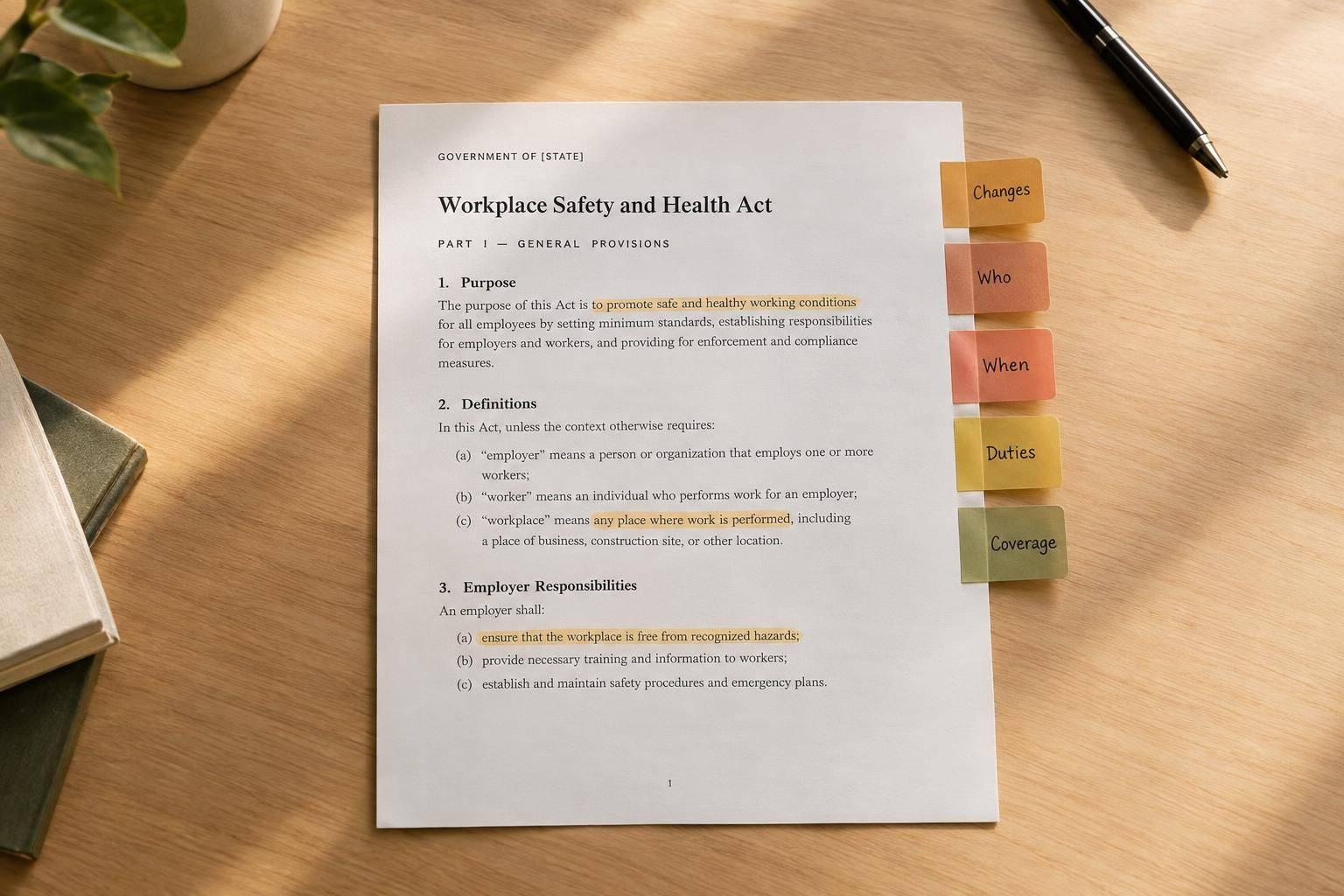
I read legislation by answering 3 questions first: What changes, who is affected, and when does it apply? Before drawing conclusions, I check the bill’s status and exact text on Congress.gov. A proposal is not law.
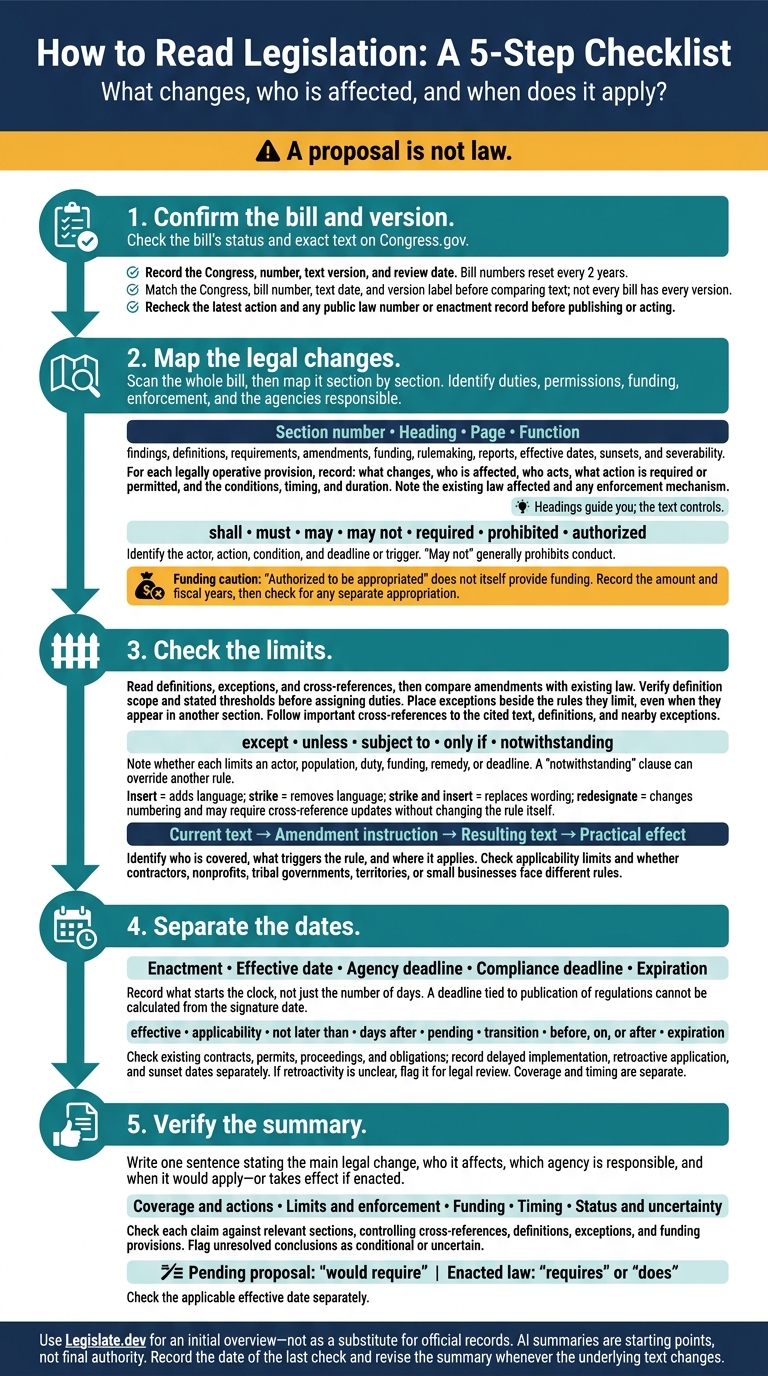
Here’s my reading checklist:
- Confirm the bill and version. Bill numbers reset every 2 years, so I record the Congress, number, text version, and review date.
- Map the legal changes. I identify duties, permissions, funding, enforcement, and the agencies responsible.
- Check the limits. I read definitions, exceptions, and cross-references, then compare amendments with existing law.
- Separate the dates. I distinguish enactment from effective dates, agency deadlines, compliance deadlines, and expiration.
- Verify the summary. I cite the relevant sections, flag uncertainty, and use “would require” for pending proposals.
I use tools such as Legislate.dev for an initial overview - not as a substitute for official records. My goal is to explain what the text does, rather than what its title promises.
How to Read Legislation: A 5-Step Checklist
Reading the Bill and the Bill Report
2. Scan the Bill for Requirements
Scan the whole bill before reading individual provisions closely. Focus on changes to rights, duties, eligibility, funding, and enforcement. Flag definitions, exceptions, and timing rules that limit those changes.
Then map the bill section by section before digging into the details.
Map the Sections in a Worksheet
Record each section’s number, heading, page, and function: findings, definitions, requirements, amendments, funding, rulemaking, reports, effective dates, sunsets, and severability. Use the worksheet to separate changes to the law from the bill’s structure. Headings guide you; the text controls. Check closing provisions for rules about when provisions expire and what remains in effect afterward.
For each provision that has legal effect, record what changes, who is affected, who acts, what action is required or permitted, and the conditions, timing, and duration. Note the existing law affected and any enforcement mechanism. Flag unresolved definitions and cross-references for later checking. Place exceptions beside the rules they limit, even when they appear in another section.
Once you’ve mapped the structure, mark the words that create legal effect.
Mark Duties, Permissions, and Exceptions
Flag “shall,” “must,” “may,” “may not,” “required,” “prohibited,” and “authorized.” Classify each as a duty, permission, prohibition, funding authority, or reporting duty. For each, identify the actor, action, condition, and deadline or trigger. “May not” generally prohibits conduct; “authorized to be appropriated” does not itself provide funding. Record the amount and fiscal years, then check for any separate appropriation.
Flag “except,” “unless,” “subject to,” “only if,” and “notwithstanding,” and note whether each limits an actor, population, duty, funding, remedy, or deadline. A funding condition can narrow a mandate; a “notwithstanding” clause can override another rule. Mark the controlling cross-reference for close review rather than summarizing the requirement without its limits.
3. Read Definitions and Changes to Existing Law
Check Definitions and Cross-References
Once you’ve mapped duties and exceptions, check the definitions to see who the rules cover. Search for For purposes of, In this Act, and Definitions. Record whether each term applies across the bill or only within a title, section, or subsection. If the bill adds a definition to an existing statute, check its scope within that statute - not just where it appears in the bill.
Definitions determine who falls under a rule. Verify any stated threshold before assigning duties.
Before restating a rule, follow each important cross-reference. Read the cited provision, its definitions, and nearby exceptions. For 5 U.S.C. § 553, that means checking the rulemaking procedures and exceptions - not simply calling it public comment. Also check whether the reference points to current law or a specified version. Compare the amendment instructions with the current statute, rather than relying on the bill text alone.
Compare Proposed Changes With Existing Law
Open the underlying statute and apply the amendment instructions to its current text. Insert adds language; strike removes it; strike and insert replaces wording. Redesignate changes numbering and may require cross-reference updates without changing the rule itself. Read the resulting provision alongside the surrounding text. If the cited Code section is not positive law, check the underlying statute named in the bill.
| Legal function | Typical wording | Affected parties and practical check |
|---|---|---|
| Direct requirement | A covered employer shall… |
Named businesses, individuals, or agencies; identify the duty. |
| Statutory amendment | Section X is amended by striking… |
Parties governed by the statute; reconstruct the resulting rule. |
| Authorization | There is authorized to be appropriated… |
Agencies, programs, and eligible recipients; authorization alone supplies no appropriation or budget authority. |
| Report or study | The Secretary shall submit a report… |
Named official and recipients; separate the reporting duty from the policy being studied. |
Record the current text, amendment instruction, resulting text, and practical effect in your worksheet. Treat the resulting rule as proposed until you confirm enactment and the amendment’s effective date.
4. Check Coverage, Dates, and Versions
Once you’ve identified the rule and its language, check who it covers and when it applies.
For each requirement, record who it covers, what triggers it, and where it applies. Read applicability clauses for limits tied to federal funding, employee counts, or jurisdiction. Check whether contractors, nonprofits, tribal governments, territories, and small businesses face different rules. Coverage and timing are separate: an entity may fall under a rule, but only for transactions after a specified date.
Separate Effective Dates From Deadlines
Search for effective, applicability, not later than, and days after. Check clauses that apply to the whole bill as well as those in individual sections. In your worksheet, keep enactment, effective date, agency deadline, and compliance deadline separate. Record what starts the clock - not just the number of days. You can’t calculate a deadline tied to publication of regulations from the signature date.
Also search for pending, transition, before, on, or after, and expiration. Check whether existing contracts, permits, proceedings, or obligations stay under earlier rules. Record delayed implementation, retroactive application, and sunset dates separately. If retroactivity is unclear, flag it for legal review rather than assuming the rule covers earlier conduct.
Compare Bill Versions
On Congress.gov, match the Congress, bill number, text date, and version label before comparing language. Not every bill has every version.
Version labels help you track text changes. They don’t establish final legal effect.
| Text version | What it means | What to check |
|---|---|---|
| Introduced - IH/IS | Text formally introduced in the House or Senate. | Original coverage, requirements, funding, and dates. |
| Reported - RH/RS | Committee-reported text, reflecting committee amendments when applicable. | Changes from introduction and the accompanying committee report. |
| Engrossed - EH/ES | Bill text passed by one chamber, including adopted amendments. | What that chamber approved; it may differ from the other chamber’s text. |
| Public print - PP | A separately printed version used during consideration. | Which revisions it includes; don’t assume it is final. |
| Enrolled - ENR | Identical text agreed to by both chambers and prepared for presentation to the President. | Enactment and public law number. |
Compare sections, definitions, covered entities, deadlines, funding, and enforcement - not just headings. For separately published amendments, verify the sponsor, chamber, number, and adoption status. Then apply the changes to the correct underlying text. Before publishing or acting, recheck the latest action and any public law number or enactment record. Record your retrieval date, and use “would require” for pending proposals.
5. Summarize the Bill and Verify Your Findings
Once you’ve checked the dates and versions, turn your notes into a clear summary. Check every claim against the text that governs, controlling cross-references, and any definitions, exceptions, or funding provisions that limit its reach.
Write a One-Sentence Summary and Key Points
Start with one sentence stating the main legal change, who it affects, which agency is responsible, and when it would apply - or takes effect if enacted. Keep current law separate from proposed changes. Use “would” for unenacted proposals; reserve “requires” or “does” for enacted law. Explain what the bill requires or permits, not just what it aims to achieve.
Then add brief key points:
- Coverage and actions: Who is covered, what they must or may do, and which agency administers the law.
- Limits and enforcement: Exceptions, waivers, penalties, and enforcement powers.
- Funding: What is authorized versus what is appropriated.
- Timing: Effective dates, implementation and compliance deadlines, and expiration.
- Status and uncertainty: The version reviewed, its current status, and any reliance on future rules, funding, or action.
Link each point to the section that creates the duty, right, prohibition, funding authority, or amendment. Mark unresolved conclusions conditional or uncertain instead of filling gaps with assumptions. Authorization alone doesn’t guarantee that money will be available.
Use Legislate.dev to Support Your Review
Use Legislate.dev to get your bearings, then check each answer against the official text and status record. Ask focused questions about implementing agencies or the sections that change existing law. Track developments through progress updates and sponsor information, but base your conclusions on the official text.
AI summaries are starting points, not final authority. Record the date of your last check, and revise your summary whenever the underlying text changes.
FAQs
Which sections should I prioritize in a long bill?
Start with the bill’s purpose, status, and version. Then review its definitions, specific requirements, exceptions, effective dates, and amendments to existing law.
To separate changes to the law from standard legal wording, identify what the bill would change, whom it would affect, and when its provisions would apply. These details help you summarize the bill and understand how it would affect current law.
How do I handle conflicting provisions in a bill?
Look for wording that says one provision takes precedence over another or applies “notwithstanding any other law.” Also check whether amendments delete or replace existing statutory text to resolve inconsistencies.
Verify the bill’s official status and version on Congress.gov so you’re reading the latest language. Later amendments or technical corrections often resolve internal conflicts before the bill becomes law.
What if a bill leaves key details to future regulations?
The bill sets broad authority or policy direction. A federal agency then develops and finalizes the rules for carrying it out, including technical standards or procedures for day-to-day work.
To understand the bill’s full impact, look for language that requires agency rulemaking, reporting, or oversight. These sections spell out the scope and timeline of future regulatory requirements.