How Congress Members Vote: Patterns and Insights
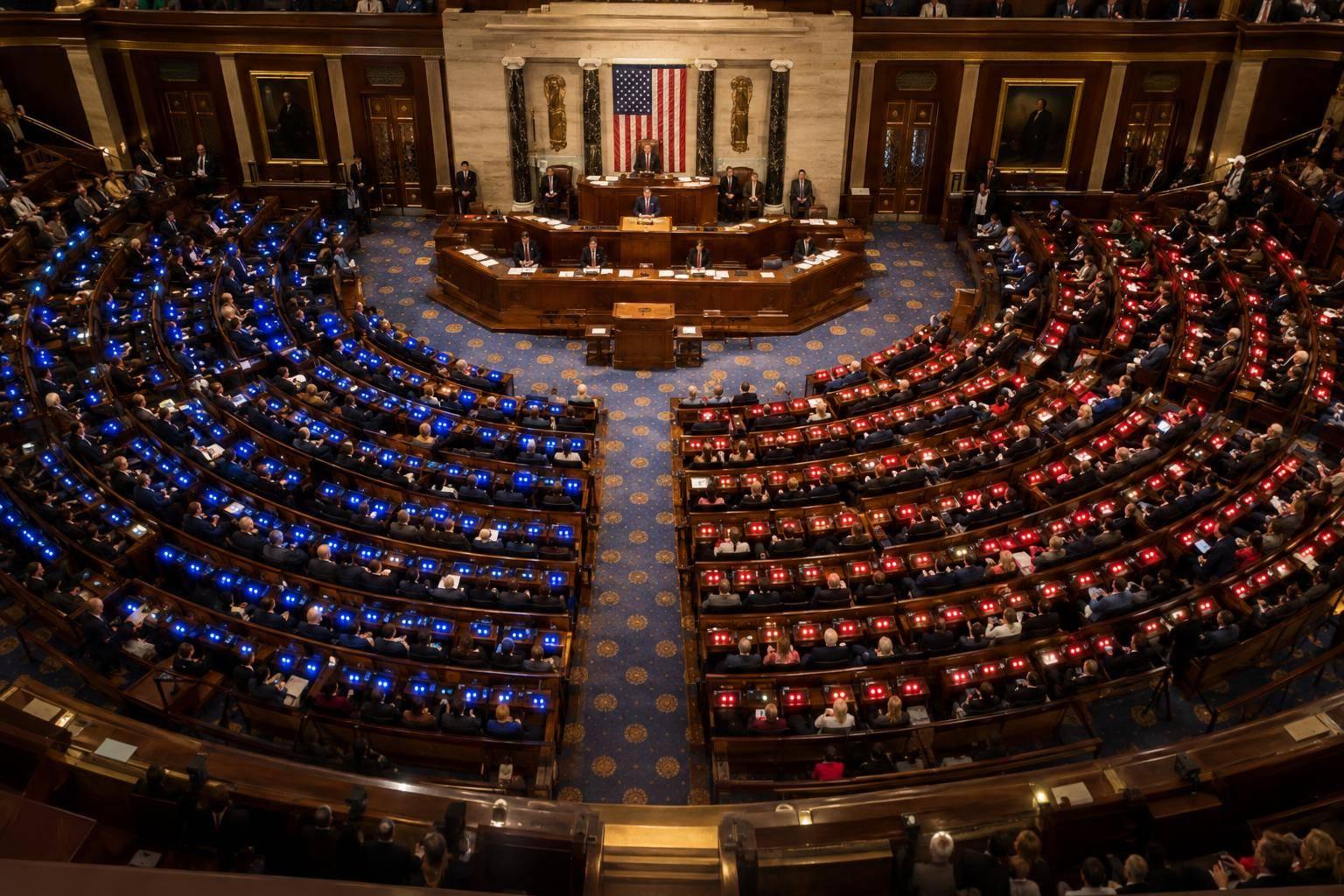
Party loyalty shapes congressional voting - but it doesn’t tell the whole story. Across 1,579 roll-call votes, the dataset reports a 74% party-line vote rate for the 119th Congress through October 3, 2026. My starting rule: check what the vote actually decided before judging a lawmaker’s record.
I compare House and Senate votes through three questions:
- Party unity: Did members follow their party, and did that side win? In the Senate, most legislative cloture votes need 60 votes; nomination cloture needs a simple majority.
- Bipartisan support: Did both parties support passage, an amendment, or a procedural step? Ending debate isn’t the same as approving a bill.
- Party departures: Who voted against their party, how often, and on which issues? The examples span spending, national security, defense, sanctions, judicial nominations, and cloture.
I also separate voting records from cosponsorship. Neither a single vote nor a departure percentage tells you why a member made that choice.
1. U.S. House of Representatives
Party unity
Party unity measures alignment, not victory. It tracks whether members vote with their party’s majority position. Majority-party success tracks whether that position wins. These House votes show how party discipline, coalition-building, and departures play out across roll-call settings.
On Sept. 1, 2026, Republicans defeated a motion to recommit on H.R. 9436, with all 210 Republicans voting no and two Democrats joining them - a procedural victory showing Republican unity.
Bipartisan coalitions
On some measures, members from both parties vote together by large margins.
On September 16, 2026, H.R. 9340, the Ratepayer Protection Act, passed 417–3, with 211 Republicans and 206 Democrats voting yes. The result showed broad bipartisan support for passage.
Member departures
A winning coalition can also go against the majority party’s position.
On June 4, 2026, H.R. 2913 passed 226–195 after 19 Republicans joined 207 Democrats in support. The winning coalition ran against the Republican majority position.
Vote records can show which members most often break with their party. Compare departures within the same vote type and policy area. A single cross-party vote doesn’t reveal a member’s motive. In the House, vote type often matters as much as party label.
2. U.S. Senate
Party unity
Party unity alone doesn’t guarantee success in the Senate. Cloture usually requires 60 votes, so even a united majority often needs votes from across the aisle. For nominations, cloture requires only a simple majority.
Bipartisan coalitions
On September 24, 2026, S. 4668, the Protect College Sports Act of 2026, drew a 74–25 vote for cloture in Senate Roll Call #243.
A vote to end debate isn’t necessarily a vote for final approval.
Angela Veronica Colmenero’s district judge nomination moved from 52–43 cloture support in Roll Call #239 to 50–47 confirmation in Roll Call #241.
These voting rules also help explain why some senators break with their party on particular votes.
Member departures
In this dataset, John Fetterman (D-PA) voted against his party’s majority position on 161 of 844 votes, or 19% - the highest Senate departure rate reported.
That figure shows how often he crossed party lines, not why he did it. The issues behind those votes matter more than the percentage alone.
The next section looks at which policy areas most often lead to those breaks.
Bipartisan Votes on Passage and Amendments
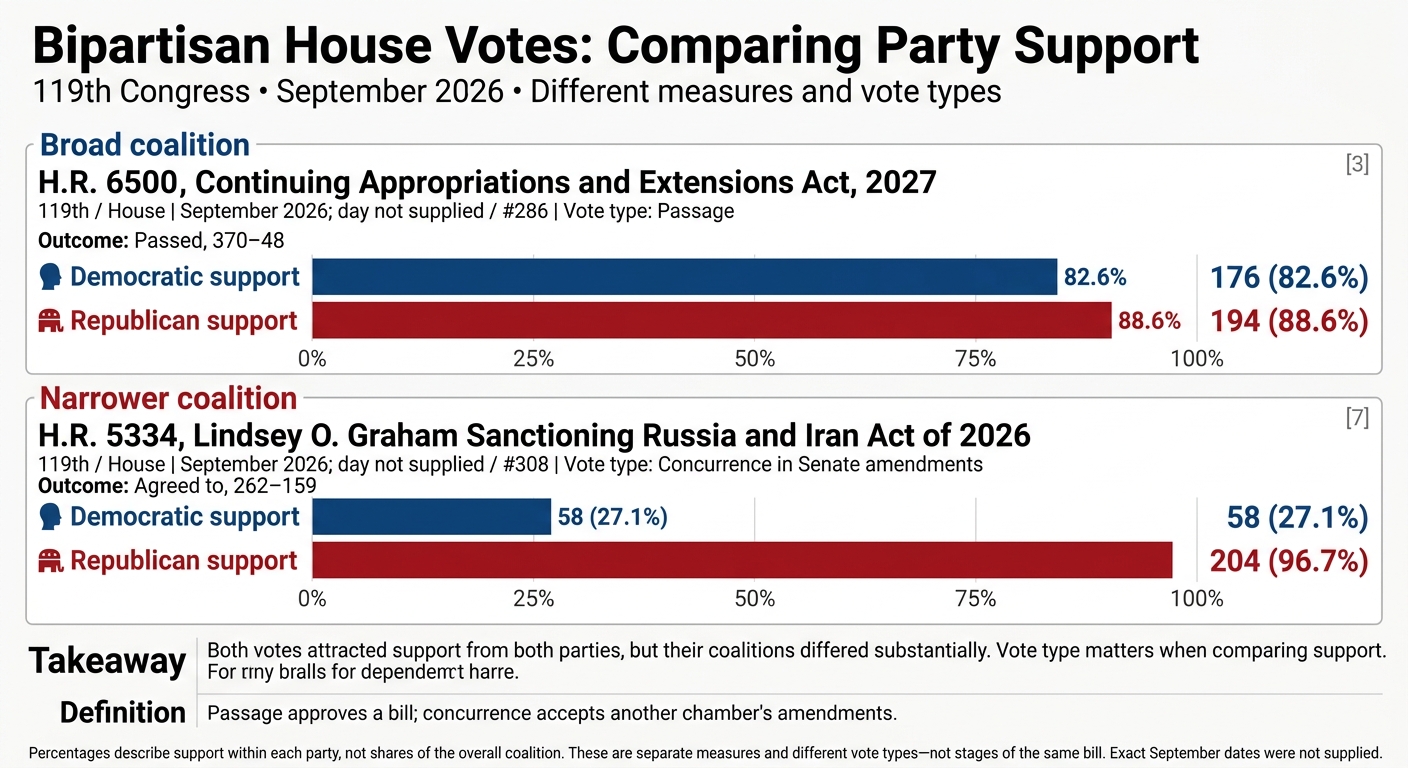
Bipartisan House Votes: Comparing Party Support
After party unity, the next question is which vote types draw the broadest coalitions. Passage and amendment votes show where support expands or contracts. The labels can overlap: a single vote may be both bipartisan and minority-supported.
Bill or motion Congress / chamber Date / roll call Vote type Democratic support Republican support Coalition breadth Outcome H.R. 6500, Continuing Appropriations and Extensions Act, 2027 119th / House September 2026; day not supplied / #286 Passage 176 (82.6%) 194 (88.6%) Broad Passed, 370–48 H.R. 5334, Lindsey O. Graham Sanctioning Russia and Iran Act of 2026 119th / House September 2026; day not supplied / #308 Concurrence in Senate amendments 58 (27.1%) 204 (96.7%) Narrower Agreed to, 262–159
The same measure can draw broader or narrower support depending on what members are voting on. Passage approves a bill, amendments change its text, and concurrence accepts another chamber’s amendments. These House votes show why vote type can matter as much as party label when comparing coalitions across chambers.
Cosponsorship signals early support, but it doesn’t guarantee final approval. Bipartisan floor votes may reflect district interests, constituent pressure, or the cost of blocking must-pass legislation. Voice votes and unanimous consent leave no individual voting record.
When Members Vote Against Their Party
Three House members show how often lawmakers vote against their own party. Party agreement measures how often a member’s roll-call vote matches the vote of their party’s majority.
The percentages below cover the 119th Congress and were recalculated from the source counts.
Member Chamber Congress / period Party agreement Votes scored Cross-party votes Thomas Massie (R-KY-4) House 119th Congress 74.3% 630 162 Henry Cuellar (D-TX-28) House 119th Congress 75.3% 664 164 Donald G. Davis (D-NC-1) House 119th Congress 78.5% 659 142
Each member voted against their party majority more than 140 times. The next section looks at which policy areas most often drive those departures.
Voting Patterns by Policy Area
This section groups recorded votes by policy area. To keep mixed-topic bills from skewing comparisons, assign each bill one primary topic and flag any secondary topics.
Grouping votes this way shows where lawmakers stick with their party and where they cross party lines. The House and Senate examples below show the clearest patterns.
Policy area / vote type Chamber Recorded vote count Party-line rate Cross-party support Example vote Appropriations (Continuing) House 418 85.0% 88.5% H.R. 6500: Continuing Appropriations and Extensions Act, 2027 National Security House 426 99.0% 50.9% H.R. 8595: National Security Appropriations, 2027 Defense (NDAA) House 428 97.0% 50.5% H.R. 8800: National Defense Authorization Act, 2027 Foreign Policy (Sanctions) House 421 62.0% (D) / 97.0% (R) 62.2% H.R. 5334: Lindsey O. Graham Sanctioning Russia/Iran Act Judicial Nominations Senate 97 98.0% 51.5% PN999-1: Angela Veronica Colmenero (District Judge) Procedural (Cloture) Senate 99 75.0% 74.7% S. 4668: Protect College Sports Act (Cloture)
House appropriations and national security votes show stronger party discipline, while Senate cloture and nominations still draw some bipartisan movement.
H.R. 5334 combined sanctions on Russia and Iran with tax deductions for early childhood educators.
As you read the table, ask two questions: Was the vote procedural or for final approval? And which policy area prompted lawmakers to cross party lines?
FAQs
How do missed votes affect party loyalty scores?
Missed votes do not automatically change a member’s party loyalty score. The score is based on recorded votes the member participates in. Absences are typically left out of the calculation, not counted as votes against the party.
Frequent absences can leave less data to assess political alignment, but they do not automatically increase or decrease the loyalty percentage.
How can I tell whether bipartisan support is meaningful?
Look beyond vote counts to the context behind the legislation. Meaningful bipartisan support often means members break with their party on high-profile or divisive issues - not just routine procedural votes. With 74% of votes in the 119th Congress falling along party lines, cross-party cooperation stands out.
Check whether the vote aligns with a member’s stated priorities or their membership in groups focused on moderate, bipartisan problem-solving, such as the Problem Solvers Caucus.
How can I find out why my representative broke party ranks?
Search and filter recorded votes on Legislate.dev to find votes that depart from party positions. Then compare them with your representative’s stated policy priorities, caucus memberships, bill sponsorship record, committee work, and advocacy group scorecards. This can help you assess whether those votes fit a broader legislative agenda or reflect constituent interests.
For context, check official statements or press releases from your representative’s office - especially for high-profile votes that cross party lines.