Understanding Congressional Bills: A Beginner's Guide
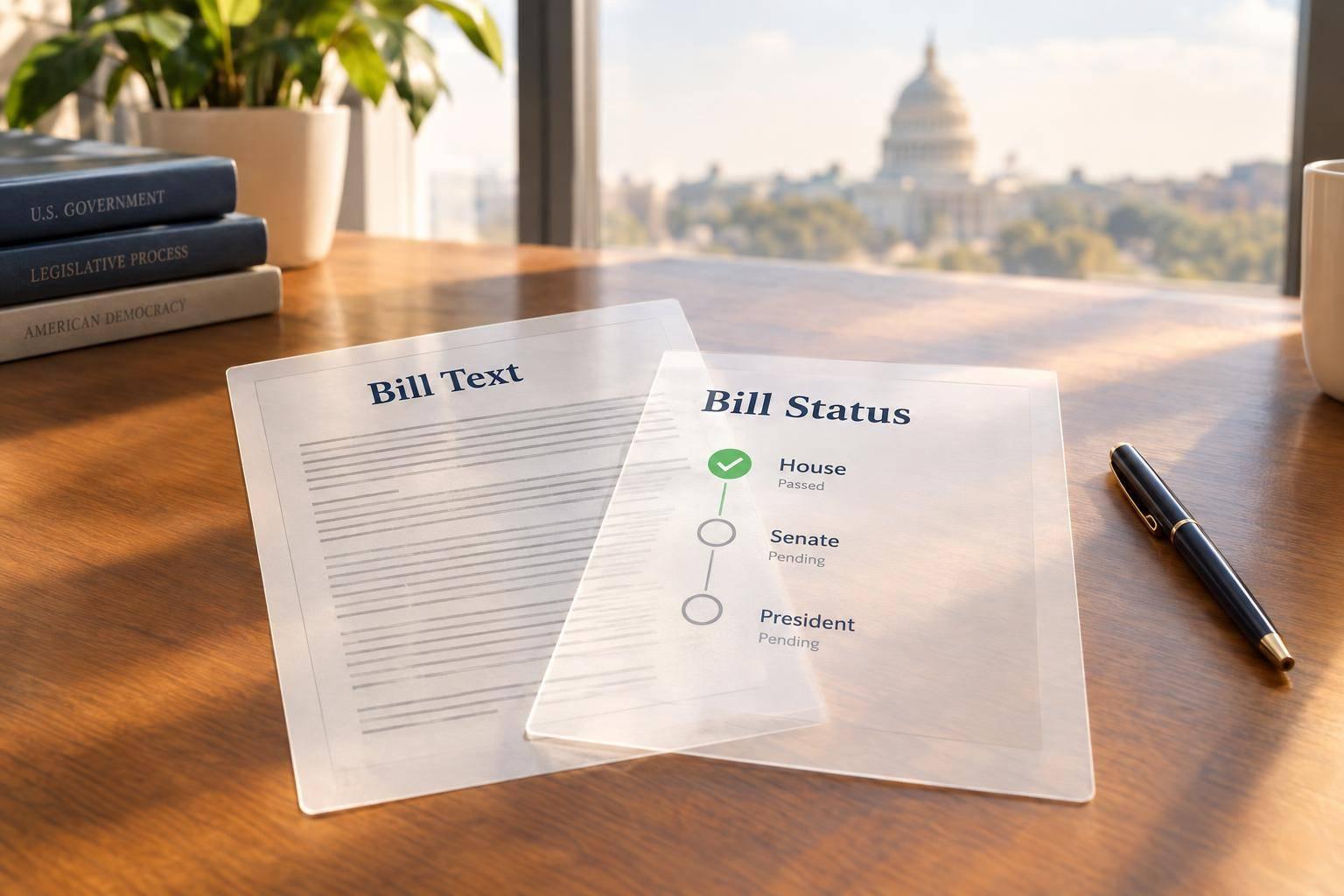
A congressional bill is a proposal - not a law. Before I describe what it would do, I check its Congress number, latest text, and dated actions on Congress.gov. Passing 1 chamber does not make it law.
Here’s what I check - and what you can check, too:
- The measure: Its bill number, sponsor, and type, including whether it is a bill or resolution.
- Its progress: Committee review, votes, agreement on identical text, and presidential action.
- Its wording: Adopted amendments, who is covered, funding, enforcement, and effective dates.
- Its updates: Official records first; Legislate.dev for tracking and summaries that I verify against those records.
My rule: check the text and status together. For a pending bill, I say “would require,” not “requires.”
How a Bill Becomes a Law: Crash Course Government and Politics #9
How a Bill Becomes Law
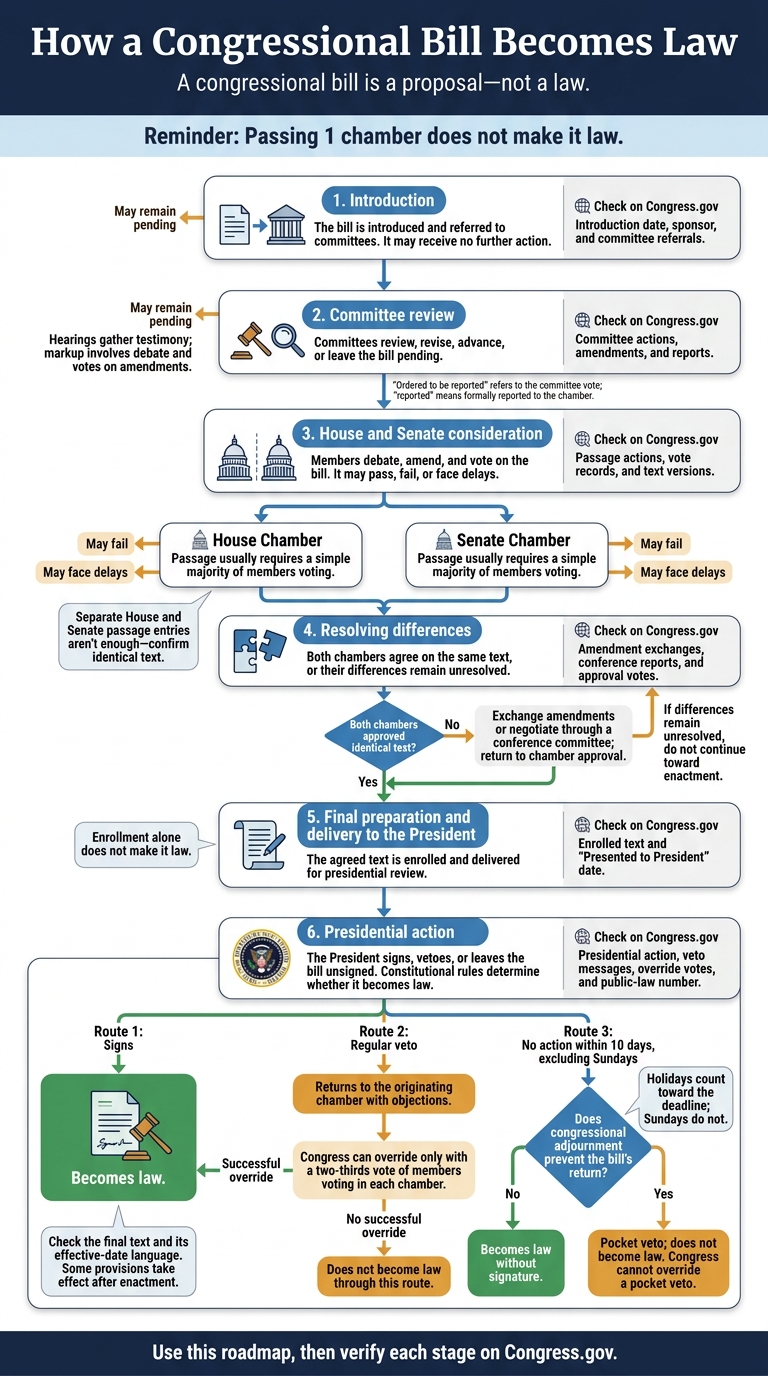
How a Congressional Bill Becomes Law
| Stage | What happens | What to check on Congress.gov |
|---|---|---|
| Introduction | The bill is introduced and referred to committees. It may receive no further action. | Introduction date, sponsor, and committee referrals. |
| Committee review | Committees review, revise, advance, or leave the bill pending. | Committee actions, amendments, and reports. |
| House and Senate consideration | Members debate, amend, and vote on the bill. It may pass, fail, or face delays. | Passage actions, vote records, and text versions. |
| Resolving differences | Both chambers agree on the same text, or their differences remain unresolved. | Amendment exchanges, conference reports, and approval votes. |
| Final preparation and delivery to the President | The agreed text is enrolled and delivered for presidential review. | Enrolled text and “Presented to President” date. |
| Presidential action | The President signs, vetoes, or leaves the bill unsigned. Constitutional rules determine whether it becomes law. | Presidential action, veto messages, override votes, and public-law number. |
Use this table as a roadmap, then check each stage on Congress.gov.
Introduction and Committee Review
Hearings gather testimony from officials, experts, and affected groups. Committees may also hold a markup, where members debate the text and vote on amendments before deciding whether to advance the bill. They may act quickly or leave it pending.
A committee report can explain the proposal’s purpose, individual sections, estimated costs, and minority views. Treat it as context - not proposed legal language - and match it to the correct text version.
“Ordered to be reported” and “reported” mean different things: the first refers to the committee vote; the second means the bill has been formally reported to the chamber.
House and Senate Votes
Floor consideration may involve debate, amendments, and procedural votes before the vote on passage. Final passage usually requires a simple majority of members voting.
If the House and Senate approve different versions, they may exchange amendments or negotiate an agreement through a conference committee. Check later actions to confirm that both chambers approved identical text. Separate House and Senate passage entries aren't enough.
Once both chambers pass the same text, the bill moves to the President.
Presidential Action and Vetoes
The enrolled bill - the final official version approved by both chambers - goes to the President. Enrollment alone does not make it law.
The President’s signature enacts the bill. A regular veto returns it to the chamber where it originated, along with the President’s objections. Congress can override that veto only with a two-thirds vote of members voting in each chamber.
If the President takes no action within 10 days, excluding Sundays, the bill becomes law unless congressional adjournment prevents its return. That exception results in a pocket veto, which Congress cannot override. Holidays count toward the deadline; Sundays do not.
If the bill becomes law, check the final text and its effective-date language. Some provisions take effect after enactment.
How to Read Bill Text and Status
Once you understand the legislative path, read the bill’s text and status together. Each tells you something different: what the bill says and where it stands.
Text Versions, Amendments, and Vote Records
Start with the Congress number, H.R. or S. identifier, and bill number. On Congress.gov, match the Text version to the corresponding Actions entry. Introduced is the original proposal; reported is the committee’s revised version; engrossed is the text passed by one chamber; and enrolled is the final text agreed to by both chambers.
Use the latest operative text - not the original proposal or a summary. Then check whether later text changed what the bill says.
Amendments are proposed changes, not automatically part of the bill. Compare versions section by section, especially after a substitute amendment that replaces much of the text. Check whether the amendment was adopted or failed, then look for its language in later text. A proposed amendment matters only if that later text reflects it.
Read the question attached to each vote. A rule vote or a motion to end debate is not a vote on final passage. Voice votes and unanimous consent may not show how individual members voted.
What Bill Status Labels Mean
| Status label | Plain-English meaning | What it does not mean |
|---|---|---|
| Introduced | The measure was formally submitted. | It is not law, and neither committee review nor support is guaranteed. |
| Committee consideration | A committee is reviewing it. | The committee has not necessarily approved it, and a floor vote may not be scheduled. |
| Floor consideration | A chamber is debating it. | The chamber has not necessarily passed it. |
| Passed one chamber | The House or Senate approved its version. | Both chambers have not yet approved it, and the text may change. |
| Passed both chambers | Both chambers approved versions of the measure. | Those versions may differ and need reconciliation before presentation to the President. |
| Resolving differences | The House and Senate are working to agree on identical text. | The measure is not necessarily ready for the President. |
| To President | Congress sent the enrolled measure to the President for action. | It has not automatically become law. |
| Became law | The measure was enacted and received a public law number. | Not every earlier version or provision discussed in the bill necessarily survived unchanged. |
| Failed one chamber | The measure failed under a chamber’s procedures. | The idea can still be reintroduced later. |
Referral is a procedural step, not approval. A public law number identifies the Congress and the law’s sequence - not its original bill number. Read the status alongside the text and dated actions. Status tracks progress, not policy results.
How to Explain Bill Provisions
Confirm the text version first. Then check who is covered, what changes, when it takes effect, how it works, how much it costs, and which agency enforces it. Focus on operative language, not findings or headings.
Before describing the bill’s scope, read its definitions, exceptions, and references to existing law. Keep qualifications such as “subject to” and “not later than,” and cite the section, version, and date you checked.
For pending legislation, write “would require,” not “requires.” Keep what the text says separate from legal interpretation or predicted outcomes.
Also distinguish authorization from appropriation: permission to fund a program does not itself provide budget authority. Don’t promise funding, claim penalties, or assume enforcement resources unless the applicable text supports those statements.
How to Find and Track Bills
Search Congress.gov and Verify the Bill
Once you know how to read bill text and status, use Congress.gov to check the official record.
Start with the bill identifier; periods and capitalization are optional. If you don’t know the number, search by title words, keywords, sponsor, cosponsor, or subject. Filter results by Congress, bill type, status, committee, and date range.
Before opening the text, confirm the Congress number, identifier, title, sponsor, chamber of origin, and latest action. Then use Sponsor, Text, Amendments, and Actions to check the bill’s text, changes, and activity. Once you’ve confirmed the bill, open its action log and text versions.
Review Text, Actions, and Supporting Records
Check the records in this order: latest action, action history, newest text, amendments, committee referrals, votes, cosponsors, and related bills.
Keep one research note with the bill identifier, Congress, text-version label and date, latest-action date, relevant sections, and official links. Follow vote links to the House Clerk or Senate record to check individual votes. Track companion bills separately: each has its own text and action history.
Use House.gov, USAGov, CRS guidance, and the U.S. Capitol Visitor Center to understand procedure - not to verify a bill’s status.
Compare dates and update times across actions, text, summaries, and committee materials. Official pages can lag behind recent action, so recheck the official record after a recent vote. A long stretch without action does not, on its own, mean a bill was defeated or withdrawn.
Track Bills with Legislate.dev
After verifying the bill on Congress.gov, use tracking tools to watch for new actions and text changes. Legislate.dev offers searches by bill number, topic, or sponsor, AI-generated summaries, live tracking, and member profiles with sponsorship history and voting records.
Track the verified measure and use summaries to find relevant provisions. Check updates against the latest official text and dated actions. Member profiles add context, but keep the bill’s own record at the center of your research.
Conclusion: Check the Text Before Drawing Conclusions
Read the text before relying on the headline. Bills are proposals, their wording can change, and passage alone does not mean a bill has become law.
Before citing a bill, check its number, Congress, latest text, and dated actions. Check its effective dates, too - a law may take effect in stages.
Use Legislate.dev to track developments after checking the official record, and base your conclusions on that record. Confirm which text passed, whether it became law, and when it takes effect.
FAQs
What happens to pending bills when a Congress ends?
When Congress finishes its two-year session, all pending bills that haven’t become law expire. For those bills to be considered again, lawmakers must reintroduce them as new legislation in a later Congress. They must then go through House and Senate approval and presidential action.
Can a bill change after passing one chamber?
Yes. When a bill moves from the House to the Senate - or the other way around - the second chamber can propose and approve amendments to the text. If it passes the amended bill, both chambers must resolve their differences and approve the exact same language before sending it to the president for signature.
How can I share my views on a bill?
Share your views by contacting your U.S. representative or senators. You can also submit comments to the House or Senate committee handling the bill.
Legislate.dev links to the official bill record and shows how lawmakers voted. Use that information to explain your position, drawing on the bill’s text and where it stands in the legislative process.