Engrossment vs Enrollment: Process Update Guide
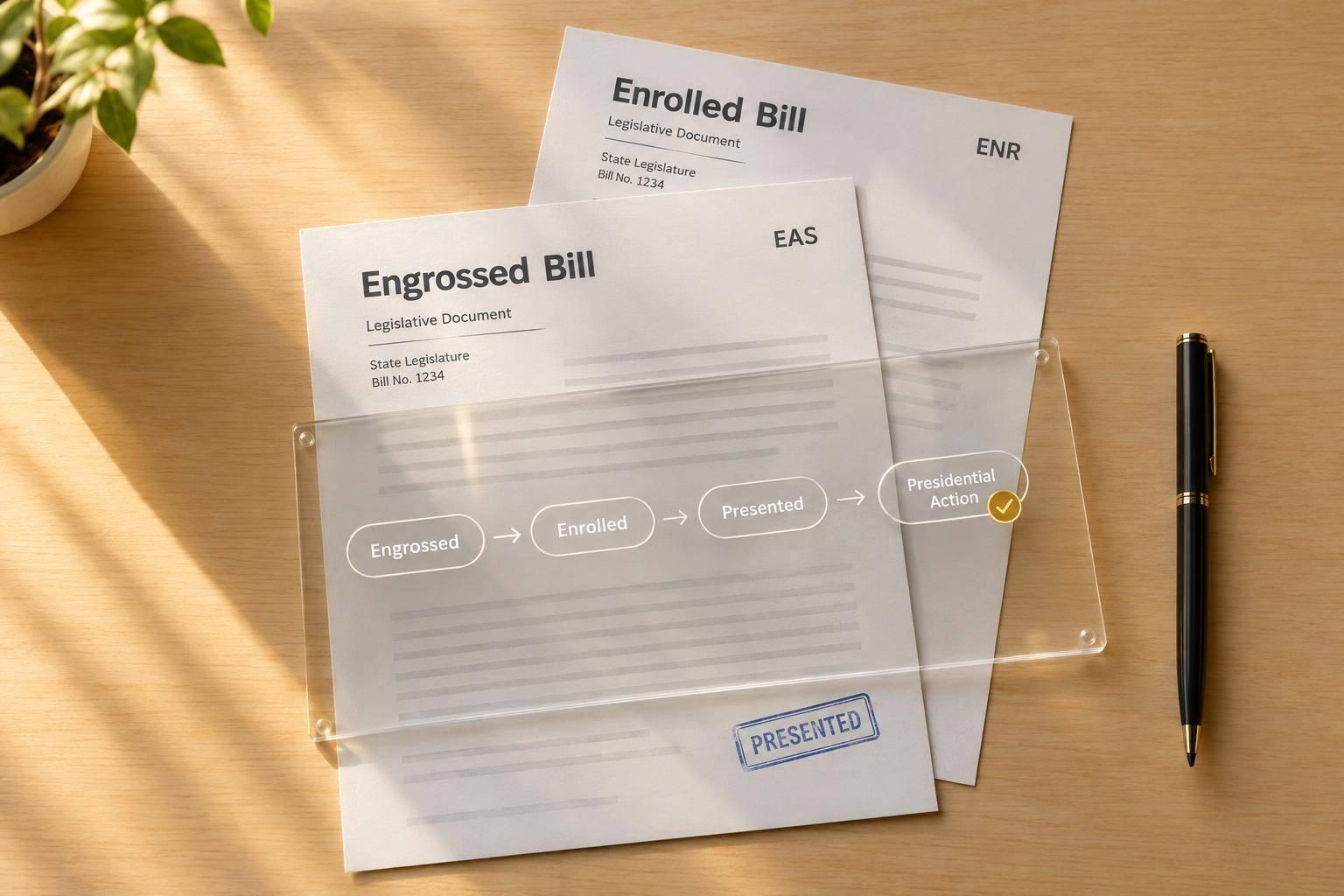
Engrossment records one chamber’s text. Enrollment records the text both chambers agreed to - but neither means a bill is law. I check the version code and latest official action across different Congresses before reporting a bill’s status.
Here’s the quick comparison I use:
| What to check | Engrossment | Enrollment |
|---|---|---|
| Text recorded | One chamber’s passed text or adopted amendments | Final text agreed to by both chambers |
| Who prepares it | Staff of the chamber taking action | Staff of the chamber where the bill started |
| Version codes | EH, ES, EAH, EAS | ENR |
| Next step | Send the text to the other chamber | Obtain required signatures, then present it to the President |
I then check three separate milestones: agreement, presentation, and enactment. An amendment version does not prove concurrence, and ENR does not prove presidential action.
Whether I use Legislate.dev or read the records directly, I confirm the event date, chamber, vote question, and latest action on Congress.gov or GovInfo. My rule: use summaries to understand the bill, and official records to confirm its stage.
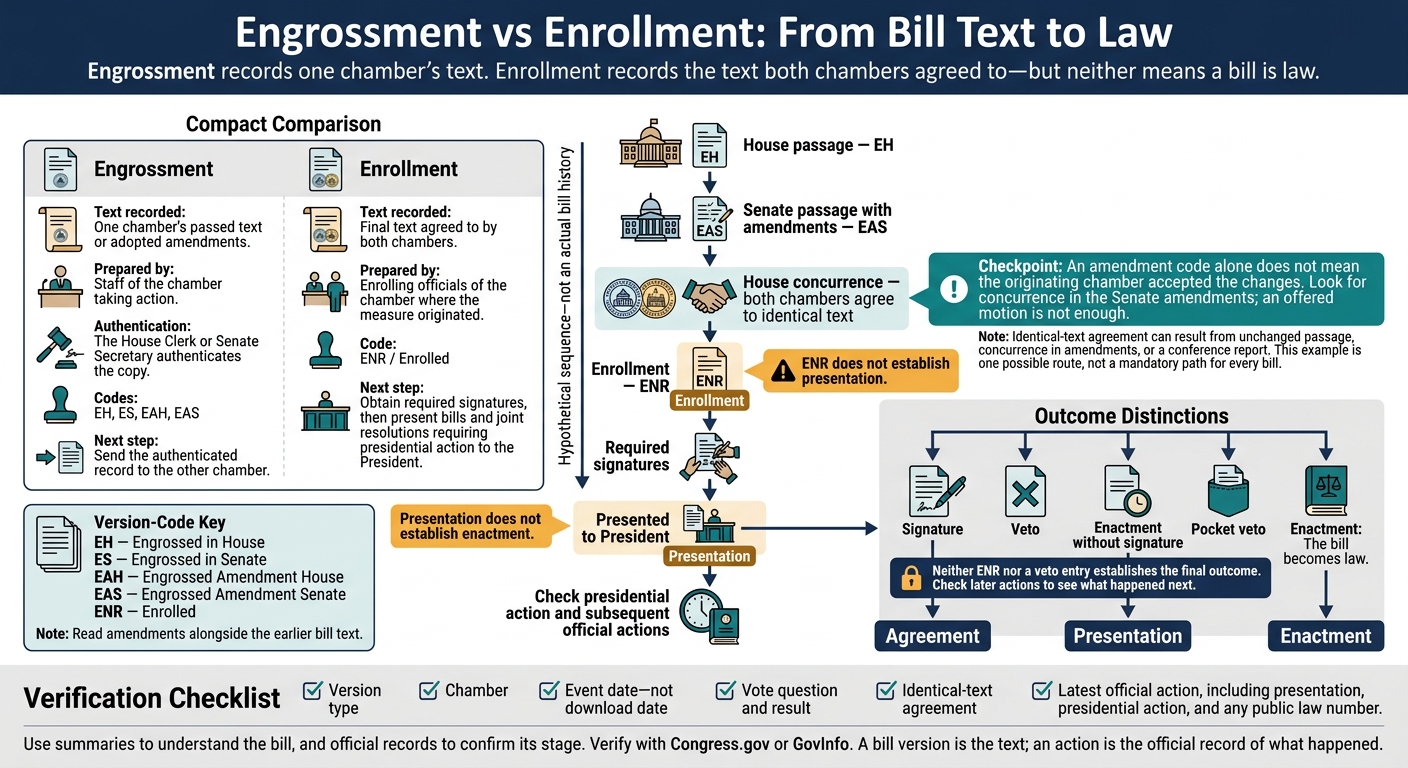
Engrossment vs Enrollment: From Bill Text to Law
Engrossment vs Enrollment: When They Occur and Who Handles Them
To tell engrossment from enrollment, check which chamber handled the bill and its version code.
| Attribute | Engrossment | Enrollment |
|---|---|---|
| Timing | Usually follows third reading and final passage. | Follows both chambers’ agreement on identical text. |
| Required action | Prepare and attest the chamber’s passed text or adopted amendments. | Prepare the final agreed text. |
| Text represented | The text one chamber passed or the other chamber amended. | The identical text both chambers accepted. |
| Preparing chamber | The chamber taking the recorded action. | The chamber where the measure originated. |
| Responsible officials | House Clerk or Senate Secretary staff prepare the copy; the Clerk or Secretary authenticates it. | Enrolling clerks under the Clerk of the House or Secretary of the Senate prepare the text; presiding officers sign measures requiring presidential action. |
| Identical-text agreement | Not required. | Required. |
| Next action | Send the authenticated record to the other chamber. | Obtain required signatures, then present bills and joint resolutions requiring presidential action to the President. |
| Meaning in congressional data | Chamber-specific versions: EH, ES, EAH, EAS. | Final bicameral version: ENR / Enrolled. |
Bill versions and status records reflect these two stages differently.
Engrossment: Recording a Chamber’s Text or Amendments
Engrossment records the text a chamber passed or amended. House or Senate staff prepare the copy. The Clerk or Secretary then authenticates it before sending it to the other chamber.
Enrollment: Preparing the Agreed Final Text
Enrollment begins when both chambers agree to identical text. That agreement can come through unchanged passage, concurrence in amendments, or a conference report. The originating chamber’s enrolling officials prepare and verify the final agreed text.
The enrolled text receives the required signatures before it is presented to the President. The shift from a chamber-specific engrossment to an enrolled version reflects agreement on the final text by both chambers.
How to Read Bill Versions and Status Updates
Read the version code alongside the latest action. A bill version is the text; an action is the official record of what happened. Before reporting progress, check the chamber, date, version type, and latest official action. Use the event date - not the download date. If the text and status conflict, review the full action log.
Engrossed Version Codes: EH, ES, EAH, and EAS
EH - Engrossed in House and ES - Engrossed in Senate identify engrossed text from the House or Senate. EAH - Engrossed Amendment House and EAS - Engrossed Amendment Senate identify engrossed amendments or substitutes from the second chamber.
Read amendments alongside the earlier bill text. An amendment code alone does not mean the originating chamber accepted the changes.
Then check whether the record has moved to enrolled text or is still at the amendment stage.
From Enrollment to Presentation and Enactment
When a bill reaches ENR, look separately for “Presented to President” in its status record. ENR does not establish presentation, and presentation does not establish enactment.
Track presidential action separately: signature, veto, enactment without signature, or pocket veto. Neither ENR nor a veto entry establishes the final outcome. Check later actions to see what happened next.
Hypothetical Example: Senate Amendments to a House Bill
The sequence below shows how version codes line up with official actions.
Hypothetical sequence - not an actual bill history: House passage (EH) → Senate passage with amendments (EAS) → House concurrence → ENR → presentation to the President. Look for concurrence in the Senate amendments; an offered motion is not enough. Amendment-stage text advances to enrollment only after both chambers agree.
Track Legislative Progress with Legislate.dev
Legislate.dev turns bill records into plain-English summaries, searchable records, and near-real-time progress and vote tracking. These tools help you check whether a measure is still engrossed, has moved to enrollment, or has reached presentation.
Verify Summaries Against Official Actions
Find the bill by number and Congress. Then compare the summary with the official action and bill version to check what changed and which chamber acted. Confirm adoption, concurrence, and agreement by both chambers on the same text in the official record. Use the summary to explain the substance - not to confirm procedural steps.
Near-real-time updates can lag. Before reporting the bill’s stage, check the latest event on Congress.gov or GovInfo. Once the summary matches the official action, move to the vote record.
Follow Document Stages and Votes in Order
After checking the version, connect each version change to the vote that produced it. Then follow the record through presentation and presidential action.
Read the vote question and result, not just the tally. This tells you whether the chamber passed the bill, adopted an amendment, or concurred. A roll-call vote alone does not establish enrollment.
Member profiles can add context, but check procedural conclusions against the bill history and vote record.
Conclusion: Confirm the Stage and Latest Action
Check the final action log to confirm the bill’s stage. The version code alone doesn’t tell the whole story.
Engrossment records the text passed by a chamber. Enrollment begins only after both chambers agree to identical text, and the chamber of origin prepares the enrolled copy.
Presentation means delivery to the President. Enactment is a separate step: it occurs only when the bill becomes law.
Before reporting a bill’s status, check these details:
- Version: EH, ES, EAH, EAS, or ENR.
- Chamber: the chamber taking action for engrossment; the chamber of origin for enrollment.
- Agreement: confirm that both chambers approved identical text.
- Latest action: check presentation, presidential action, and any public law number.
FAQs
What happens if the chambers disagree on bill text?
The House and Senate must agree on the same bill text before sending it to the President. They usually exchange amendments: each chamber can accept the other’s changes or propose more. They can also use a conference committee to negotiate a compromise.
Once both chambers approve identical text, the bill is prepared for enrollment, the final step before it goes to the President for action.
Can an enrolled bill still be corrected?
Yes. An enrolled bill is the final, official version prepared for presentation to the President. But technical or clerical errors can still be corrected through specific legislative procedures. For example, a concurrent resolution can authorize corrections to the enrolled text.
Why might a bill’s text and status differ?
A bill’s text and status may differ because engrossment and enrollment happen at different stages.
Engrossment incorporates amendments into a chamber’s text and finalizes its official version for passage. Enrollment happens after both chambers agree on identical text and prepares the final version for presidential action.
These separate administrative steps can affect which text version is available and which status is reported.