Federal Legislative Process: Floor Stage Summary
A floor vote does not always mean a bill passed - and passage does not mean it became law. I start by checking what the vote decided: whether to begin consideration, change the text, end debate, or pass the measure.
Here’s how I track floor action:
- Getting to the floor: Calendar placement makes a measure eligible for action; it does not schedule a vote.
- Debate and amendments: House suspension allows 40 minutes of debate, bars separately offered floor amendments, and requires a two-thirds vote for passage. Senate cloture on legislation usually requires 60 votes.
- Vote results: I check the vote question and amendment outcome before treating either as a text change or passage.
- Next steps: Bills need identical House and Senate text before enrollment and presentation to the president. Some resolutions do not require presidential action.
- Source checks: I use official bill histories, chamber records, and vote records to confirm each step. Research tools can help organize that work, but official records come first.
This guide explains how I separate procedure from results - and check what actually happened.
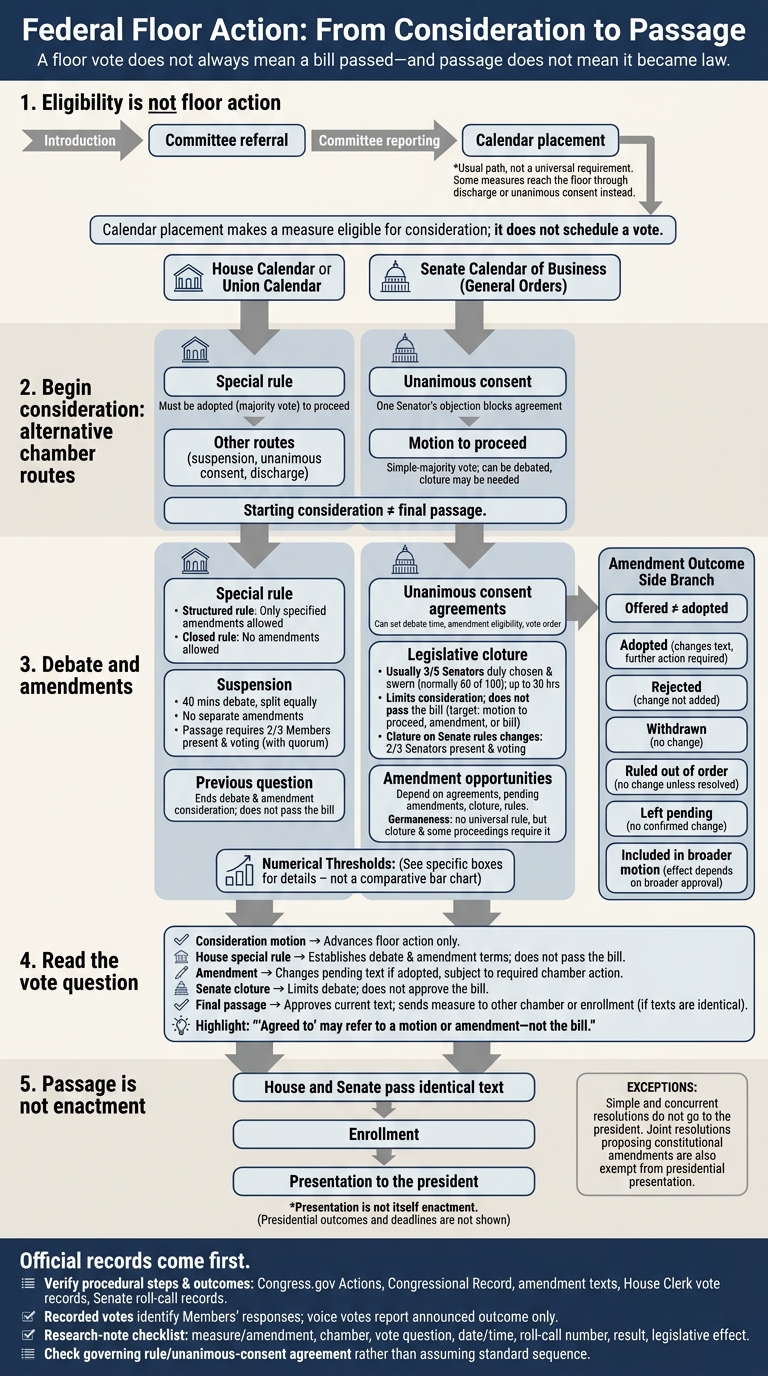
Federal Floor Action: From Consideration to Passage
How Measures Reach the Floor
Calendars and Bill Status
Calendars show which measures are eligible for consideration - not when debate will begin. Introduction, committee reporting, calendar placement, floor consideration, and passage are separate steps.
Introduction gives a bill its number and sends it to committee. Committee reporting returns it to the chamber. Calendar placement makes it eligible for consideration, but the chamber still must agree to take it up.
Reported House measures usually go on the Union Calendar or House Calendar. Senate measures ready for consideration usually appear under General Orders on the Calendar of Business. Leadership priorities, limited floor time, and procedural hurdles can leave measures waiting until the Congress ends.
Procedures for Starting Consideration
A special rule is a House resolution, usually reported by the Committee on Rules, that sets debate time, amendment options, and procedural waivers for a measure. The House must adopt the rule before proceeding under its terms.
Other House routes include suspension, unanimous consent, and discharge. Some measures reach the floor through discharge or unanimous consent instead of the usual reported-bill path.
| Stage or feature | House | Senate | What it means |
|---|---|---|---|
| Starting consideration | Special rule, suspension, unanimous consent, or discharge | Unanimous consent or motion to proceed | Calendar placement alone does not start floor action. |
| Debate limits | Set by the procedure; suspension allows 40 minutes | May continue unless limited by agreement or cloture | The route determines floor time. |
| Floor amendments | Controlled by the special rule; suspension bars floor amendments | Usually available, subject to rules, agreements, and cloture | Floor consideration does not guarantee amendment opportunities. |
| Key vote threshold | Adopting a special rule usually takes a majority; passage under suspension takes two-thirds of Members present and voting | A motion to proceed usually takes a simple majority; cloture may be needed to end debate | Starting consideration and ending delay require different votes. |
In the Senate, unanimous consent starts consideration if no Senator objects. Otherwise, a motion to proceed can itself be debated, delaying debate on the bill.
Track the procedure used to begin consideration in the Congressional Record and bill history. Record that step separately from final passage. Once consideration begins, debate rules control what happens next.
Rules for Debate and Amendments
Once a measure reaches the floor, these rules govern what Members may debate, amend, and vote on.
House Debate and Amendments
Start with the adopted special rule. It sets debate time, allowed amendments, and any waivers. A structured rule allows only specified amendments; a closed rule allows none.
Suspension allows 40 minutes of debate, split equally between proponents and opponents. It bars separately offered floor amendments, though an amendment may be included in the suspension motion. Passage requires two-thirds of Members present and voting, with a quorum present.
The previous question ends debate and amendment consideration on the pending question - it does not pass the bill. Special rules, suspension, and the previous question work together to control what reaches a vote. In the Committee of the Whole, permitted amendments are considered and reported back to the House. Further House action may still be required.
The chambers use different tools, but both limit debate and amendment opportunities to control floor action.
Senate Debate, Cloture, and Amendments
A unanimous consent agreement can set debate time, amendment eligibility, and vote order. One Senator’s objection blocks the agreement.
Cloture limits consideration - it does not pass the bill. For legislation, cloture usually requires three-fifths of Senators duly chosen and sworn, normally 60 of 100, and allows up to 30 additional hours. For Senate rules changes, the threshold is two-thirds of Senators present and voting.
Amendment opportunities depend on the agreement, pending amendments, cloture, and applicable rules. Germaneness means an amendment must relate to the pending matter. The Senate has no universal germaneness rule, but cloture and some proceedings require it.
These tools determine whether debate can end and amendments can move forward. For each cloture vote, check its target: the motion to proceed, an amendment, or the bill itself.
Amendment results then determine whether the text changes before final passage.
Amendment Outcomes and Text Changes
Offered does not mean adopted, and debated does not mean voted on. Track each amendment’s disposition in the Congressional Record alongside its text. The outcomes below are possibilities, not a required sequence. Some measures receive no floor amendments at all.
| Outcome | What to record | Effect on text |
|---|---|---|
| Adopted | Amendment text and approval by vote or consent | Changes the text, subject to further required chamber action |
| Rejected | Negative vote and disposition | Proposed change is not added |
| Withdrawn | Withdrawal before final disposition | No change |
| Ruled out of order | Procedural objection and ruling | No change unless later action resolves the barrier |
| Left pending | Latest action; no final disposition | No confirmed change |
| Included in broader motion | Governing text and whether it was adopted | Depends on approval of that motion or agreement |
Floor Votes and Their Effects
Once debate and amendments are set, the vote record shows what the chamber decided.
Read the vote question first. “Agreed to” may mean the chamber approved a motion or amendment - not the bill. The table shows what each vote decides and what happens next.
| Vote type | What it decides | Typical legislative effect | Official source |
|---|---|---|---|
| Consideration motions | Whether to take up a measure or proceed to a stage of consideration | Advances floor action only. | Chamber record; Congress.gov Actions history |
| House special rules | Whether to accept debate and amendment terms | Sets debate and amendment terms; does not pass the bill. | House Clerk vote record; Congress.gov Actions history |
| Amendments | Whether to adopt proposed text changes | Changes the pending text if adopted. | Chamber vote record; amendment text; Congress.gov Actions history |
| Senate cloture | Whether to limit further debate | Limits debate; does not approve the bill. | Senate roll-call record; Congress.gov Actions history |
| Final passage | Whether to approve the current text | Sends the measure to the other chamber, or to enrollment if both chambers have already passed identical text. | House Clerk or Senate roll-call record; Congress.gov Actions history |
Once you understand the vote question, check how the vote was recorded. That determines how much detail the record provides.
Voting Methods and Vote Records
The House uses voice votes and electronic recorded votes. The Senate uses voice votes and roll calls. Recorded votes identify individual members’ responses. Voice votes report the announced outcome, not how each member voted. Don't call a voice vote unanimous unless the official record expressly says it was.
For a useful research note, record the measure or amendment, chamber, vote question, date and time when available, roll-call number, result, and immediate legislative effect. Check the House Clerk’s vote records or Senate roll-call records for individual votes. Then match the result to the corresponding bill action on Congress.gov.
Why Passage Is Not Enactment
Final passage ends floor action, not the legislative process. The House and Senate must pass identical text before enrollment and presentation to the president. Simple and concurrent resolutions do not go to the president. Joint resolutions proposing constitutional amendments are also exempt from presidential presentation.
Conclusion and Source Notes
Calendar placement means a bill is eligible for action - not that action has occurred. Floor procedure governs debate, amendments, and votes. Passage and enactment are separate steps.
Verification depends on the quality of the sources and when they were reviewed.
Official Sources and Review Dates
Use official records to confirm each procedural step, vote, and text change.
Include only sources you’ve reviewed. Record each source’s title, issuing institution, publication or update date, and review date. Article reference date: October 8, 2026. That date does not prove any source was reviewed that day.
Start with House.gov, Senate.gov, Congress.gov, current chamber rules, and CRS reports on floor practice and amendments. CRS guides explain procedure; they do not establish what happened to a particular bill.
Match each claim to bill histories, amendment texts, and vote records. Check the governing rule or unanimous-consent agreement instead of assuming the steps follow a standard sequence. If records conflict, flag the discrepancy and follow the official record from the time of the action.
Organizing Research with Legislate.dev
Legislate.dev offers plain-English bill summaries, near-real-time progress and vote tracking, searchable bill indexes, and member profiles covering sponsorships, voting records, and floor activity. Use it to organize your research, then verify status, text changes, and outcomes in official records.
FAQs
What happens if the House and Senate pass different versions?
If the House and Senate pass different versions of the same bill, they must agree on one version before sending it to the president. That usually means negotiating a compromise that both chambers can pass.
Legislate.dev tracks these developments in near real time, so users can follow bill status, floor activity, and progress toward final passage.
Can a failed floor vote be reconsidered?
Yes. The House often follows a motion to reconsider almost immediately with a motion to lay it on the table. This effectively locks in the vote’s result and blocks further attempts to change it.
Legislate.dev tracks legislative actions and floor proceedings in near real time, so you can follow how motions and votes shape a bill’s progress through Congress.
What happens to bills when a Congress ends?
When a Congress ends, pending legislation that hasn’t become law expires. Bills that haven’t passed both the House and Senate in identical form by the final adjournment of the two-year session must be reintroduced in a later Congress for further consideration.
Legislate.dev provides near-real-time updates on bill activity, progress on the House and Senate floors, and legislative outcomes.