What Happens When a Bill Is Introduced? Q&A Explained

Introducing a bill starts the process - it does not make it law or guarantee a vote. When I check a new bill, I look at Congress.gov’s Latest Action and its date, not just the announcement.
Here’s what you need to know:
- Who files it: Only a Member of Congress can introduce a bill. Each bill has 1 sponsor; cosponsors publicly support it but do not promise a final vote.
- What happens next: The bill gets a number, enters the official record, and goes to the committee responsible for its subject. House bills use H.R.; Senate bills use S. Pair the bill number with the Congress number.
- What is not promised: Referral does not guarantee a hearing, amendments, or a vote. Text may appear later, and a bill can sit in committee until the 2-year Congress ends.
- How it becomes law: Both chambers must pass identical text, followed by presidential action, enactment without a signature, or a veto override.
My rule: Check the dated action record. Introduced, passed, and enacted mean different things. Read All Actions, then check committee records and the bill text before describing its progress.
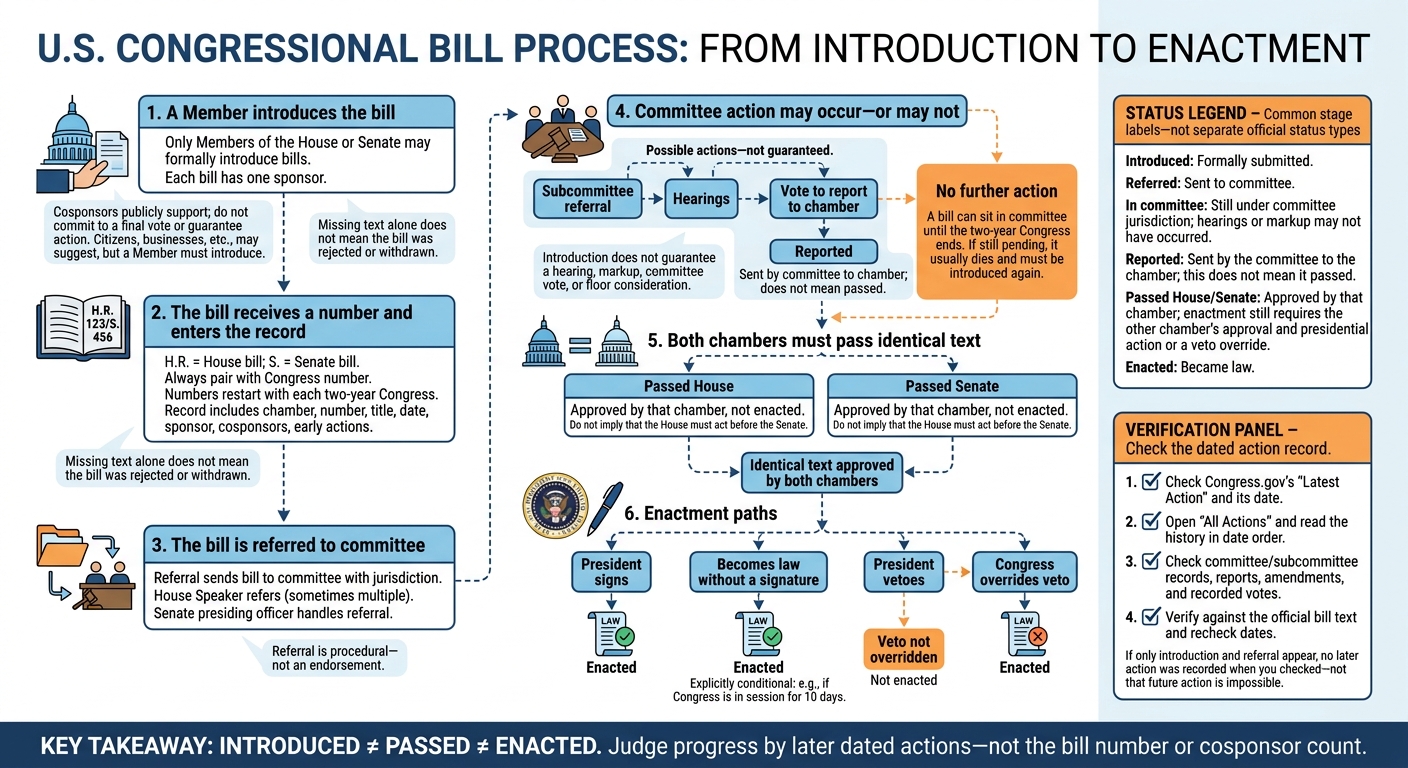
What Happens After a Bill Is Introduced?
Bill Sponsors and Cosponsors
Who Can Introduce a Bill
A bill’s introduction establishes who filed it and whose name appears on it.
Only Members of the House or Senate may formally introduce bills. The Member who introduces a bill is its primary sponsor.
Citizens, businesses, nonprofits, and executive agencies can suggest or draft bills. But a Member must introduce them.
What Sponsorship and Cosponsorship Mean
Each bill has one sponsor. Other Members who formally support it are cosponsors, and public bills can have unlimited cosponsors. Sponsorship tells you who filed the bill - not whether it will pass.
These roles show who leads the bill and who publicly backs it.
| Role | Meaning | Timing |
|---|---|---|
| Primary sponsor | The Member who formally introduces the bill | At introduction |
| Cosponsor | A Member who formally joins a bill to show support | At introduction or later |
In the House, cosponsors can usually be added or removed until the last committee with jurisdiction reports the bill or is discharged. In the Senate, adding cosponsors after introduction usually requires unanimous consent.
House and Senate companion bills have separate sponsor and cosponsor lists.
For the current record, check Congress.gov’s sponsor and cosponsor entries, including join dates, rather than relying on press release wording. Cosponsorship shows support, but it does not commit a Member to a final vote or guarantee action on the bill.
Bill Numbers, Records, and Committee Referral
How Bill Numbers Are Assigned
Once a Member files a bill, Congress assigns it a number and enters it into the official process. The House Clerk and Senate clerks assign the next bill number: H.R. for House bills and S. for Senate bills. Numbers generally restart with each two-year Congress. They identify bills - not their importance or chances of passing.
Always pair the bill number with the Congress number. A later Congress can use the same number for a different bill. Resolutions have their own prefixes: H.J.Res. and S.J.Res. for joint resolutions, H.Con.Res. and S.Con.Res. for concurrent resolutions, and H.Res. and S.Res. for simple resolutions.
How Introduction Is Recorded
A newly introduced bill’s record usually lists its chamber, number, title, introduction date, sponsor, cosponsors, and early actions. Its introduction also appears in the Congressional Record. Congress.gov may post the filing details before the full bill text is available.
If the text is missing, check back later. Missing text alone does not mean the bill was rejected or withdrawn.
Once the bill is numbered and recorded, Congress determines where to send it.
How Committee Referral Works
Referral formally sends a bill to the committee with jurisdiction over its subject. In the House, the Speaker refers bills, sometimes to more than one committee. In the Senate, the presiding officer handles referral. Senate Rule XVII generally directs bills to the committee covering their predominant subject. These assignments are procedural - not endorsements.
A committee may send the bill to a subcommittee, hold hearings, or mark it up to debate and amend it. It may then vote to report the bill to the full chamber - or take no further action. Referred to committee means the bill has a next step. It does not mean a hearing, markup, or vote has happened.
What Introduction Does Not Guarantee
Referral starts committee review, but it does not require the committee to act.
Hearings and Votes Are Not Guaranteed
Introducing a bill does not automatically put it on a chamber calendar or guarantee floor consideration. It can sit in committee without further action until the Congress ends.
For a bill with no further action, use introduced or pending, not approved or advancing. If it remains pending at the end of a Congress, it usually dies and must be introduced again.
Introduction is only the start of the process - not a promise of a hearing or vote.
Introduction Does Not Make a Bill Law
A bill must pass both chambers with identical text before it reaches the President.
The President may sign it, veto it, or let it become law without a signature. Congress can also override a veto. Introduced, passed, and enacted mark different steps in the process.
Conclusion: Check Status and Later Action
Judge a bill’s progress by later dated actions, not its bill number or cosponsor count.
How to Read a Newly Introduced Bill’s Status
Once a bill is introduced, check whether the record shows any later actions. The labels below describe common stages, not separate status types.
| Label | Meaning |
|---|---|
| Introduced | Formally submitted. |
| Referred | Sent to committee. |
| In committee | Still under committee jurisdiction; hearings or markup may not have occurred. |
| Reported | Sent by the committee to the chamber; this does not mean it passed. |
| Passed House/Senate | Approved by that chamber; enactment still requires the other chamber’s approval and presidential action or a veto override. |
| Enacted | Became law. |
Record: Latest action and date, committee/subcommittee, reports, amendments, and recorded votes. Note when no later action is recorded.
Open All Actions and read the history in date order. If it shows only introduction and referral, no later action was recorded when you checked. That does not mean future action is impossible.
How to Track a Bill’s Next Steps
Look beyond the status label and check the action log for movement.
Start with Congress.gov’s Latest Action. Then check the relevant committee records for hearing notices, markups, reports, amendments, and votes. Recheck the dates, since records may change after publication.
Use summaries to get your bearings, then verify claims against the official text and procedural record.