Byrd Rule and Reconciliation Scope

A proposal can change federal spending and still fail the Byrd Rule. I check its text against six tests - not just its budget score - to see whether it belongs in a Senate reconciliation bill.
Here’s what I look for:
- Budget effects: Does it change spending or revenue, and are those effects more than a side effect of policy rules?
- Committee limits: Is it within the committee’s jurisdiction, and does the committee’s title meet its assigned target?
- Later-year deficits: Are deficit increases after the budget window offset within the same title?
- Social Security: Does it change the benefits barred from reconciliation?
Tax and benefit changes are stronger candidates than stand-alone mandates. But a budget score is not Senate clearance. The Parliamentarian advises; the presiding officer rules on challenges. A waiver generally needs 60 votes, even when final passage needs only a simple majority.
I’ll explain those limits, the gray areas, and how to use bill text, fiscal estimates, and Senate records to check what survived - and why.
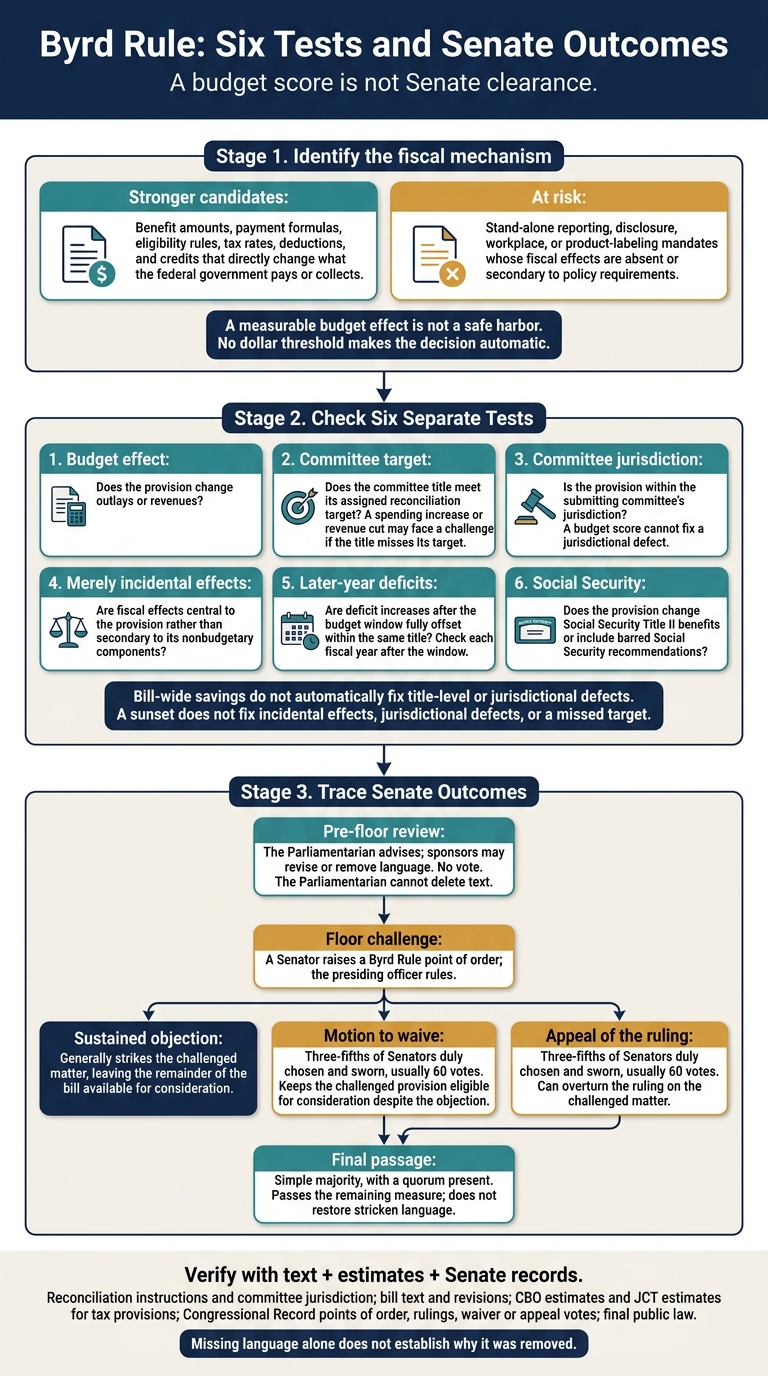
Byrd Rule: Six Tests and Senate Outcomes
Ballotpedia explains: The Byrd Rule
Budget Items That May Qualify vs. Policy Items That May Fail
The next step is to separate direct budget changes from policy provisions that affect spending only indirectly.
Judge the text’s budget effect, not its policy label. A provision has a direct budget effect when its text changes what the federal government pays or collects. The examples below show where that line falls.
Spending, Taxes, and Program Rules
Mandatory spending changes can adjust benefit amounts or payment formulas. Tax changes can adjust rates, deductions, or credits. Eligibility rules matter, too: deciding who receives a payment - or owes a tax - changes the terms governing federal spending or collections.
Provision type Direct budgetary mechanism Why it may qualify Likely Byrd Rule issue Mandatory benefit change Changes the amount paid per beneficiary Payment formulas directly determine outlays The committee may miss its spending target, or the provision may create deficits outside the budget window Benefit eligibility change Expands or narrows who receives federal benefits Eligibility directly governs payments Outside committee jurisdiction or merely incidental fiscal effects Tax-rate or tax-base change Changes tax liability or taxable income Directly changes federal receipts Revenue losses inconsistent with committee instructions or later-year deficits Refundable business tax credit Reduces tax liability and may increase refundable outlays The credit’s eligibility, amount, refundability, and duration determine its fiscal effect Other Byrd Rule tests still apply Stand-alone reporting mandate May create agency administrative costs without changing taxes or payments A fiscal connection would need to be established No budget effect or effects merely incidental to reporting requirements
Refundable credits usually have the clearest fiscal link. Reporting mandates usually do not. Most Byrd Rule disputes begin at that dividing line.
Regulatory Mandates and Other Grounds for Exclusion
A workplace standard, product-labeling rule, or disclosure requirement does not qualify just because enforcement costs money. A measurable budget effect is not a safe harbor. The Senate can still find that effect “merely incidental” to the nonbudgetary components. No dollar threshold makes the decision automatic.
Policy objective Budgetary connection Likely Byrd Rule issue Possible Senate consequence Require business disclosures None, or only administrative costs No budget effect or merely incidental effects Language may be stricken after a sustained point of order Increase a federal benefit Direct increase in outlays Committee title misses its reconciliation target Cost-increasing provision may face a point of order Change a program assigned to another committee Potentially direct spending effect Outside the submitting committee’s jurisdiction Provision may be removed Create a credit with costs after its expiration Reduced receipts or refundable outlays in later years Unoffset deficit increase beyond the budget window Language may need revision or sufficient later-year offsets Change Social Security Title II benefits Direct change in benefit spending Social Security exclusion Provision may be stricken unless the rule is waived
Read the bill text alongside the budget estimate and committee assignment when checking which provisions may draw a point of order. Direct fiscal effects do not cure jurisdiction problems, and offsets elsewhere do not fix a title that misses its instruction.
Gray Areas That Lead to Byrd Rule Disputes
Direct vs. Incidental Budget Effects
The legal effect matters more than the score. The question is whether the budget effect is central to the provision or secondary to it. A payment rule differs from a conduct rule that changes costs only as a side effect.
| Disputed feature | Argument for inclusion | Argument for exclusion | Applicable Byrd Rule test |
|---|---|---|---|
| Hypothetical: Reduce the federal reimbursement rate paid to participating health providers while adding provider operating standards | The rate change directly cuts outlays | Provider standards may be mainly regulatory | Change in outlays or revenues; merely incidental; committee jurisdiction |
| Hypothetical: Impose a broad emissions standard on all manufacturers, including some federal contractors | Compliance could change procurement costs or tax receipts | Fiscal effects may be secondary to environmental regulation | Merely incidental; scope and jurisdiction |
| Hypothetical: Change the eligibility formula for a federal tax credit | The eligibility formula directly changes revenue collections | Related requirements may impose mainly nonbudgetary conditions | Change in revenues; merely incidental; committee jurisdiction |
When a provision is disputed, connect its operative language to the specific spending or revenue provision. Separate the requirements that produce the scored change from those that regulate conduct beyond that fiscal mechanism.
A budget score does not settle the title-level or budget-window questions. Either can support a point of order.
Committee Targets vs. Individual Provision Costs
A spending increase does not automatically disqualify a provision. The provision may pass on its own while the title fails its test.
| Assessment level | Question | Evidence | Byrd Rule effect |
|---|---|---|---|
| Individual provision | Does this section produce a permitted change in outlays or revenues? | Budget score and statutory payment or tax mechanism | May still fail the Byrd Rule if another test is not met |
| Committee title | Does the title meet its assigned savings or deficit-reduction target? | Net score for the title and reconciliation instruction | A costly provision may face a challenge if the title misses its target |
| Committee jurisdiction | Was the matter submitted by the committee authorized to address it? | Instruction language, subject matter, and statutory jurisdiction | A jurisdictional defect can make the provision extraneous |
| Whole bill | Do other titles offset the provision? | Aggregate bill score | Bill-wide savings do not automatically fix title-level or jurisdictional defects |
Whether a title meets its instruction is a separate question from whether a provision is extraneous. A spending increase or revenue cut may face a point of order if its title misses the assigned target.
Budget-Window Savings vs. Later-Year Deficits
Later-year deficits must be fully offset within the same title. Check the offsets for each fiscal year after the budget window.
| Fiscal period | Hypothetical budget effect | Relevant test | Possible drafting response |
|---|---|---|---|
| Covered years | Benefit expansion costs $8 billion over the 10-year budget window | Change in outlays; committee compliance | Pair the cost with permitted savings or revenue increases in the responsible title |
| After the budget window | The expansion continues and increases deficits by $3 billion annually | Deficits outside the instruction period | Add same-title offsets or a carefully drafted sunset |
| Later years with a same-title offset | A program costs $5 billion after the window, but another provision in the same title saves $5 billion | Outside-the-window deficit test | Keep the offset in the same title and confirm it is scored in full |
A sunset may reduce later costs. It does not fix incidental effects, jurisdictional defects, or a missed target. Those are common starting points for floor challenges.
How Byrd Rule Challenges Change Senate Bills
When a provision faces a Byrd Rule challenge, the Senate may narrow it, delete it, or put it to a vote.
Parliamentarian Advice vs. Floor Rulings
The Parliamentarian advises; the presiding officer rules. After pre-floor Byrd review, sponsors may narrow, rewrite, or remove provisions. The Parliamentarian cannot delete text. A sustained point of order usually strikes only the challenged matter, leaving the rest of the bill available for consideration.
To trace changes, compare committee-reported text, manager’s amendments, engrossed Senate text, conference text, and the enrolled bill. Attribute revisions to review - or deletions to sustained points of order - only when floor debate and amendment records support that explanation. Missing language alone doesn’t establish why it was removed.
Waiver Votes vs. Passage Votes
Saving a challenged provision can take more votes than passing the bill. Gray-area provisions usually follow one of three paths: revision, removal, or a waiver.
| Senate action | Vote requirement | Effect on the bill |
|---|---|---|
| Pre-floor advice | No vote | May prompt revision or removal |
| Byrd Rule point of order | Chair rules on a Senator’s objection | A sustained objection generally strikes the challenged matter |
| Motion to waive | Three-fifths* | Keeps the provision eligible for consideration despite the objection |
| Appeal the ruling | Three-fifths* | Can overturn the ruling on the challenged matter |
| Final passage | Simple majority, with a quorum present | Passes the remaining measure; does not restore stricken language |
Waivers and appeals require three-fifths of Senators duly chosen and sworn, usually 60 votes.
Sources for Tracking Reconciliation Changes
After a Byrd Rule dispute, track every revision, estimate, and ruling in the record to check whether the revised language stayed within reconciliation scope.
Start with reconciliation instructions and committee materials. Identify the submitting committee and its target, then use Congress.gov text to record the section number, operative language, dollar amounts, eligibility rules, effective date, and sunset. Date each revision as the text changes. Committee explanations help establish intent, but the final public law controls what became law.
Match each version to its CBO estimate and, for tax provisions, its JCT estimate. Record the date, baseline, budget window, and covered years. Keep spending cuts, revenue effects, and deficit effects separate rather than combining them into one number.
For example, CBO’s May 7, 2025 estimate projected $8.5 billion less direct spending, $3.3 billion less revenue, and $5.2 billion in deficit reduction over fiscal years 2025–2034.
Search the Congressional Record for “section 313,” “point of order,” and “waive.” Save the page references and recorded actions, then trace the provision from estimate to challenge, ruling, and any removal or waiver. An estimate does not establish Byrd Rule eligibility: it provides evidence, not procedural clearance.
Track Bills and Votes with Legislate.dev
Research tools can help you find bills and vote trails faster, but check what you find against official records.
Use Legislate.dev to access searchable bills, plain-English summaries, legislative progress, votes, and member activity. Verify all policy and procedural details against official sources.
Conclusion: Reconciliation Scope Checklist
Once you’ve separated clear passes, likely failures, and gray areas, use this checklist to review the final text.
Direct changes to spending or revenue are stronger reconciliation candidates. Policy riders fail when their budget effects are merely incidental. The Byrd Rule uses a comparative test - not a fixed dollar threshold.
Check each provision against these seven questions before markup or floor action.
| Question | Evidence to inspect | Effect on eligibility |
|---|---|---|
| Does the provision fit the committee’s reconciliation instruction? | Instruction, title assignment, target, and budget window | Noncompliance can trigger a point of order. |
| Does the text directly change outlays or revenues? | Operative text and score | No budget effect, or merely incidental effects, put the provision at risk of exclusion. |
| Is it within the submitting committee’s jurisdiction? | Referral, jurisdiction rules, and title placement | A budget score cannot fix a jurisdictional defect. |
| Does the title still meet its instruction? | Title score and assigned target | Missing the target leaves spending increases or revenue cuts open to challenge. |
| Does the title create unoffset deficits after the budget window? | Year-by-year estimates and same-title offsets | Unoffset later-year deficits create a Byrd Rule problem. |
| Does it change Social Security? | Title II amendments or Social Security recommendations | Reconciliation cannot include Social Security recommendations. |
| Was the provision challenged, waived, or struck? | Point of order, ruling, waiver or appeal vote, and final text | A waiver generally requires three-fifths - normally 60 Senators. |
A favorable fiscal score or a simple majority does not guarantee inclusion. Each provision must pass the Byrd Rule’s separate tests, meet reconciliation instructions and jurisdictional limits, and survive any point of order or secure the required waiver.
FAQs
Can a policy provision be rewritten to pass the Byrd Rule?
Yes, a policy provision can often be rewritten so its main, direct effect is on the budget. The Byrd Rule generally excludes provisions that don’t change spending or revenues, or whose budget effects are merely incidental to their policy goals.
Rewriting a provision to directly support the budget resolution’s deficit-reduction or spending targets can sometimes bring it into compliance.
What happens if no Senator raises a Byrd Rule objection?
If no Senator objects under the Byrd Rule, budget reconciliation provisions generally move forward without a Byrd Rule point of order. The Senate does not use that process to limit reconciliation’s scope, and no provisions are blocked or removed on Byrd Rule grounds.
Can rejected provisions become law outside reconciliation?
Yes. Provisions rejected during reconciliation can still become law through the standard legislative process, either as standalone legislation or as part of another legislative package.
Reconciliation speeds up budget-related measures by bypassing the Senate filibuster. Rejection through that process doesn’t block a provision from moving forward through another legislative path.
Legislate.dev tracks bill progress, votes, and floor activity in near real time, helping users follow provisions that reappear in other bills.