Committee Oral Testimony: Senate vs House
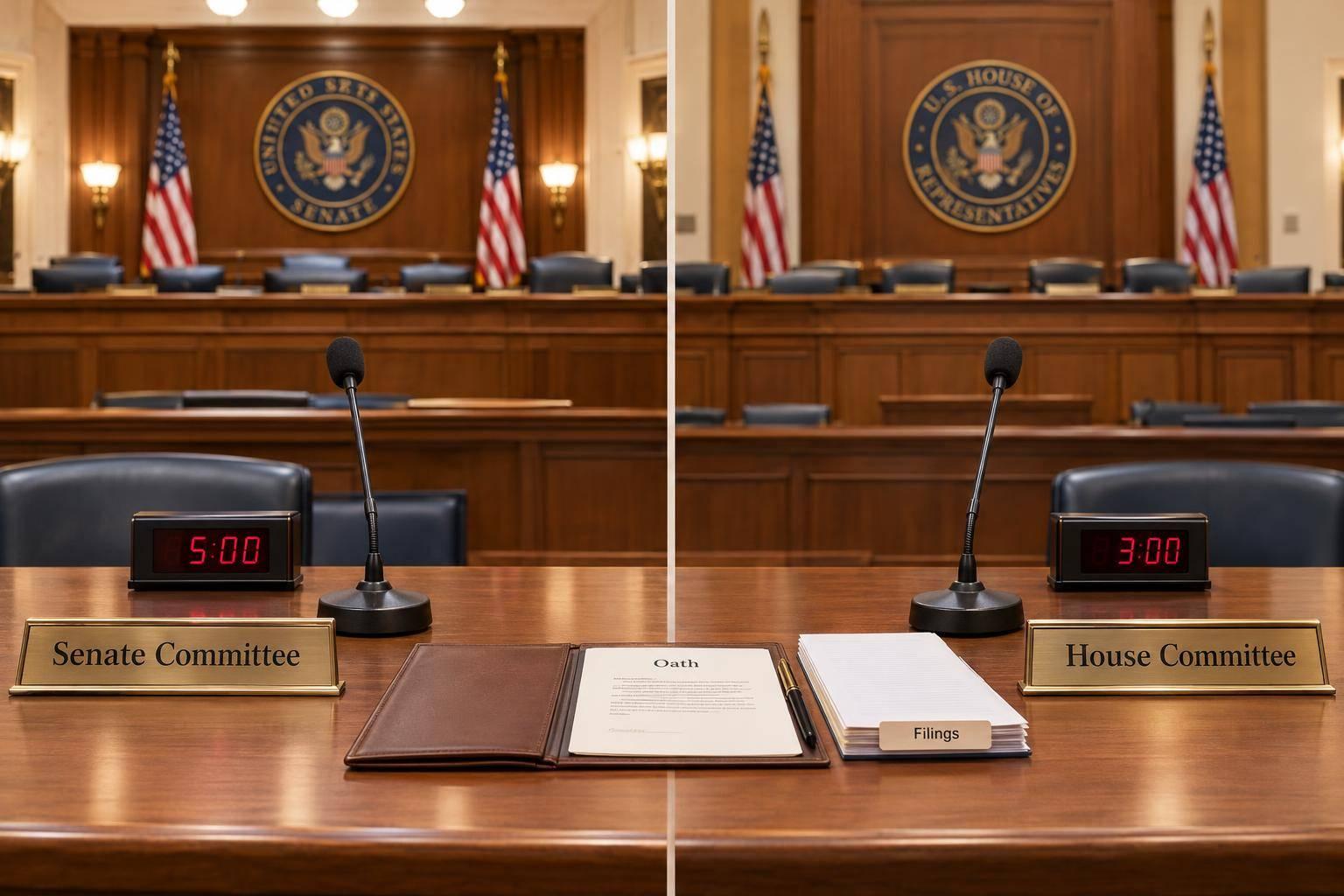
My first step for either chamber: check the committee’s rules and witness instructions for your specific Congress. House questioning generally uses five-minute rounds; Senate limits vary by committee. In both, I plan a short opening and direct answers because the chair’s instructions and panel size shape the time available.
I also keep prepared testimony separate from what was said aloud. A written statement may omit the entire question-and-answer exchange.
Quick Comparison
| What I check | Senate | House |
|---|---|---|
| Written testimony and opening | Confirm the filing deadline and speaking limit | Confirm the filing deadline and brief-opening requirements |
| Questioning time | Committee-specific limits and rounds | Generally five minutes per member per witness |
| Recognition and follow-ups | Committee practices and chair instructions | Chair recognition, committee order, and rules for further questioning |
| Staff questions and oaths | Check staff authority and oath procedures | Check staff authorization and whether an oath will be administered |
| Panel format | Attendance and panel size can affect exchanges | Multiple witnesses share attention during timed exchanges |
| Hearing records | Open-proceeding recordings or transcripts generally due within 21 business days | Check the committee archive; published transcripts may take months |
Before testifying, I verify bill details, sources, deadlines, and correction procedures. Before quoting testimony, I check the recording or transcript - and cite later written answers separately.
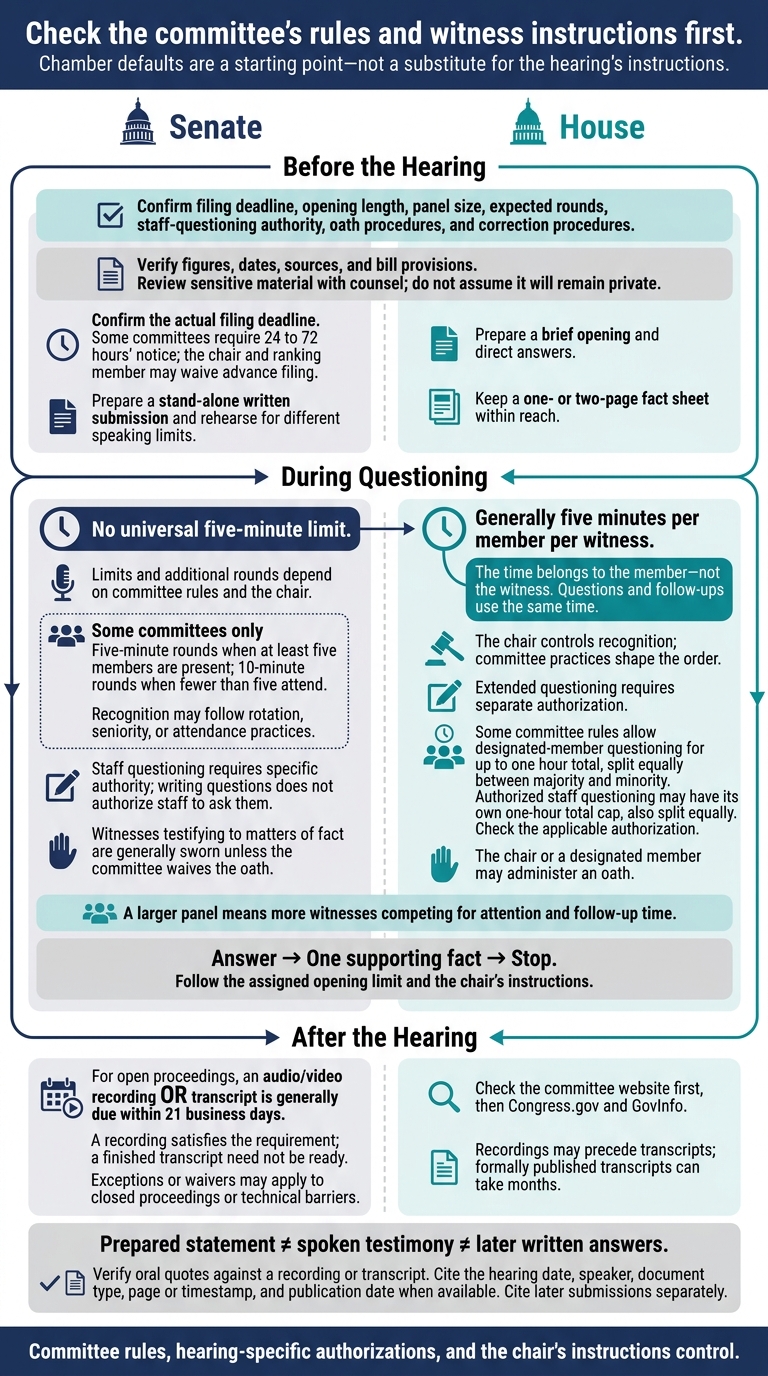
Senate vs House Testimony: A Witness’s Guide
Senate vs House: Rules and Questioning
Senate and House hearings follow different rules for testimony, speaking time, and follow-up questions.
| Issue | Senate | House | What controls |
|---|---|---|---|
| Written testimony | Committees usually set advance filing deadlines. | Committees set their own deadlines. | Chamber requirements and committee instructions |
| Oral openings | Witnesses usually summarize filed testimony. | Witnesses usually give brief openings. | Committee instructions and the chair’s directions |
| Questioning limits | No universal five-minute limit; some committees adjust limits based on attendance. | Generally five minutes per member per witness. | Senate committee rules; House Rule XI |
| Recognition order | Committee rotation, seniority, or attendance practices apply. | The chair and ranking minority member commonly go first, followed by the committee’s usual order. | Committee rules and chair recognition |
| Staff questioning | Requires specific authority; writing questions does not authorize staff to ask them. | Requires authorization, with applicable time limits and majority-minority allocations. | Applicable rules and authorization |
| Oaths or affirmations | Witnesses testifying to matters of fact are generally sworn unless the committee waives the oath. | The chair or a designated member may administer an oath. | Chamber authority and committee procedure |
| Extended questioning | Further questions may follow initial rounds, depending on committee rules and the chair. | Authorized extended periods may provide equal majority-minority time, subject to caps. | Applicable rules and hearing decisions |
These differences help witnesses decide what to cover in the opening and what to save for questions.
Senate: Advance Statements and Questioning Limits
Confirm the actual filing deadline, not just the minimum requirement. Some committees require 24 to 72 hours’ notice, and the chair and ranking member may waive advance filing. Use that deadline and the assigned speaking time to plan how much of your case to present aloud. For a panel appearance, also ask how members will be called on and whether to expect additional rounds.
Some Senate committees allow five-minute rounds when at least five members are present and 10-minute rounds when fewer than five attend. That rule varies by committee. Check oath procedures and whether staff questioning has been authorized. Staff-written questions alone do not give staff permission to ask them.
House: Brief Openings and Five-Minute Rounds
House Rule XI sets the default five-minute round. Those five minutes belong to the member, not the witness. Questions and follow-ups use the same time, so answer the question first, then add support. The chair controls recognition, while committee rules may also account for seniority, party rotation, or arrival order.
Extended questioning requires separate authorization. Some committee rules let designated members question witnesses for up to one hour total, split equally between majority and minority members. Authorized staff questioning may have its own one-hour total cap, also divided equally. Check the applicable authorization before assuming either arrangement applies.
With limited time for each exchange, put the main point in your first answer rather than relying on the opening statement to carry it.
How Panels and Chairs Shape Follow-Ups
Panel size and the chair’s practices affect how much follow-up time a witness gets. Before deciding how much supporting material to cover aloud, ask the clerk about panel size, attendance, and expected rounds. More witnesses, more members, and stricter chair control leave less room for long answers.
| Factor | Senate effect | House effect |
|---|---|---|
| Larger panel | More witnesses compete for follow-up time. | Multiple witnesses share attention within timed exchanges. |
| Member attendance | May change time limits under committee rules. | More members seeking recognition can lengthen the initial round. |
| Additional rounds | Depend on rules, chair rulings, and remaining time. | Further or extended questioning follows applicable authorization procedures. |
| Chair control | Rotation and timekeeping affect the pace. | Recognition and timekeeping shape whether answers get finished. |
Witness Preparation: Shared Steps and Chamber Differences
Once the hearing format is set, fit your opening and backup material to the chamber’s time limits.
Use written testimony to support - not repeat - your oral opening. Confirm the deadline and format with your staff contact, then submit the testimony and any required summary. Check every figure, date, and citation. Distinguish estimates from measured results, and label and source all exhibits.
Review sensitive or privileged material with counsel. Ask staff how to handle it; don’t assume it will stay private. Confirm the procedures for taking an oath and correcting testimony.
Senate: Prepare for Follow-Up Questions
Your written submission should stand on its own, including sources, methods, limitations, and recommendations. Keep your opening within the committee’s time limit and save supporting details for questions.
Practice explaining key assumptions in both technical terms and plain English. Answer, give one supporting fact, then stop. Rehearse for different time limits, and don’t assume follow-up questions give you unlimited speaking time. Clearly identify any changed estimates and coordinate corrections with staff.
House: Answer the Question First
For House testimony, focus on speed and direct answers. Write a short opening that covers your expertise, position, and main recommendations. When questioned, answer directly and add one supporting fact - not a background lecture. Keep a one- or two-page fact sheet within reach.
Rehearse questions from both parties, interruptions, and shifts between members and topics. Stop rather than rush through qualifications, and log any requests for written responses. Have longer explanations ready, and adjust rehearsals if the committee changes the format.
Review Bill Text and Member Records
Start with official bill text and committee materials. Check key language, status, and votes against congressional sources. Confirm the version, section numbers, effective dates, exemptions, and amendments relevant to your testimony.
Treat sponsorships and votes as context - not proof of a member’s position. Match each claim in your oral testimony to the exact bill provision under review.
Hearing Records: Posting Times and Access
Neither chamber follows a fixed schedule for posting hearing materials. Check the committee and document type, not just the chamber.
| Material | Senate and House publication practice | Responsible office | What to monitor |
|---|---|---|---|
| Hearing notice | Announced under chamber and committee rules | Committee clerk and website staff | Confirm the date, time, location, witnesses, and access instructions |
| Prepared statement | May appear before, during, or after the hearing | Committee staff; witness’s office | Check the hearing page and posting date |
| Audio or video | Often available before a finalized transcript | Committee staff and congressional media offices | Check the official archive and save timestamps for quotes |
| Official transcript | GPO transcripts can take months | Committee clerk; GPO for formally published records | Search by committee, hearing title, Congress, and date |
| Exhibits and supporting documents | May appear separately or in a later volume; some may be restricted | Committee clerk and hearing staff | Check attachments and additional materials in the published record |
| Corrections and written answers | Added under committee-specific procedures | Committee staff and witnesses | Watch for revised files and responses to questions for the record |
Senate committees generally must post an audio or video recording, or a transcript, within 21 business days for open proceedings. A recording meets the rule; a finished transcript doesn’t have to be ready that soon. Exceptions or waivers may apply to closed proceedings or technical barriers.
For House hearings, check the committee website first. Then search Congress.gov and GovInfo for official hearing publications. Recordings may appear before transcripts, which can take months to publish. The Congressional Record covers floor business - it does not replace a hearing transcript.
Find Statements, Recordings, and Transcripts
A prepared statement isn’t the same as what a witness said aloud. Before citing oral testimony, verify it against the recording or transcript. Include the hearing date, speaker, document type, page or timestamp, and publication date when available.
Separate Oral Testimony From Later Submissions
Keep live questioning separate from transcript corrections, added exhibits, and written answers to questions for the record. Save earlier versions, cite later submissions separately, and follow the committee’s submission instructions and deadlines.
After confirming the hearing record, track the bill’s next official actions through its Congress.gov action history, committee markup notices, reports, and official roll-call records. Legislate.dev can help track bill summaries, progress, sponsorships, and votes from official sources.
Conclusion: Follow the Hearing’s Rules
Prepare for the committee’s rules, not just the chamber label. More witnesses means less time for each person. That affects how much you say in your opening, how you pace answers, and what you save for questions.
What Changes in Practice
| Practice area | Hearing-day preparation |
|---|---|
| Openings | Follow the committee’s required format and time limit. |
| Answer length | Keep initial answers short to leave time for follow-ups. |
| Chair control | Follow the chair’s instructions on recognition, order, and pacing. |
Before the hearing, confirm the notice, committee rules, witness instructions, submission deadlines, panel order, questioning limits, and oath procedures. Use the committee’s rules and the chair’s instructions - not assumptions about the chamber - to guide your preparation.
FAQs
What should I do if my answer is cut off?
Don’t guess what comes next. Check the official bill page again for the exact dated action, hearing or markup details, and vote question/version. If witness testimony or a transcript is missing, use the committee’s video/audio, amendment files, and action history instead.
Record the bill number, publication date, and what changed. If no next step is listed, mark it as unknown rather than filling in the blanks.
How should I handle questions I can’t answer?
If you can’t answer a question during oral testimony, don’t guess. Say clearly that you don’t know. Committee proceedings and legislative updates need to be accurate.
When the next procedural step is unknown, state that no action is listed or that the next step remains unclear, as appropriate. Use official records and verified data, not assumptions about procedures or outcomes.
What if the transcript misquotes my testimony?
If you think a transcript misquotes your testimony, start with the committee’s official records. Official transcripts serve as the standard record, but check the wording against the committee’s original video or audio recordings of the hearing. If you still find differences, review the committee’s official meeting materials, including the prepared testimony you submitted for the record.