Reconciliation Bill Limits: Fiscal Year Rules

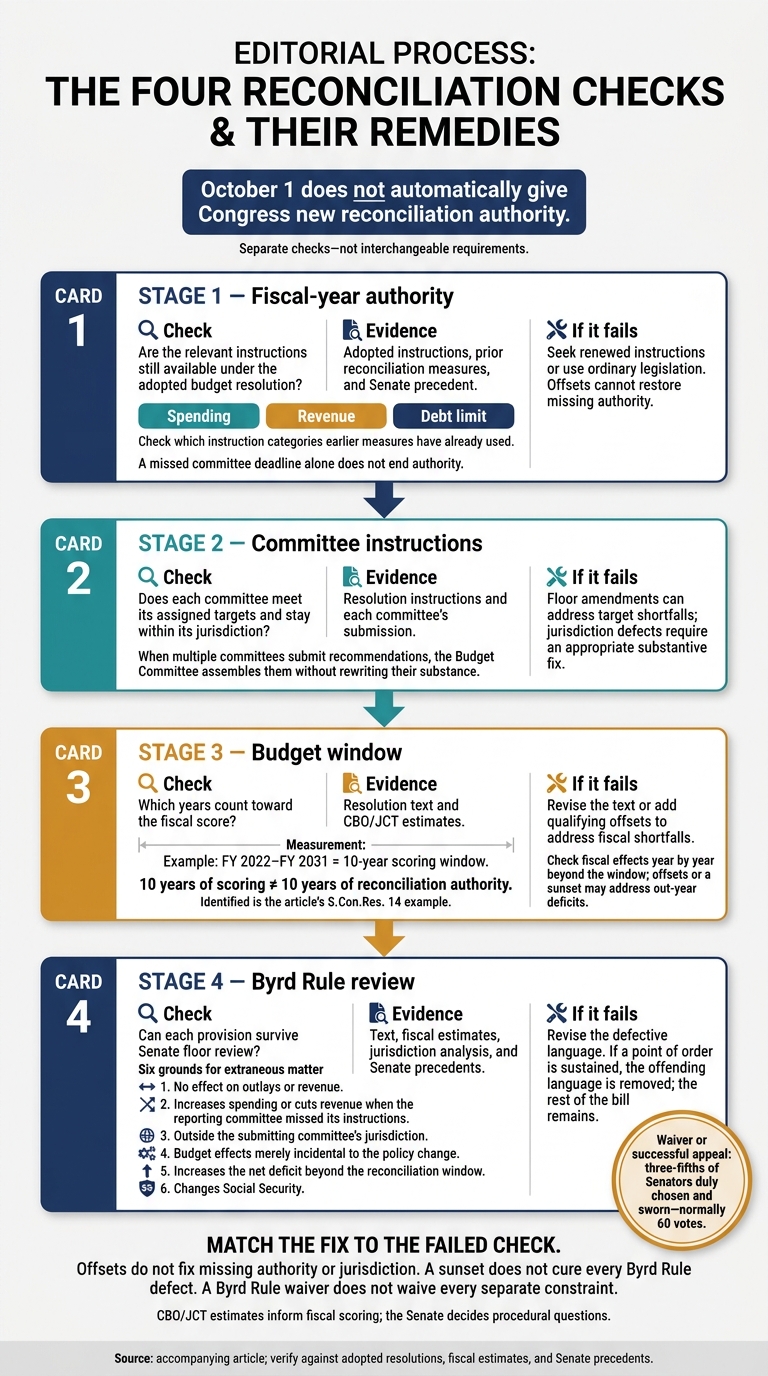
October 1 does not automatically give Congress new reconciliation authority. I start with the adopted budget resolution and check whether earlier bills have used its spending, revenue, or debt-limit instructions - not just whether a new fiscal year has begun.
Here are the four checks I use:
- Fiscal-year authority: Are the relevant instructions still available? A missed committee deadline alone does not end that authority.
- Committee instructions: Does each committee meet its assigned targets and stay within its jurisdiction?
- Budget window: What years count toward the fiscal score? A 10-year scoring window does not mean 10 years of authority.
- Byrd Rule: Can each provision survive Senate review? Budget effects alone are not enough, and deficits beyond the window can cause problems.
My bottom line: match the fix to the failed check. Offsets may address deficits, but they cannot fix missing authority or committee jurisdiction. A Byrd Rule waiver generally requires 60 Senate votes.
Reconciliation Bill Limits: Four Essential Checks
1. Fiscal-Year Usage Limits
Timing and Duration
A committee deadline does not automatically end reconciliation authority. Check the adopted resolution and Senate precedent before assuming a missed deadline ends that authority.
If authority remains available, check whether earlier enactments have already used up the relevant instruction categories.
Scope and Budgetary Requirements
The limit isn't simply one bill per fiscal year. It depends on which instruction categories - spending, revenue, or debt limit - have already been used under the budget resolution.
Enforcement and Remedies
If recommendations don't meet the instructions, the usual fix is a floor amendment, not a Budget Committee rewrite.
Fiscal-year authority is only the starting point. The Byrd Rule and budget window determine what the bill may contain and how its fiscal effects are measured.
2. Budget-Window Rules
Timing and Duration
Once fiscal-year authority exists, the next question is how the bill is scored. The budget window measures budget effects; it does not grant authority. The concurrent resolution on the budget sets that window, usually the current budget year plus the next nine fiscal years. It does not extend reconciliation authority.
For example, S.Con.Res. 14 set FY 2022 levels through FY 2031 - a 10-year scoring window, not 10 years of reconciliation authority.
Scope and Budgetary Requirements
Within the window, CBO and JCT score whether committees meet their spending and revenue targets. The distinction matters: the window governs scoring, while committee targets govern compliance with instructions. Even if committees meet those targets, deficits after the window can trigger a Byrd Rule problem.
Enforcement and Remedies
Offsets or a sunset can prevent deficits after the scoring window. The next section breaks down the Byrd Rule tests that follow from those scoring limits.
Budget reconciliation, explained
3. Byrd Rule Tests
Once reconciliation authority exists, the Byrd Rule determines which provisions can survive Senate floor review.
Timing and Duration
Section 313 applies to reconciliation bills, amendments, and conference reports on the Senate floor.
Scope and Budgetary Requirements
A provision is extraneous if it:
- Has no effect on outlays or revenue;
- Increases spending or cuts revenue when the reporting committee missed its instructions;
- Falls outside the submitting committee’s jurisdiction;
- Has budget effects that are merely incidental to the policy change;
- Increases the net deficit beyond the reconciliation window; or
- Changes Social Security.
A budget effect alone isn't enough. If that effect is merely incidental to the policy change, the provision still fails the test. Any Senator can use these tests to challenge a provision on the floor.
Enforcement and Remedies
Any Senator may bring a Byrd Rule point of order. If it's sustained, the offending language is removed, but the rest of the bill remains. The fix must address the defective language, not just the bill's overall budget score.
A waiver or successful appeal can override the ruling. Either requires three-fifths of Senators duly chosen and sworn - normally 60 votes.
4. Committee Reconciliation Instructions
Committee instructions turn reconciliation authority into specific targets for each committee.
Timing and Duration
Budget resolutions give committees reconciliation instructions and reporting deadlines. Missing a deadline does not end reconciliation authority. The resolution - not the deadline alone - controls that authority.
Scope and Budgetary Requirements
Instructions set dollar targets for spending, revenue, or debt-limit changes within each committee’s jurisdiction. They also identify the fiscal years used to measure those targets, not when authority begins.
The budget window defines the scoring period. Instructions define what each committee must achieve within it. Those targets guide chamber action but do not replace floor-stage Byrd Rule review.
H.Con.Res. 14 directed the House Agriculture Committee to achieve at least $230 billion in deficit reduction over FY2025–2034, while allowing the House Armed Services Committee up to $100 billion in deficit increases. The same resolution also directed the House Ways and Means Committee to recommend a $4 trillion increase in the debt limit.
Enforcement and Remedies
When only one committee receives instructions, it reports directly to its chamber. When multiple committees receive instructions, they send recommendations to the Budget Committee, which assembles them without rewriting their substance - even if committees miss their targets.
Each submission must be judged separately. The Budget Committee cannot fix shortfalls during assembly.
What Each Limit Requires
Use the matrix below to distinguish authority, scoring, and review on the Senate floor. Authority, scoring, and Senate enforceability are separate checks.
| Constraint | What it governs | What failure looks like | Evidence to check |
|---|---|---|---|
| Fiscal-year usage limits | Authority under a specific budget resolution | Reusing a spending, revenue, or debt-limit category that has already been exhausted | Adopted instructions and prior reconciliation measures under that authority |
| Budget-window rules | Years used to measure fiscal effects | Scored changes miss applicable targets or allocations | Resolution text and CBO/JCT estimates |
| Byrd Rule | Provisions considered in Senate reconciliation | A provision fails a test for extraneous matter | Fiscal estimates, jurisdiction analysis, and Senate procedural determinations |
| Committee instructions | Each instructed committee’s recommendations | Recommendations miss the required spending, revenue, or debt-limit result | Committee reports and submissions to the Budget Committee |
Committee Jurisdiction and Budget Targets
The budget resolution provides authority, and prior measures exhaust the categories they use. Each committee must also stay within its jurisdiction. Deadlines are procedural requirements, not scoring rules.
| Instruction category | Committee assignment | Required result | Authority use | Senate enforcement issue |
|---|---|---|---|---|
| Spending | Instructed committee | Specified spending or deficit target | Exhausts spending category | Committee noncompliance with instructions |
| Revenue | Tax-writing committee | Specified revenue result | Exhausts revenue category | Budget effects merely incidental |
| Debt limit | Debt-limit committee | Specified statutory debt-limit change | Exhausts debt-limit category | Scope of instructions and jurisdiction |
| Combination | Multiple instructed committees | Each assigned result | Exhausts combined categories | Separate committee compliance and provision-level review |
The Six Byrd Rule Tests
Once authority and committee targets are set, Senate review turns to whether each provision passes Byrd Rule scrutiny. Fiscal-year authority does not cure Byrd defects. A provision can still fail because of jurisdiction, merely incidental budget effects, deficits beyond the budget window, or Social Security changes.
The Scoring Window and Deficits Beyond It
After reviewing a provision’s content under the Byrd Rule, check its fiscal effects beyond the scoring window. The window is only a measurement period. Check effects year by year: a provision can violate the Byrd Rule by increasing deficits after the window, even if the package as a whole meets its scoring target.
How Limits Are Enforced and Defects Are Addressed
Once Congress identifies the limits, it must enforce them and fix any defects. Here’s how those checks work when a bill reaches the floor.
| Check | Enforcement question | Evidence needed | Enforcement | Consequence and possible remedy |
|---|---|---|---|---|
| Procedural authority | Is authority still available for this action? | Adopted resolution, instructions, and chamber action dates | Applicable Budget Act rules and Senate precedents | If authority is unavailable or exhausted, seek renewed instructions or use ordinary legislation. An offset alone won’t fix the problem. |
| Committee compliance | Do recommendations meet the assigned targets? | Instructions and committee submissions | Floor amendments and applicable Byrd Rule points of order | Floor amendments can fix noncompliance, but the Budget Committee cannot rewrite substance. |
| Fiscal scoring | Which fiscal effects count for scoring and points of order? | CBO/JCT estimates and Senate Budget Committee determinations | Relevant budget points of order | Revise the text or add qualifying offsets. The score alone does not strike language. |
| Byrd Rule | Can challenged language remain? | Text, fiscal estimates, jurisdiction, and Senate precedents | Section 313 point of order | Challenged language may be stricken unless revised or the rule is waived. |
Check Procedural Authority First
Start with the adopted resolution’s fiscal years and instructions. Then compare chamber action dates with the September 30 cutoff and Senate precedent.
Separate Fiscal Estimates From Senate Rulings
Fiscal estimates inform the score; they don’t decide Senate order. CBO and JCT provide fiscal evidence, while the Senate decides whether a provision is procedurally in order. The presiding officer rules on points of order. Waiving the Byrd Rule generally requires three-fifths of Senators duly chosen and sworn - normally 60 votes.
Match the Remedy to the Problem
The fix depends on which limit failed. Offsets can address deficit increases, but they cannot fix missing committee jurisdiction. A sunset may address out-year deficits while leaving other Byrd Rule problems unresolved.
Revise defective text, seek new instructions when authority is missing or exhausted, or use ordinary legislative procedures. A Byrd Rule waiver addresses that rule - not every separate constraint. Match the remedy to the specific defect.
Verify Sources and Legislative Dates
Check the exact bill and amendment versions. Use CRS reports alongside Congressional Budget Act Sections 310 and 313 to interpret the record.
Verify procedural conclusions and fiscal scores against adopted resolutions, dated chamber actions, Senate precedents and rulings, and dated CBO/JCT estimates. Use those records to identify which limit applies, who enforced it, and what remedy remains.
Conclusion: Check Authority, Content, and Fiscal Effects
Fiscal-year rules are the first check, not the last. Authority, floor content, and fiscal effects each require a separate test. Check the authority for the next reconciliation step - not just the years covered by the fiscal estimate. The scoring window does not extend that authority.
FAQs
What happens if a reconciliation bill crosses fiscal years?
A reconciliation bill that covers multiple fiscal years must meet the deficit reduction targets for the budget window set by the underlying budget resolution. The Byrd Rule treats provisions as extraneous if they increase the deficit or reduce a surplus in any fiscal year beyond those covered by the reconciliation instructions. The bill’s language must account for its budget effects throughout the defined period.
Can reconciliation make tax cuts permanent?
Reconciliation can turn tax cuts into law, but it doesn’t guarantee they’ll last. Budget-window rules still apply, including limits on deficit increases or surplus reductions over the current fiscal year plus the next 4 or 9 fiscal years. The Byrd Rule also restricts “extraneous matter” based on its effects on deficits by fiscal year.
How can I verify whether reconciliation authority is exhausted?
Compare the deficit impact of proposed legislation or amendments against each committee’s numerical limits in the governing concurrent budget resolution. These instructions cap deficit increases or set minimum deficit reductions over a specific period, such as fiscal years 2026 through 2035.
Use Legislate.dev’s searchable bill indexes and legislative tracking to find the resolution and committee instructions, then check whether authority remains for new measures.