Study Summary: Companion Bill Sponsor Ties
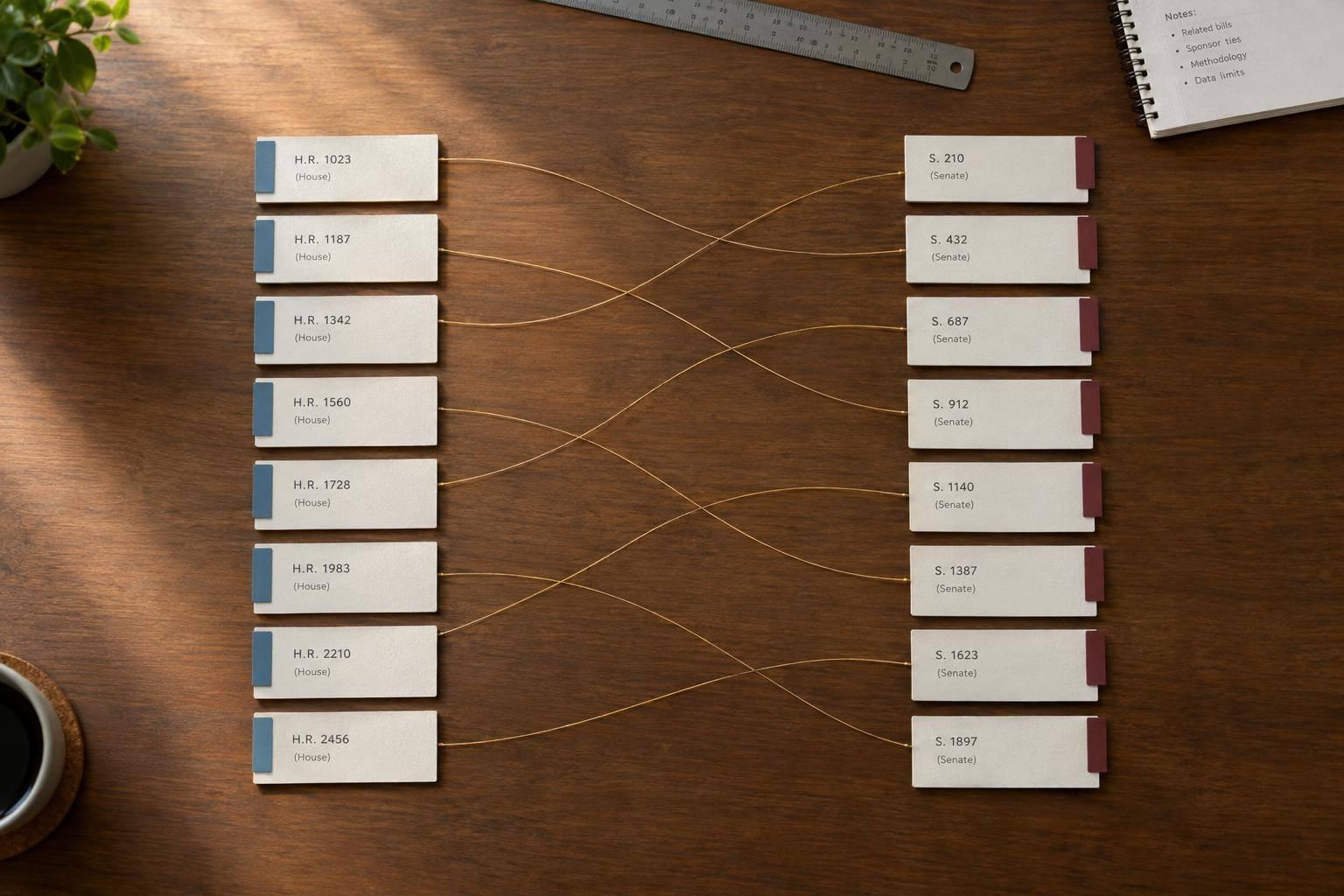
I can’t report how often House–Senate sponsor pairs recur: the supplied records contain no verified counts or percentages. To calculate that rate, I’d first need confirmed companion-bill matches, dated sponsor lists, and a defined study period.
Here’s what I focus on:
- Cross-chamber ties: Which Representatives and Senators support matching bills, such as H.R. 1247, - not whether the same person appears in both chambers.
- Repeat partnerships: Whether the same House–Senate pair supports 2 or more matched companion pairs.
- Separate counts: Bills, bill pairs, and lawmaker pairs need their own totals and denominators.
- Record checks: I’d verify companion labels and sponsorship dates against Congress.gov, keeping missing records separate from zero counts.
My takeaway: these ties show legislative association, not proof of coordination or passage. Any study covering the current Congress through November 1, 2026, must also be labeled incomplete.
Study Scope and Methods
How to Measure Companion Bill Sponsor Ties
Study Period, Sources, and Bill Selection
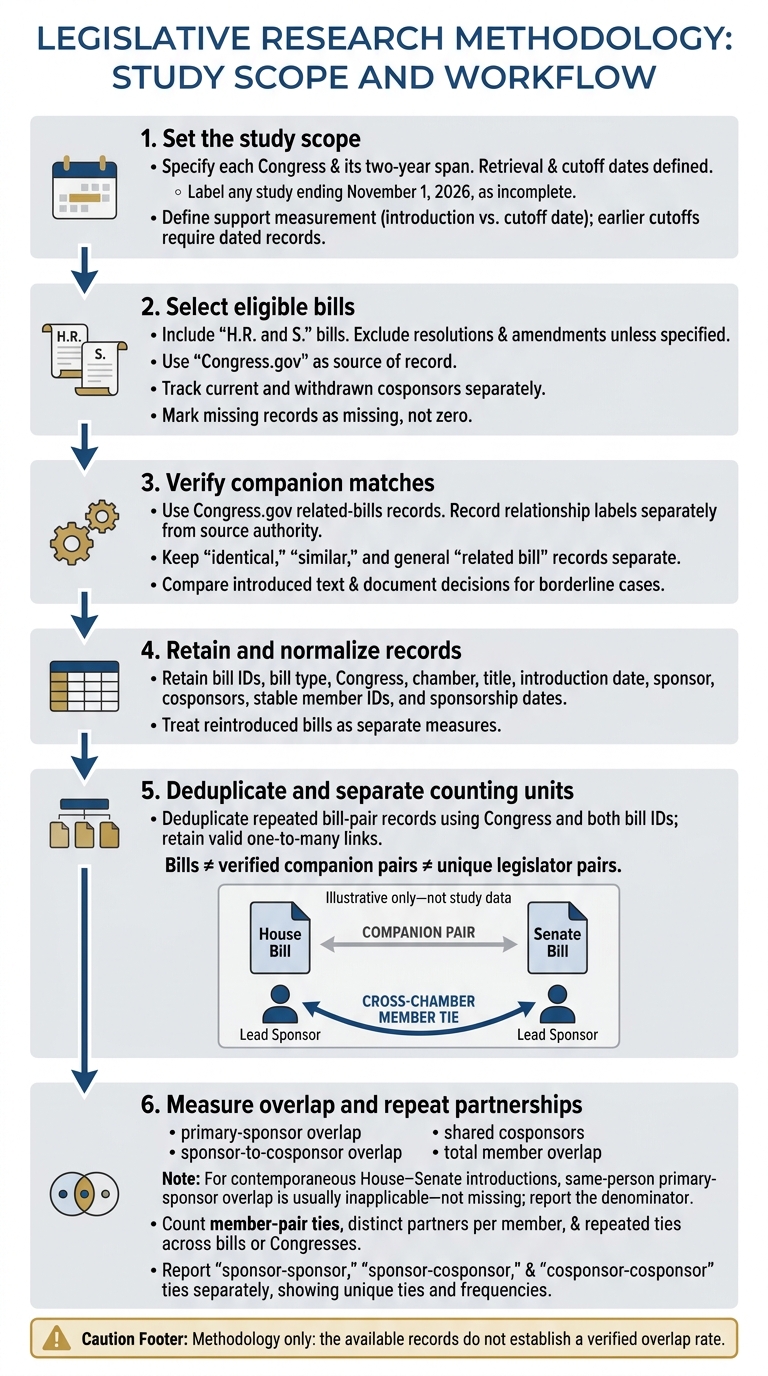
This section sets the rules for counting cross-chamber sponsor and cosponsor overlap in companion bills. List each Congress by its two-year span, along with the retrieval date and cutoff date. Label any study ending November 1, 2026, as incomplete.
Limit the primary sample to House and Senate bills (H.R. and S.). Exclude resolutions and amendments unless the research question explicitly includes them. Use Congress.gov as the source of record, and track current cosponsors separately from withdrawn cosponsors.
State whether support is measured at introduction or at the cutoff date. Reconstructing an earlier cutoff requires dated records - not today’s totals alone. Mark missing records as missing, not zero. Set these sample rules before reporting overlap counts in the findings.
Matching Companion Bills and Counting Pairs
Use Congress.gov related-bills records, recording the relationship label separately from the source authority. Keep “identical,” “similar,” and general “related bill” records separate. For borderline cases, compare the introduced text and document the decision.
Retain bill IDs, bill type, Congress, chamber, title, introduction date, sponsor, cosponsors, stable member IDs, and sponsorship dates. Treat reintroduced bills as separate measures.
Deduplicate repeated bill-pair records using the Congress and both bill IDs, while retaining valid one-to-many links. Keep bill counts, verified companion pairs, and unique legislator pairs separate. The next section uses these matched pairs to measure sponsor and cosponsor overlap.
Measuring Member Overlap and Partnerships
Define four overlap measures separately: primary-sponsor overlap, sponsor-to-cosponsor overlap, shared cosponsors, and total member overlap. For contemporaneous House-Senate introductions, primary-sponsor overlap is usually zero. Mark it as inapplicable - not missing - and report the denominator.
Count companion ties by member pair, distinct partners per member, and repeated ties across bills or Congresses. Report sponsor-sponsor, sponsor-cosponsor, and cosponsor-cosponsor ties separately, showing both unique ties and frequencies so the findings distinguish structural overlap from repeated partnerships.
Findings on Cross-Chamber Sponsor Ties
Under the matched-pair rules above, the available records do not establish a verified overlap rate.
Member Overlap and Repeated Lead-Sponsor Pairs
The records explain how to count overlap, but the overlap measures remain unmeasured: same-person sponsor overlap, sponsor-to-cosponsor overlap, shared cosponsors, and total member overlap. No percentages are reported. Recurring lead-sponsor partnerships also remain unmeasured.
Recurrence means the same normalized House–Senate sponsor pair appears on two or more matched companion pairs, within or across specified Congresses. Bill-pair counts must stay separate from legislator-pair counts. Identity normalization must also account for name or chamber changes.
Read chamber-level summaries separately from overlap counts.
House and Senate Comparisons
Raw chamber totals do not show coalition breadth or how quickly matched companion bills move. They cannot replace matched-pair counts.
| Chamber-level measure | House result | Senate result | Unit and denominator needed |
|---|---|---|---|
| Median companion-bill cosponsors | Not measured | Not measured | Cosponsors per distinct matched bill with complete records |
| Party composition of companion coalitions | Not measured | Not measured | Party counts among recorded sponsors and cosponsors |
| Share of eligible bills with companions | Not calculated | Not calculated | Distinct matched bills divided by eligible bills in each chamber |
| Introduction timing | Not measured | Not measured | House-first, Senate-first, same-day, or within a stated time window among matched pairs with reliable dates |
| Legislative status at cutoff | Not measured | Not measured | Status category for each bill in the matched pair as of a fixed cutoff |
Total bills introduced are not a companion-pair denominator. Count one-to-many matches only under the stated matching rule.
For overlap broken out by party or committee, report only coded relationships.
Coalition Types and Partnerships Across Congresses
Same-party and cross-party lead-sponsor ties, relevant committee ties, and partnerships repeated across Congresses were not measured. Their denominators and observation periods therefore remain unset. Report only party and committee ties that were actually coded.
Cross-Congress reporting requires the Congress range, matched bill-pair counts, and policy areas for each normalized House–Senate sponsor pair. It must also record chamber changes and departures.
Interpreting and Checking the Results
The matched ties above need careful interpretation: association is not the same as coordination.
Sponsor Ties Do Not Prove Coordination or Passage
A recorded tie shows a legislative association, not coordination. Co-sponsorship signals support, but it does not commit a lawmaker to vote for final passage. Repeated partnerships or a central role in a network do not establish communication, negotiation, or enactment.
Policy topic, party, committee assignments, and introduction timing provide context unless formally controlled for. Claims of coordination need additional evidence. Data coverage and timing also shape how these ties should be read.
Data Coverage, Timing, and Procedural Limits
Incomplete companion labels can cause eligible pairs to be missed. Missing records and withdrawn co-sponsorships also need separate treatment. House co-sponsors can join after introduction, while Senate additions depend on unanimous consent. Lists retrieved on different dates may not be comparable.
Prolific lawmakers and large coalitions can dominate raw tie counts. Bills introduced later have less time to gain co-sponsors. Repeated introductions can overstate persistent pairings, and one-to-many matches can inflate totals. Record checks therefore need dated, source-based verification.
Checking Records With Legislate.dev and Official Sources
Use Legislate.dev to identify bills and sponsorship patterns. Then check companion labels, sponsor identities, dated co-sponsor lists, withdrawals, committee referrals, and actions against Congress.gov and other official records.
To let others repeat the analysis, retain bill and member identifiers, Congress numbers, source links, and retrieval dates. Record the rules for selection, matching, timing, and deduplication. Save original and later-added co-sponsors separately, and document discrepancies.
Conclusion: Findings and Limits
Under the matched-pair rules above, the key measure is cross-chamber ties between different lawmakers - not same-person overlap.
The supplied material does not report recurrence rates, chamber-specific companion coverage, or sponsor/cosponsor overlap. Calculating those results requires matched-pair counts and chamber-level denominators.
The table therefore serves as a reporting checklist, not a set of measured results.
Results Table and Method Notes
The table shows what the records support and where data or documentation is missing.
| Measure | Supported result or reporting status |
|---|---|
| Study period and cutoff | Neither supplied |
| Matched bills and pair counts | Counts and chamber-specific companion coverage unavailable; cross-chamber sponsor ties remain unquantified |
| Sponsor/cosponsor overlap and average shared members | No quantified results provided |
| Identical-person overlap | Not applicable in ordinary House–Senate lead-sponsor comparisons; include only under an explicit same-person rule |
| Recurrence, bipartisanship, and exclusions | Recurrence counts and thresholds, bipartisan sponsor pairs and their definition, and excluded or unclassifiable records undocumented |
Keep denominators separate. Companion coverage uses qualifying bills in each chamber. Pair-level percentages use distinct matched pairs or the subset with complete records. Bipartisanship must specify whether it refers to lead sponsors or the combined sponsor and cosponsor lists.
Use “not supplied” for missing data and “not applicable” only when a metric has no valid meaning. Use structural zero only when the study design makes the outcome impossible.
Reproducing numerical findings requires documented exclusions, duplicate handling, recurrence rules, and a cutoff date. Timing gaps in cosponsor records limit cross-Congress comparisons.
FAQs
How can I tell whether a sponsor partnership is unusually frequent?
Compare how often specific members work together against their usual sponsorship and cosponsorship activity. Legislate.dev’s member profiles, sponsorship records, and searchable bill indexes can help you spot these patterns.
Use total and cross-party cosponsorship data to set benchmarks for typical behavior. Then look for partnerships that occur more often than those benchmarks suggest. This helps separate routine coalition-building from unusually frequent alliances between representatives and senators.
How do coalition sizes affect House–Senate comparisons?
Coalition size depends partly on chamber size. During the 119th Congress, 451 members served in the House, compared with 104 in the Senate. House-led bills therefore often have more cosponsors in absolute terms. For example, the Major Richard Star Act had 340 cosponsors.
Legislate.dev’s member profiles and bill indexes help users track these coalition patterns across chambers.
What evidence would show coordination beyond shared sponsorship?
Evidence of bipartisan collaboration includes frequent cross-party cosponsorships and bills with an even mix of Democratic and Republican sponsors. By tracking these patterns alongside floor activity and voting records, researchers can spot consistent partnerships that point to lasting collaboration rather than casual bill endorsement.